Table of Contents
Fiqh-us-Sunnah: Introduction
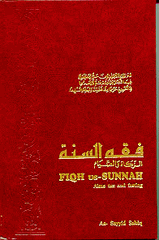
Fiqh-us-Sunnah was written by Sayyid Saabiq (1915-2000 C.E.), may Allaahhave mercy on him. The following information is taken from his obituary in the March 2,2000 Daily News of IANA Radionet.
“…Sabiq’smost famous book was the three-volume Fiqh As-Sunnah, which in the firstwriting of its kind brought the four major madhahib together, in acomprehensive treatment of Fiqh matters. The book has since been translatedinto dozens of languages and is used by Muslims throughout the world. Sabiqwrote Fiqh As-Sunnah in the 1940s when he was only 30 years old. He wrote thebook at the request of Ustadh Hassan al-Banna, the founder of the MuslimBrotherhood. Every Fiqh ruling in the book goes back to the Qur’an and Sunnahand Sabiq dealt with all four madhahib objectively, with no preferentialtreatment to any. Sabiq also wrote the book, “Islamic Theology,”along the same lines: simplification and avoidance of overphilosophization orgetting involved in disputes on arcane topics. Besides his academic work, Sabiqwas a noted Islamic activist. After writing Fiqh As-Sunnah, Sabiq spent some timefighting along with the Mujahideen in Palestine in the late 1940’s and he latervisited most countries in the world and lectured in their mosques. He was thefirst graduate of Azhar to visit the Soviet Union and check on the conditionsof Muslims there. Sabiq was born in 1915 in the Egyptian village, Istanha. Hereceived his education at Al-Azhar and after his graduation worked as theDirector of Mosques and Islamic Education in the Egyptian Islamic AffairsMinistry. He also taught at Al-Azhar, and later moved to Saudi Arabia, where heheaded the Shari’a Graduate Studies Department in Um Al-Qura University. Aftermoving back to Egypt, he spent years teaching students in a Mosque inCairo…”
In the early 1990’s, Fiqh-us-Sunnah was translated into English by a groupof people commissioned by American Trust Publications. The translators includedMuhammad Sa’eed Dabas, Jamal al-Din M. Zarabozo, Abdul-Majid Khokhar, and M. S.Kayani. This group published Fiqh-us-Sunnah in five volumes which form thebasis for this online edition. MSA-USC obtained the “raw” electronicdata from the Al Muhaddith project, andconverted this data into Web-ready format. A similar effort may be found at Islamic Resources Repository (IRR) bythe DEED group at the International Islamic University, Malaysia.
Fiqh-us-Sunnah, Volume 1: Purification