
Table of Contents
Download Now 📖
Before each chapter,
there is a brief passage like this that tells you a little bit about my journey to Islam.
I came to Islam after three decades of restless dissatisfaction with conventional Christianity. Although I’ve read a lot of conversion stories since I embraced Islam in March of 2003, I haven’t found many that cited the Gospels as a point of entry to the Holy Qur’an. That is how it was for me.
If you are a Christian reading this book, please know that what follows is not meant disrespectfully, but is offered only in the service of a deep, shared love of the Messiah.
1 – Why ‘Mere’?
The deepest and bitterest curse of ancient China, supposedly, was ‘May you live in interesting times.’
Those of us who have lived as Christians in the late twentieth and early twenty-first centuries have, for reasons that may mystify us, found ourselves living in very interesting times indeed. In recent years, uneasiness about Islam has been increasingly impossible to ignore in the United States, Europe, and Australia.
In particular, one hears a great deal today about a ‘war,’ ‘conflict,’ or ‘clash’ between Islam and Christianity. The topic is so prominent in the media that many people assume that there is something irreconcilable between these two approaches to God. It is not surprising, then, that so many Christians of good will have concluded that Islam and Christianity are fundamentally incompatible.
Yet, if, by ‘Christianity’, we mean ‘that which Jesus Christ meant to convey to his hearers’, I believe that these people of good will may well be mistaken when they tell us that Islam is incompatible with Christianity.
What’s more, I believe we can now make the case that the historically oldest Gospel verses reflecting the reported sayings of Jesus are entirely compatible with Islam.
Ó Ó Ó
This is a book for Christians, and about Islam. These days, anyone who writes such a book should expect to face a skeptical audience, and that is just as well. Skepticism about important matters is healthy.
What’s more, the author of a book like this one should probably expect only thoughtful Christians to accompany him to the end of the page, or, God willing, beyond. Only thoughtful people are willing to examine their own religious assumptions closely.
The thoughtful, skeptical Christian, then, is the audience for this book. That you have read even this far suggests that you are a thoughtful Christian. So please complete the equation and be as skeptical as you possibly can as you make your way through these pages.
Ó Ó Ó
What, specifically, is there to be skeptical about?
We can start with the title. The book is called Beyond Mere Christianity for two reasons. First, in response to C.S. Lewis’ influential 1952 work, Mere Christianity, which stands as a masterpiece of Christian apologetics and perpetuates, I believe, a long-standing betrayal of the ministry of Jesus.
The second reason, perhaps less obvious, is that a case can be made, based on current, responsible Gospel scholarship, that Jesus was calling his people to the Salvation that lies beyond the worship of the merely created, and that relies instead on the direct worship of the Creator. I believe emphatically that this variety of direct worship is Islam, and that the authentic words of Jesus emphatically invite us to move beyond what is conventionally understood as Christianity for this Salvation, and enter with no delay the ‘house’ of Islam (to borrow a metaphor from Lewis). Which room we choose to occupy once we’re inside, of course, is up to us.
If you’re a Christian, and you find that you are skeptical about these points, then we’re ready to move on.
Ó Ó Ó
The word ‘Islam’ means, simultaneously, ‘submission’ and ‘peace’. This faith demands in no uncertain terms that its adherents reject anything and everything that conflicts with obedience to God. It does not mandate blind obedience to any human authority.
I believe that someone who scrupulously follows this religion’s command of submission to God Alone is in fact adhering completely to the authentic teachings of Jesus, at least to the degree that they are reflected in the surviving Gospels. I also believe this religion is precisely the same one he preached and practiced.
Holding and expressing this view has led me into any number of interesting life experiences, many of which involved heated discussions with Christians who believed a) that I had no right to describe myself any longer as a follower of Jesus, and b) that Islam and Christianity have far more separating them than they have in common. This book challenges thoughtful Christians to consider the discussions that follow before coming to a final conclusion on a) and b), above.
Ó Ó Ó
If you are a Christian, the idea that Jesus practiced the same faith that today’s news broadcasts hold responsible for so many of the world’s problems probably seems far-fetched to you.
It certainly seemed far-fetched to me when I first encountered it. Yet many contemporary Christians have reached life-changing personal conclusions about the Gospel message and its relation to Islam. A prominent American sheikh, Yusuf Estes, is an obvious example, and there are many others.
The American television news magazines usually don’t share the stories of these converts to Islam with the world at large, and their motivations sometimes seem mysterious to non-Muslims who encounter them. From personal experience, though, I strongly suspect that most of these people found themselves, at the end of the day, deeply concerned about the consequences of calling Jesus ‘Lord’ without obeying his instructions—found themselves far more concerned about that command, in fact, than about any media coverage of geopolitical issues.
So we changed our lives.
Ó Ó Ó
People like us do indeed exist in North America, Europe, and Australia. There are more of us than you may imagine. This book is here to give you a clear answer to the question we hear over and over again: ‘Why?’
Why would a Christian believer choose to embrace this faith, over all the other possible faith choices? Why pursue the one system of worship that most of today’s commentators agree is ‘at odds with Christianity’? Why leave the familiar congregations of friends, relatives, and members of the clergy — congregations whose concern and support sustained us for so long, and who would rejoice if we were only to renounce Islam and return to the way of life of which they approve?
The pages that follow, aim to answer these questions.
Ó Ó Ó
Two flawed understandings of Islam can present a major challenge for anyone trying to come to terms with it. First and foremost is the notion that it is an anti-Christian faith. It is not. Christians often express profound surprise at Islam’s extraordinary reverence for Jesus, and for the special status that Christians enjoy under traditional Islamic law.
The second misconception is the common notion that Islam is rooted in violence. Outsiders studying the actual teachings of the faith are usually caught unawares by its ceaseless promotion of mercy and forgiveness over violence and revenge.
Even if political upheavals, irresponsible media coverage, and the lunacy of religious extremists have sometimes combined to obscure these two core truths of Islam—as a cloud may seem, for a time, to blot out the sun—they remain core truths nevertheless. I hope my work here does these truths justice, but if it does not, the responsibility lies not with Islam, but with me.
I was born in Los Angeles, California, in 1961.
My parents did not practice Christianity, but other relatives and friends did, and the teachings of Jesus Christ emerged early in my life as the ‘true north’ of my spiritual journey.
I was drawn to the Gospels at a young age–eleven– and I read them compulsively.
I still have the red King James Bible I bought as a child; my own handwritten note on the front page proclaims June 26, 1974, as the date I accepted Jesus as my personal savior.
Two:
2 – What is ‘Q’?
(Jesus) spoke out: ‘I am indeed a servant of God. He has given to me the Book and made me a Prophet. Wherever I go, His blessings follow me.’ (Qur’an 19:30)
There is, in terms of literal content, little for a mainstream Christian to object to in the passage from the Qur’an you just read. Virtually all Christian theologies accept Jesus’ role as Prophet, or Messenger of God. If ‘Book’ means an authentic Divine Revelation, surely no Christian would dispute that Jesus received this.
But that is the content. The context is a different matter. The very fact that the words in question appear in the Qur’an, rather than in the Gospels, is enough to give many people pause.
Ó Ó Ó
Most contemporary Christians simply do not believe that Jesus was a practitioner of the same religion practiced by Muslims. To be more specific: Most Christians do not believe that Jesus’ actual mission and teachings, by whatever name we may choose to call them, would be recognizable to a contemporary Christian, or even to a fair-minded neutral observer, as those of the Prophet Muhammad.
If you were to switch on a time machine and set out to test the matter, ninety-nine out of a hundred Christians would probably predict that your journey back through time would prove definitively that Jesus was not, in fact, a Muslim.
The problem is that most of those ninety-nine people would have a hard time describing, in even the vaguest terms, what a Muslim actually believes.
Ó Ó Ó
We don’t have a time machine, of course, and perhaps it would be better for us not to wish for one. How many of us would actually risk making such a trip for the first time, risking the possibility that we might never return to the certainties of our present lives?
It might be safer and more practical to plan a different kind of journey. It might be better—at least for those of us who are not particularly brave about journeys—if Jesus could gain access to the time machine and approach us.
Ó Ó Ó
Fortunately, we are in a position to ask Jesus to make just that kind of journey through time for us.
We can appeal to a kind of ‘hard evidence’—evidence, at any rate, that should be of interest to thoughtful Christians. The evidence to which we can appeal, the journey Jesus makes on our behalf, resides in the Gospels, in words attributed to Jesus himself. We can evaluate these words on their own merits. Then we can compare these words to the core principles of Islam.
You will be reading, in this book, a number of New Testament scriptures. When a passage like this comes up, it will appear in this kind of bold type, and indented. Quotes of prominent Christians are in bold type, italics and indented, while passages from the Qur’an are in italics style and indented.
Ó Ó Ó
Now, it is a common, and probably a fair, complaint from Christians that Muslims sometimes ‘pick and choose’ their way through the New Testament in discussions about Jesus. Some Muslims cite the Gospel of John one moment to prove some prophecy or other, and then, the next moment, dismiss the sixteenth verse of the third chapter in that same Gospel, which describes Jesus as the only begotten Son of God. Similarly, some Muslims appeal with great enthusiasm to St. Paul’s advice to women to cover their heads in public, but ignore the portions of his epistles that emphasize Jesus’ role as the sacrificial Savior of humanity.
This kind of flip-flopping exasperates the Christians and embarrasses Muslims, or ought to. Selective criticisms like these ignore the question ‘How did you come to prefer that passage over this one?’ They are demeaning to people of any faith or tradition, because they suggest that religion is little more than a rhetorical game in which an opponent’s fundamental beliefs can be uprooted easily—if only one knows what to ignore. No one, I think, is convinced by these kinds of arguments.
Of course, this book relies to a certain extent on my own Biblical interpretation and arguments. But you should understand that, for the purposes of consistency, historical authenticity, and clarity, this book is different from other Islamic assessments of the Gospels. This book relies primarily on a very narrowly defined group of verses, verses that are not to be found in the Gospel of John or in any of the Epistles. So when a thoughtful Christian asks, ‘Why do you prefer verse X over verse Y?’ the answer can be a clear one: ‘Because responsible scholars believe verse X to be older in derivation, and therefore more likely to be authentic.’
Ó Ó Ó
The verses in question, known as Q verses, are the passages many of today’s scholars believe to be the earliest surviving expression of the oral tradition of sayings attributed to Jesus.
Make no mistake: This is your father’s (and grand-father’s, and great-grandfather’s) New Testament. Yet the focus here is on Gospel verses that were, in all probability, compiled long before the text surrounding them was.
Ó Ó Ó
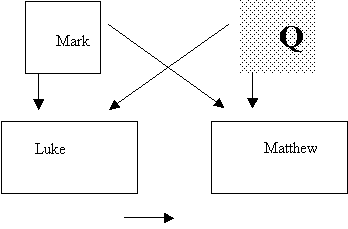
The remnants of a lost, but identifiable, ‘sayings gospel’ called Q (from the German Quelle, or ‘source’) do appear in Matthew and Luke.
What, you may ask, was a ‘sayings gospel’? This was, scholars believe, an ancient document consisting of instructions attributed to Jesus, ‘sayings’ that generally lack narrative material.
A sayings gospel would have carried material that eventually found its way into the Gospels we are familiar with—but a sayings gospel would have made no attempt to tell the life story of Jesus.
Ó Ó Ó
A little background is in order. The Gospel of Mark, most scholars believe, is the oldest extant Gospel. Intriguingly, Matthew and Luke depend on Mark for much, but not all, of their material. (The Gospel of John does not depend on any other Gospel in a textual sense; it is independent in a way that the other three Gospels are not. It is also compiled later.)
When we remove the influence of Mark and look at what Matthew and Luke still have in common, we find dozens of obviously parallel verses in Matthew and Luke—verses that often give us nearly verbatim expressions of the same saying.
Many scholars feel these parallel verses constitute clear evidence of a sayings gospel that supplies Matthew and Luke with a substantial amount of their content. These parallel verses, known as the Q verses, appear to reflect a lost manuscript that is almost certainly older than even Mark’s Gospel.
Ó Ó Ó
This all sounds, perhaps, more complex than it actually is. The simplest explanation for the situation we are examining is known as the Two Source Theory. This theory holds that the authors of Matthew and Luke made use of two important written sources—Mark and the lost gospel we now call Q—in developing their own accounts of the life of Jesus.
Here is a simple visual summary of the Two Source Theory on the next page, which is not my creation; this theory is familiar to virtually all responsible contemporary Gospel textual scholars, and has been a topic of scholarly discussion for many years.
Now, even this brief summary of Q is enough to stir up any number of intricate scholarly debates, and this book is not meant to be about scholarly debates. You should know, however, that the analysis of the development of the Gospels you have just read reflects the findings of some of the most accomplished researchers and scholars working in the field of New Testament textual studies. See The Complete Gospels, edited by Robert J. Miller, HarperSanFrancisco, 1992.
|
‘Traditionalist’ Christian clergy and theologians are generally hostile to the whole idea of Q. They claim that students of Q are somehow eager to diminish the status of Jesus. (Actually, we are only eager to learn what he is most likely to have said.)
The hostility of these preachers and theologians to the proposition that Q was a source for Matthew and Luke is often palpable. Such a response may have something to do with the many challenges that the reconstructed text reflecting the (lost) Q manuscript represents to accepted Christian theology.
One part of this challenge that has been little noticed by lay Christians up to this point—but feared, I suspect, by orthodox Christian theologians—has to do with Islam.
It is the observation, difficult to avoid for any attentive student of comparative religion that Q tends to support the most important elements of Islam’s conception of Jesus.
Ó Ó Ó
The Q scholarship suggests that the ways most Muslims have, down the centuries, envisioned the message, identity, and priorities of Jesus are, broadly speaking, historically correct.
Specifically, Q tends to confirm Islam’s image of Jesus as a distinctly human Prophet.
It tends to confirm Islam’s depiction of the mission of Jesus as following the theological principles of the Qur’an.
It tends to confirm Islam’s rejection of the doctrine of the Trinity.
And it tends to confirm Islam’s claim that the surviving scriptures of Christianity have been tampered with in a way meant to dilute an uncompromisingly rigorous monotheism.
This particular variety of monotheism, Islam has always insisted, was the driving force of all the great prophetic missions, including that of Jesus.
This particular variety of monotheism allows for no such formulation as ‘Father, Son, and Holy Spirit’.
Ó Ó Ó
These connections between the message of Islam and the message of Q are my observations, not the observations of the textual scholars who have done such meticulous work over the years identifying the early Gospel verses. Those scholars are writing about textual research. This book is about Jesus and Islam.
You may agree with the evidence offered in the pages that follow. You may disagree. In the end, it doesn’t really matter how popular or unpopular the analysis offered here proves to be. What matters is that thoughtful Christians have the opportunity to evaluate it fairly and make their own decisions.
Ó Ó Ó
What exactly do I mean when I maintain that Jesus called his people ‘to Islam’?
Let me put it as clearly as I can. I believe that Jesus was, as a matter of historical probability, calling his listeners to a faith system whose guiding principle is that the Creator, not the created, must be worshipped and obeyed. It is a corollary of this belief that God’s will, not human will, should be done on earth.
I believe later manipulations subverted that teaching and pointed the religion of Jesus toward the principle of sacrificial atonement for the sins of mankind. I believe that the Q verses of the Gospels tend to confirm these beliefs of mine.
Ó Ó Ó
Occasionally, people wonder if it is possible to ‘boil down’ the complex textual issues raised by Q scholarship to a single sentence. Here is the sentence I’ve come up with:
Today’s best New Testament experts believe that some Gospel verses appear to present a more historically accurate picture of Jesus than other Gospel verses do.
That is to say, today’s scholarship identifies certain passages—the Q passages—as not only instructive, but historically is more relevant than other passages. Yet most Christians are totally unaware of this research, or of its momentous implications.
If you were to tell the members of any Christian congregation of the existence of such verses … and then ask them what they believe the earliest layer of Gospel verses teaches … most of them would answer that the earliest verses must somehow emphasize Jesus’ status as the only begotten Son of God.
And yet they would be mistaken.
Of course, reasonable people may disagree on the age and authenticity of the sayings that form the centerpiece of this book.
Everyone must agree, though, that the words in question do appear in the Gospels found in every Bible, and are binding on every Christian. And for anyone who is truly committed to the task of following the words of Jesus, that should be enough.
To learn more about why so many scholars are so insistent now about the early dating of the passages in question, see Appendix A. For now, please understand that this book puts forward a very narrow ‘slice’ of the New Testament, and emphasizes the sayings that appear within that slice. As you evaluate that ‘slice’, bear in mind that the most accomplished Biblical scholars of our day—none of them Muslims, by the way—regard the Q verses in Matthew and Luke as the closest we are ever going to get to the teachings of the historical Jesus, barring the discovery of some previously unknown ancient text.
Ó Ó Ó
Some people who hear my reasons for believing as I do react with great anger, and many of these angry people attempt to discredit the scholarship behind Q. They are missing the point.
Whether the Q theory is persuasive to you depends on your interpretation of the evidence. Yet even if you reject all the work of all the Q scholars, this book may nevertheless be of interest to you, assuming two and only two facts:
First, that you are a thoughtful Christian capable of making decisions for yourself about important matters (such as whether or not Jesus preached publicly about his own sacrifice for the sins of mankind).
And second, that you do not reject the Gospel verses in question.
This second point is extremely important, and worth emphasizing. Even if one were to disagree vehemently with the scholars on the dating of the Q verses, one would have a very hard time indeed disputing their presence in the New Testament.
They are there, whether or not one accepts Q as a source for the Gospels, and whether or not they are convenient to contemporary Christian theology.
It is possible, of course, that some people may feel uncomfortable with the whole idea of certain Gospel passages being older or more authoritative than other Gospel passages. If it is easier to think of the verses that appear in the pages that follow as simply coming from certain portions of the Bible—portions that the author happens to prefer over other portions—that is just as well.
There is nothing ‘new’ here. There is only an attempt to refocus, or perhaps focus for the first time, on something very old, on some vitally important parts of Jesus’ message.
If you consider the study of the Gospels to be an important part of your spiritual life, I hope you will consider continuing on to the next chapter. If, on the other hand, you believe that what we find in the Gospels does not have any bearing on your spiritual life, you may want to stop here.
For most of my adolescence I studied the Christian scriptures on my own, and I did so obsessively.
When I say I read the scriptures obsessively, I mean that I was drawn to the Gospels of Matthew, Mark, Luke, and John like a magnet.
There are plenty of notes and highlights in that old Bible of mine in Psalms, in Ecclesiastes, in Proverbs—but most of the notes and underlining are in the Gospels. But I sensed, even at an early age, that there were some internal problems with the texts I loved so dearly.