Table of Contents
The Qur’an, Hadith andModern Science
The Qur’an does not constitute the sole source ofdoctrine and legislation in Islam. During Muhammad’s lifeand after his death, complementary information of alegislative nature was indeed sought in the study of thewords and deeds of the Prophet.
Although writing was used in the transmission ofhadith from the very beginning, a lot of this came alsofrom the oral tradition. Those who undertook to assemblethem in collections made the kind of enquiries which arealways very taxing before recording accounts of pastevents. They nevertheless had a great regard for accuracyin their arduous task of collecting information. This isillustrated by the fact that for all of the Prophet’ssayings, the most venerable collections always bear thenames of those responsible for the account, going rightback to the person who first collected the informationfrom members of Muhammad’s family or his companions.
A very large number of collections of the Prophet’swords and deeds thus appeared under the title of Hadiths.The exact meaning of the word is ‘utterances’, but it isalso customary to use it to mean the narration of hisdeeds.
Some of the collections were made public in thedecades following Muhammad’s death. Just over two hundredyears were to pass before some of the most importantcollections appeared. The most authentic record of thefacts is in the collections of Al Bukhari and Muslim,which date from over two hundred years after Muhammad andwhich provide a wider trustworthy account. In recentyears, a bilingual Arabic/English edition has beenprovided by Doctor Muhammed Muhsin Khan, of the IslamicUniversity of Madina. [ Pub. Sethi Straw Board Mills (Conversion) Ltd andTaleem-ul-Qur’an Trust, Gujranwala, Cantt. Pakistan. 1stedition 1971, for Sahih Al Bukhari.] Al Bukhari’s work is generallyregarded as the most authentic after the Qur’an and wastranslated into French (1903-1914) by Houdas and Marcaisunder the title Les Traditions Islamiques (IslamicTraditions). The Hadiths are therefore accessible tothose who do not speak Arabic. One must, however, be waryof certain translations made by Europeans, including theFrench translation, because they contain inaccuracies anduntruths which are often more of interpretation than ofactual translation. Sometimes, they considerably changethe real meaning of a hadith, to such an extent indeedthat they attribute a sense to it which it does notcontain.
As regards their origins, some of the hadiths andGospels have one point in common which is that neither ofthem was compiled by an author who was an eyewitness ofthe events he describes. Nor were they compiled untilsome time after the events recorded. The hadiths, likethe Gospels, have not all been accepted as authentic.Only a small number of them receive the quasi-unanimousapproval of specialists in Muslim Tradition so that,except al-Muwatta, Sahih Muslim and Sahih al-Bukhari, onefinds in the same book, hadiths presumed to be authenticside by side with ones which are either dubious, orshould be rejected outright.
In contrast to Canonic Gospels which though questionedby some modern scholars but which have never beencontested by Christian high authorities, even thosehadiths that are most worthy to be considered asauthentic have been the subject of criticism. Very earlyin the history of Islam, masters in Islamic thoughtexercised a thorough criticism of the hadiths, althoughthe basic book (The Qur’an) remained the book ofreference and was not to be questioned.
I thought it of interest to delve into the literatureof the hadiths to find out how Muhammad is said to haveexpressed himself, outside the context of writtenRevelation, on subjects that were to be explained byscientific progress in following centuries. Al-thoughSahih Muslim is also an authentic collection, in thisstudy 1 have strictly limited myself to the texts of thehadiths which are generally considered to be the mostauthentic, i.e. those of Al Bukhari. I have always triedto bear in mind the fact that these texts were compiledby men according to data received from a tradition whichwas partially oral and that they record certain factswith a greater or lesser degree of accuracy, depending onthe individual errors made by those who transmitted thenarrations. These texts are different from other hadithswhich were transmitted by a very large number of peopleand are unquestionably authentic. [ Muslim specialists designate the first by theword Zanni and the second by the word Qat’i.]
I have compared the findings made during anexamination of the hadiths with those already set out inthe section on the Qur’an and modern science. The resultsof this comparison speak for themselves. The differenceis in fact quite staggering between the accuracy of thedata contained in the Qur’an, when compared with modernscientific knowledge, and the highly questionablecharacter of certain statements in the hadiths onsubjects whose tenor is essentially scientific. These arethe only hadiths to have been dealt with in this study.
Hadiths which have as their subject the interpretationof certain verses of the Qur’an sometimes lead tocommentaries which are hardly acceptable today.
We have already seen the great significance of oneverse (sura 36, verse 36) dealing with the Sun which”runs its course to a settled place”. Here isthe interpretation given of it in a hadith: “Atsunset, the sun . . . prostrates itself underneath theThrone, and takes permission to rise again, and it ispermitted and then (a time will come when) it will beabout to prostrate itself . . . it will ask permission togo on its course . . . it will be ordered to returnwhence it has come and so it will rise in the West . ..” (Sahih Al Bukhari). The original text (The Bookof the Beginning of the Creation, Vol. IV page 283, part54, chapter IV, number 421) is obscure and difficult totranslate. This passage nevertheless contains an allegorywhich implies the notion of a course the Sun runs inrelation to the Earth: science has shown the contrary tobe the case. The authenticity of this hadith is doubtful(Zanni).
Another passage from the same work (The Book of theBeginning of the Creation, vol. IV page 283, part 54,chapter 6, number 430) estimates the initial stages inthe development of the embryo very strangely in time: aforty-day period for the grouping of the elements whichare to constitute the human being, another forty daysduring which the embryo is represented as ‘somethingwhich clings’, and a third forty-day period when theembryo is designated by the term ‘chewed flesh’. Once theangels have intervened to define what this individual’sfuture is to be, a soul is breathed into him. Thisdescription of embryonic evolution does not agree withmodern data.
Whereas the Qur’an gives absolutely no practicaladvice on the remedial arts, except for a single comment(sura 16, verse 69) on the possibility of using honey asa therapeutic aid (without indicating the illnessinvolved), the hadiths devote a great deal of space tothese subjects. A whole section of Al Bukhari’scollection (part 76) is concerned with medicine. In theFrench translation by Houdas and Marcais it goes frompage 62 to 91 of volume 4, and in Doctor Muhammad MuhsinKhan’s bilingual Arabic/English edition from page 395 to452, of volume VII. There can be no doubt that thesepages contain some hadiths which are conjectural (Zanni),but they are interesting as a whole because they providean outline of the opinions on various medical subjectsthat it was possible to hold at the time. One might addto them several hadiths inserted in other parts of AlBukhari’s collection which have a medical tenor.
This is how we come to find statements in them on theharms caused by the Evil Eye, witchcraft and thepossibility of exorcism; although a certain restrictionis imposed on the paid use of the Qur’an for thispurpose. There is a hadith which stresses that certainkinds of date may serve as protection against the effectsof magic, and magic may be used against poisonoussnakebites.
We should not be surprised however to find that at atime when there were limited possibilities for thescientific use of drugs, people were advised to rely onsimple practices; natural treatments such asblood-letting, cupping, and cauterization, head-shavingagainst lice, the use of camel’s milk and certain seedssuch as black cumin, and plants such as indian Qust. Itwas also recommended to burn a mat made of palm-treeleaves and put the ash from it into a wound to stopbleeding. In emergencies, all available means that mightgenuinely be of use had to be employed. It does not seem-apriori-to be a very good idea, however, to suggestthat people drink camel’s urine.
It is difficult today to subscribe to certainexplanations of subjects related to various illnesses.Among them, the following might be mentioned:–the origins of a fever. there are four statementsbearing witness to the fact that “fever is from theheat of hell” (Al Bukhari, The Book of Medicine,vol. VII, chapter 28, page 416).
–the existence of a remedy for every illness:”No disease God created, but He created itstreatment” (Ibid. chapter 1, page 396). This conceptis illustrated by the Hadith of the Fly. “If a flyfalls into the vessel of any of you, let him dip all ofit (into the vessel) and then throw it away, for in oneof its wings there is a disease and in the other there ishealing (antidote for it). i.e. the treatment for thatdisease” (Ibid. chapter 15-16, pages 462-463, alsoThe Book of the Beginning of Creation part 54, chapters15 & 16.)
–abortion provoked by the sight of a snake (which canalso blind). This is mentioned in The Book of theBeginning of Creation, Vol. IV(chapter 13 and 14, pages330 & 334).
–haemorrhages between periods. The Book of Menses(Menstrual Periods) Vol. VI, part 6, pages 490 & 495contains two hadiths on the cause of haemorrhages betweenperiods (chapters 21 & 28). They refer to two women:in the case of the first, there is a description(undetailed) of the symptoms, with a statement that thehaemorrhage comes from a blood vessel; in the second, thewoman had experienced haemorrhages between periods forseven years, and the same vascular origin is stated. Onemight suggest hypotheses as to the real causes of theabove, but it is not easy to see what arguments couldhave been produced at the time to support this diagnosis.This could nevertheless have been quite accurate.
–the statement that diseases are not contagious. AlBukhari’s collection of hadiths refers in several places(chapters 19, 25, 30, 31, 53 and 54, Vol. VII, part 76,of the Book of Medicine) to certain special cases, e.g.leprosy (page 408), plague (pages 418 & 422), camel’sscabies (page 447), and also provides general statements.The latter are however placed side by side with glaringlycontradictory remarks: it is recommended, for example,not to go to areas where there is plague, and to stayaway from lepers.
Consequently, it is possible to conclude that certainhadiths exist which are scientifically unacceptable.There is a doubt surrounding their authenticity. Thepurpose of reference to them lies solely in thecomparison that they occasion with the verses of theQur’an mentioned above: these do not contain a singleinaccurate statement. This observation clearly hasconsiderable importance.
One must indeed remember that at the Prophet’s death,the teachings that were received from this fell into twogroups:–firstly, a large number of Believers knew the Qur’an byheart because, like the Prophet, they had recited itmany, many times; transcriptions of the text of theQur’an already existed moreover, which were made at thetime of the Prophet and even before the Hegira [ The Hegira was in 622, ten years beforeMuhammad’s death.].
-secondly, the members of his following who wereclosest to him and the Believers who had witnessed hiswords and deeds had remembered them and relied on themfor sUPport, in addition to the Qur’an, when defining anascent doctrine and legislation.
In the years that were to follow the Prophet’s death,texts were to be compiled which recorded the two groupsof teachings he had left. The first gathering of hadithswas performed roughly forty years after the Hegira, but afirst collection of Qur’anic texts had been madebeforehand under Caliph Abu Bakr, and in particularCaliph Uthman, the second of whom published a definitivetext during his Caliphate, i.e. between the twelfth andtwenty-fourth years following Muhammad’s death.
What must be heavily stressed is the disparity betweenthese two groups of texts, both from a literary point ofview and as regards their contents. It would indeed beunthinkable to compare the style of the Qur’an with thatof the hadiths. What is more, when the contents of thetwo texts are compared in the light of modern scientificdata, one is struck by the oppositions between them. Ihope I have succeeded in showing what follows:–on the one hand, statements in the Qur’an which oftenappear to be commonplace, but which conceal data thatscience was later to bring to light.
–on the other hand, certain statements in the hadithswhich are shown to be in absolute agreement with theideas of their times but which contain opinions that aredeemed scientifically unacceptable today. These occur inan aggregate of statements concerning Islamic doctrineand legislation, whose authenticity is unquestioninglyacknowledged.
Finally, it must be pointed out that Muhammad’s ownattitude was quitedifferent towards the Qur’an from whatit was towards his personal sayings. The Qur’an wasproclaimed by him to be a divine Revelation. Over aperiod of twenty years, the Prophet classified itssections with the greatest of care, as we have seen. TheQur’an represented what had to be written down during hisown lifetime and learned by heart to become part of theliturgy of prayers. The hadiths are said, in principle,to provide an account of his deeds and personalreflections, but he left it to others to find an examplein them for their own behaviour and to make them publichowever they liked: he did not give any instructions.
In view of the fact that only a limited number ofhadiths may be considered to express the Prophet’sthoughts with certainty, the others must contain thethoughts of the men of his time, in particular withregard to the subjects referred to here. When thesedubious or inauthentic hadiths are compared to the textof the Qur’an, we can measure the extent to which theydiffer. This comparison highlights (as if there werestill any need to) the striking difference between thewritings of this period, which are riddled withscientific inaccurate statements, and the Qur’an, theBook of Written Revelation, that is free from errors ofthis kind. [ The truth of the hadiths, from a religious pointof view, is beyond question. When they deal, however,with earthly affairs there is no difference between theProphet and other humans. One hadith gives an account ofan utterance of the Prophet: “Whenever I command youto do something related to Religion do obey, and if Icommand you something according to my own opinion (doremember this) I am a human being”.Al Saraksi in his ‘Principles’ (Al Usul) transmitted thisstatement as follows: “If I bring something to youon your religion, do act according to it, and if I bringyou something related to this world, then you have abetter knowledge of your own earthly affairs”.]
General Conclusions
At the end of this study, a fact that stands forthvery clearly is that the predominant opinion held in theWest on the Texts of the Holy Scriptures we possess todayis hardly very realistic. We have seen the conditions,times and ways in which the elements constituting the OldTestament, the Gospels and the Qur’an were collected andwritten down: the circumstances attendant upon the birthof the Scriptures for these three Revelations differedwidely in each case, a fact which had extremely importantconsequences concerning the authenticity of the texts andcertain aspects of their contents.
The Old Testament represents a vast number of literaryworks written over a period of roughly nine hundredyears. It forms a highly disparate mosaic whose pieceshave, in the course of centuries, been changed by man.Some parts were added to what already existed, so thattoday it is sometimes very difficult indeed to identifywhere they came from originally.
Through an account of Jesus’s words and deeds, theGospels were intended to make known to men the teachingshe wished to leave them on completion of his earthlymission. Unfortunately, the authors of the Gospels werenot eyewitnesses of the data they recorded. They werespokesmen who expressed data that were quite simply theinformation that had been preserved by the variousJudeo-Christian communities on Jesus’s public life,passed down by oral traditions or writings which nolonger exist today, and which constituted an intermediatestage between the oral tradition and the definitivetexts.
This is the light in which the Judeo-ChristianScriptures should be viewed today, and-to beobjective-one should abandon the classic concepts held byexperts in exegesis.
The inevitable result of the multiplicity of sourcesis the existence of contradictions and oppositions: manyexamples have been given of these. The authors of theGospels had (when talking of Jesus) the same tendency tomagnify certain facts as the poets of French Medievalliterature in their narrative poems. The consequence ofthis was that events were presented from each individualnarrator’s point of view and the authenticity of thefacts reported in many cases proved to be extremelydubious. In view of this, the few statements contained inthe Judeo-Christian Scriptures which may have somethingto do with modern knowledge should always be examinedwith the circumspection that the questionable nature oftheir authenticity demands.
Contradictions, improbabilities and incompatibilitieswith modern scientific data may be easily explained interms of what has just been said above. Christians arenevertheless very surprised when they realize this, sogreat have been the continuous and far-reaching effortsmade until now by many official commentators tocamouflage the very obvious results of modern studies,under cunning dialectical acrobatics orchestrated byapologetic lyricism. A case in point are the genealogiesof Jesus given in Matthew and Luke, which werecontradictory and scientifically unacceptable. Exampleshave been provided which reveal this attitude veryclearly. John’s Gospel has been given special attentionbecause there are very important differences between itand the other three Gospels, especially with regard tothe fact that his Gospel does not describe theinstitution of the Eucharist: this is not generallyknown.
The Qur’anic Revelation has a history which isfundamentally different from the other two. It spanned aperiod of some twenty years and, as soon as it wastransmitted to Muhammad by Archangel Gabriel, Believerslearned it by heart. It. was also written down duringMuhammad’s life. The last recensions of the Qur’an wereeffected under Caliph Uthman starting some twelve yearsafter the Prophet’s death and finishing twenty-four yearsafter it. They had the advantage of being checked bypeople who already knew the text by heart, for they hadlearned it at the time of the Revelation itself and hadsubsequently recited it constantly. Since then, we knowthat the text has been scrupulously preserved. It doesnot give rise to any problems of authenticity.
The Qur’an follows on from the two Revelations thatpreceded it and is not only free from contradictions inits narrations, the sign of the various humanmanipulations to be found in the Gospels, but provides aquality all of its own for those who examine itobjectively and in the light of science i.e. its completeagreement with modern scientific data. What is more,statements are to be found in it (as has been shown) thatare connected with science: and yet it is unthinkablethat a man of Muhammad’s time could have been the authorof them. Modern scientific knowledge therefore allows usto understand certain verses of the Qur’an which, untilnow, it has been impossible to interpret.
The comparison of several Biblical and Qur’anicnarrations of the same subject shows the existence offundamental differences between statements in the former,which are scientifically unacceptable, and declarationsin the latter which are in perfect agreement with moderndata: this was the case of the Creation and the Flood,for example. An extremely important complement to theBible was found in the text of the Qur’an on the subjectof the history of the Exodus, where the two texts werevery much in agreement with archaeological findings, inthe dating of the time of Moses. Besides, there are majordifferences between the Qur’an and the Bible on the othersubjects: they serve to disprove all that has beenmaintained-without a scrap of evidence-concerning theallegation that Muhammad is supposed to have copied theBible to produce the text of the Qur’an.
When a comparative study is made between thestatements connected with science to be found in thecollection of hadiths, which are attributed to Muhammadbut are often of dubious authenticity (although theyreflect the beliefs of the period), and the data of asimilar kind in the Qur’an, the disparity becomes soobvious that any notion of a common origin is ruled out.
In view of the level of knowledge in Muhammad’s day,it is inconceivable that many of the statements In theQur’an which are connected with science could have beenthe work of a man. It is, moreover, perfectly legitimate,not only to regard the Qur’an as the expression of aRevelation, but also to award it a very special place, onaccount of the guarantee of authenticity it provides andthe presence in it of scientific statements which, whenstudied today, appear as a challenge to explanation inhuman terms.
Back Cover
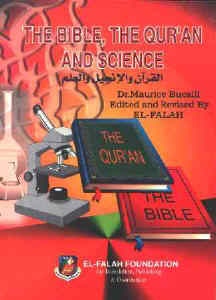
In his objective study of the texts, Maurice Bucailleclears’ away many preconceived ideas about the OldTestament, the Gospels and the Qur’an. He tries, in thiscollection of Writings, to separate what belongs toRevelation from what is the product of error or humaninterpretation. His study sheds new light on the HolyScriptures. At the end of a gripping account, he placesthe Believer before a point of cardinal importance: thecontinuity of a Revelation emanating from the same God,with modes of expression that differ in the course oftime. It leads us to meditate upon those factors which,in our day, should spiritually unite rather thandivide-Jews, Christians and Muslims.
As a surgeon,Maurice Bucaille has often been in a situation where hewas able to examine not only people’s bodies, but theirsouls. This is how he was struck by the existence ofMuslim piety and by aspects of Islam which remain unknownto the vast majority of non-Muslims. In his search forexplanations which are otherwise difficult to obtain, helearnt Arabic and studied the Qur’an. In it, he wassurprised to find statements on natural phenomena whosemeaning can only be understood through modern scientificknowledge.
He then turned to the question of the authenticity ofthe writings that constitute the Holy Scriptures of themonotheistic religions. Finally, in the case of theBible, he proceeded to a confrontation between thesewritings and scientific data.
The results of his research into the Judeo-ChristianRevelation and the Qur’an are set out in this book.
Ansariyan PublicationsP.O.B 37185/187 QUMIslamic RePublic Of Iran Tel 74 17 44