
Table of Contents
METHODS OF CRUCIFIXION
ORIGINS OF CRUCIFIXION
Crucifixion was the common mode of eliminating political prisoners, murderers and insurgents. Long before the birth of Jesus, the Phoenecians had experimented with various methods to get rid of their anti-social characters. They had tried hanging, impaling, stoning, drowning, etc. But all these were too quick in their effects; the culprits expired too soon for their liking. So they invented the crucifixion, a system which produced a slow L-I-N-G-E-R-I-N-G death.
TWO METHODS OF CRUCIFIXION
The Romans borrowed and perfected the system. They developed a crucifixion for fast death and disposal, and another for a slow death and disposal.
The Christian Masters1 are confused in their paintings of the gruesome scene. They portray the two robbers2 who were simultaneously crucified with Jesus, his “crossmates”, one on his right hand and the other on his left hand, as undergoing the FAST method, whereas Jesus himself is painted as undergoing a S-L-O-W process.
The Romans never combined these two different methods. They were never confused, as the Christian artists were, with the fast and the slow methods. The Old Masters have painted hybrid crosses (mixture) of the “fast” and “slow” methods in their drawings of Jesus’ bodily supports on the cross — i.e. with Sadile or without sadile 3 either nails or leather thongs to bind the arms to the crossbar; and, either platforms to support the feet, or spikes.
1. Meaning great artists like Michaelangelo, Rembrandt, Leonardo Da Vinci, etc.
2. Mark 15:27 – “lestes” in the original. Alternatively translated as “thieves” or “brigandas” is actually a derogatory term for “Zealot.” These “crossmates” of Jesus were not common thieves or crooks. They were the terrorists of their day, heroes of their nation.
3. Sadile: Obviously a SADDLE, or “horn” which was fitted in the middle of the upright piece of the cross, so that it projected between victim’s legs at the crotch to support his body-weight, but for aesthetic reasons the Christian fathers have eliminated the “horn” from the cross. See illustrations further down.
“THE GOSPEL UNTRUTH”
Contrary to common belief, Jesus was not nailed to the cross, but bound, if at all, like the other two. In the light of the knowledge available, we must regard the “Doubting Thomas” episode as a flagrant “gospel fabrication”, similar to the story of the woman caught in the act of adultery. See below for a reproduction of the Bible page and note that John chapter 8, begins with verse 12. Can you imagine any chapter in any religious Book beginning with verse 12 as the first verse? Verses 1 to 11 are expunged as a fabrication by the 32 Christian Scholars of the highest eminence, backed by 50 co-operating denominations in their “Most up-to-date Version of the Bible”— the R.S.V.1
1. R.S.V. stands for Revised Standard Version, first published in 1952. The translators claimed to have had access to the “Most Ancient Manuscripts” from which they learnt that the story about the adulteress was a fabrication. See <!a href=”http://www.jamaat.net/IsTheBibleGodsWord/BibleIntro.html”>”Is the Bible God’s Word?”<!/a> for further information on the R.S.V.
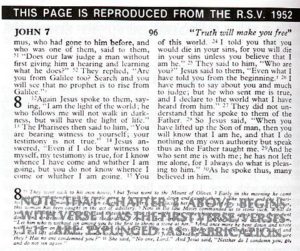
THIS IS A FOOTNOTE, REPRODUCED AS IS FROM THE BIBLE.
THEIR HURRY A BLESSING IN DISGUISE
The Jews were in extreme haste to have Jesus done away with. Remember the midnight trial? Early in the morning, they dragged him to Pilate. From Pilate to Herod. From Herod back to Pilate. According to a boisterous American (another “born-again”) there were “SIX” trials within twelve hours. At the busiest time in Jerusalem, around the Feast of the Passover, it appears from the Gospel narratives that people of worth had nothing else to do but twiddle their thumbs in great expectation of interviewing Jesus. Exactly as things happen on the “set”, for the shooting of films. Hurry! hurry! hurry!
According to the Gospel writers, the Jews and the Romans managed to have Jesus on the cross by the 6th hour, that is by 12 noon; and by the 9th hour1, that is, by 3 o’clock he had given up the ghost — he had died (?). Strange people, these Jews! As much as they were in a hurry to mount Jesus on the cross, no sooner had they succeeded, they were once more agitated to bring him down. Can you imagine why? Their religious scruples -the Sabbath! They were warned in the “fifth Book of Moses”:
“His body (any crucified person) shall not remain all night upon the tree, but thou shah in any wise bury him that day, (for he that is hanged is accursed of God), that thy land be not defiled, which the Lord thy God giveth thee for an inheritance.”
(HOLY BIBLE) Deuteronomy 21:23
To appease the religious scruples of the Jews (or for any other reason) if it became necessary to expedite death on the cross, the executioners resorted to the “cruri-fragium”, a club like horror with which the legs were broken. The victim expired by suffocation within the hour. This was the fast method.
1. Matthew 27:46. 32
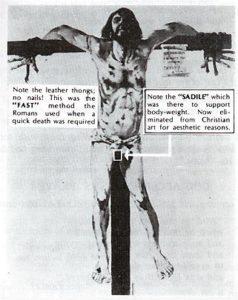
This drawing is an attempt at a more accurate representation of the “execution” of Jesus. To check his ideas the artist Charles Pickard, actually manoeuvred himself into this position.