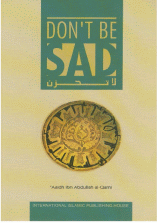
All praise is for Allah, the Exalted; may He send peace and blessings on Prophet Muhammad, his family, and his Companions.ln Don’t be Sad, Shaykh ‘Aaidh al-Qarnee offers a practical approach not only in dealing with, but also in overcoming, the various hardships and difficulties we face in life. He manages to engage the reader’s attention from the very beginning of the book, giving answers to the doubts that besiege us when we are afflicted with hardship or depression. Because Shaykh ‘Aaidh writes from an Islamic perspective, with his advice taken from infallible sources – the Qur’an and the Sunnah, he goes beyond other books on this topic, books that, for the most part, are full of platitudes and rhetoric and short on sound, practical advice.Yet Shaykh ‘Aaidh does something in this book that some Muslims might object to: at times, he quotes Western and Eastern Philosophers. Some might say that relying on their sayings is contrary to what an Islamic author should do, given the vast wealth of knowledge that can be found in books written and compiled by Muslim scholars. However, Shaykh Aaidh quotes non-Muslims only when what they say is relevant to the subject matter and is in agreement with the truth. Furthermore, he doesn’t rely on those quotes to establish principles and rules, rather, he uses them merely to add variety and flavor to the book. wisdom is the goal of every believer; wherever he finds it, he is most deserving of it.This book provides the reader with the Islamic approach to dealing with the trials and tribulations of life. Because change is a gradual and painstaking process, I advise you not to read this book in one sitting in an attempt to absorb everything in the span of a few hours. You should take it in doses, allowing yourself time to reflect on the seemingly simple, yet profoundly deep, wisdom written herein. At the present time, when so many of us are afflicted with the ailments described in this book – depression, grief spiritual malaise – we would be wise to read Don’t be Sad.My Methodology in Translating Don’t be SadThis book is intended for both the Arab and the Non-Arab readers; however, in all fairness to the English reader, I did not render a word-for-word translation. Doing so would have defeated the author’s purpose. He wrote in a style that is both elegant and graceful in Arabic, but if it were to be translated verbatim into English, the result would be unfavorable – the style would at best seem awkward. Here I give you an outline of how I translated this work:
Poetry: I translated approximately twenty-five percent of the poems found in the original version of the book. I translated those verses of poetry that I clearly understood and that I felt would have a positive impact on the reader. Those translated verses do not come close to their full meanings and some of them lose the many connotations found in the precise wording of the original. But I, nonetheless, translated them because their meanings contain some wisdom.
The author’s style, as is the style of most good Arabic writers, is very descriptive, very florid: he often uses many adjectives when attempting to give a single meaning. Because this style is not as effective in English, I had to do some pruning, striking out, and summarizing – all for the sake of concision. Wherever I did this, I did so in the interest of the English reader, trying to simplify and summarize sentences and paragraphs without sacrificing nuances in meaning.
Islamic terms: I loosely translated some Islamic terms that other translators often transliterate (words such as ‘Eemaan’). Transliteration makes the reader pause so that he can understand the word’s meaning. Unlike the case for a scholarly essay that deals with a difficult subject, a person should be able to read Don t be Sad quickly, without having to stop and consider difficult terms; he should be able to move from one idea to the next, without being interrupted by unwelcome pauses. If the book were on Islamic Jurisprudence, however, where the meanings of terms are more crucial, I feel that terms should be transliterated, so as to preserve their full meaning.
The book contains a great deal of repetition; the author himself mentions this in his introduction. On some occasions, when I deemed it important to the flow of the book, I omitted some of the repetition.
For the most part, though, I tried to remedy the problem by expressing an idea the second time around in a different way, changing both the wording and the style.
Though the author did not do so, I mentioned the Chapter and Verse numbers of the Qur’anic text.
The author quotes many non-Arab writers, most of them being English thinkers or philosophers. Because he mentions the quotes in Arabic, and because of the difficulty involved in finding all of the original sayings in English, I deemed it sufficient to translate the quotes back into English, and so, they are not the exact words of the persons being quoted.
May Allah, the Exalted, reward the author for his efforts in writing this much-needed book. May He guide us to the Straight Path, save us from the Hellfire, and admit us by His mercy into Paradise.Faisal ibn Muhammad