
Table of Contents
Chapter 6: Muhammad in the Bible
“Those who followthe Messenger, the unlettered Prophet whom they find written inthe Torah and the Gospel with them. He enjoins upon them thatwhich is right and forbids for them that which is evil. He makeslawful for them all things that are good and prohibits for themall that is foul and he relieves them from their burden and thefetters that they used to wear. Then those who believe in him,honor him, assist him, and follow the light which is sent downwith him: they are the successful”
The noble Qur’an, Al-A’araf(7):157.
“And when there came to them a messengerfrom Allah, Confirming what was with them, a party of the peopleof the book threw away the book of Allah behind their backs asif (it had been something) they did not know”
The Qur’an, Al-Bakarah(2): 101
“And because of their breaking of their covenant,We have cursed them and made hard their hearts. They change thewords from their places and they forget a portion thereof”
The noble Qur’an, Al-Maida(4): 13.
Before starting this topic, let me first clear upa common misconception. Many Christians require of all Muslimsto either accept all of the Bible or to reject all of the Bible.Therefore, they sometimes find a Muslim’s attitude towards theBible bewildering. For this reason, I will explain how a Muslimis commanded to deal with the Bible.
Muslims are told that Allah Almighty sent down an”Injeel” upon Jesus (pbuh). The Qur’an then goes onto describe how mankind later changed this “Injeel”and altered it’s original message to them. For this reason, Muhammad(pbuh) told all Muslims to deal with the Bible with respect sinceit started out as the true word of God. Muhammad (pbuh) told hisfollowers that if they were to reject the whole book, then theymight be rejecting words that remain the true word of God. Hetold them that the Qur’an had been sent down to “bear witnessover” that which was changed by mankind in the Bible andto return it to the original teachings of God through it’s ownguardianship. We read this in the Qur’an:
“And unto you (O Muhammad) have We revealedthe Scripture (Qur’an) with the truth, confirming that which wasbefore it of the Scripture, and a watcher/corrector over it. Sojudge between them by that which Allah has revealed, and follownot their desires away from the truth which has come unto you..”
The noble Qur’an, Al-Maidah(5):48.
The actual word used in this verse was the Arabicword “Muhaimin” which means”Guardian/warden/overseer/watcher/protector.”For this reason, Muhammad (pbuh) commanded them to accept onlythat which is verified by the Qur’an and to reject that whichcontradicts the Qur’an.
Muslims have recorded that the “people of thebook” at the time of Muhammad (pbuh) had been expecting anew prophet to be coming soon. There are many historical reportsto this effect. We are told that the Jews of Yathrib (Al-MadinahAl-Munawarah) were constantly threatening it’s Arab citizens withhis impending arrival and that they would follow him and slaughterthem in a similar manner as A’ad and Iram where slaughtered, andthis was one of the major reasons that the Arabs of Yathrib followedMuhammad (pbuh) so quickly. To beat the Jews to him. There arealso other similar stories, such as the story of Salman Al-Farisi,the story of the monk Bahira, and the story of Al-Najashi, theking of Ethiopia among many others.
There are many predictions of the coming of Jesus(pbuh) in the Old Testament. Many Christians have even told usthat the Bible has predicted much of what has occurred after thetime of Jesus (pbuh) including the Pope and Israel. Unlike theJews, Muslims do not contest the claimed prophesies of the comingof Jesus (pbuh) since the Qur’an commands them to believe in him.We have also seen in the verse which was presented at the verybeginning of this chapter how the Qur’an tells us that both theTorah of Moses as well as the Injeel (Gospel) of Jesusboth contain prophesies of Muhammad However, if we ask the Christianswhether they can find any mention of Muhammad (pbuh) in the Bible,their immediate response is an emphatic “No!” But ifthe Bible has predicted all of these other things then we mustask: why does it have absolutely nothing at all to say about theman who single-handedly convinced many billions of people overthe ages to believe in the miraculous birth of Jesus (pbuh), hismessage, the piety and chastity of his mother Mary (pbuh), themiracles of Jesus (pbuh), and the fact that he was one of thegreatest messengers of God for all time?
There is not a single prophesy in the Old Testamentthat mentions Jesus (pbuh) by name. Messiah, translated”Christ” is not a name. It is a description, a title.It means “the anointed one.” Even “Jesus”is not Jesus’ true name. “Jesus” is a Latinized versionof the Hebrew name “Yeshua,” which itselfis the shortened form of “Yehoshua” -God Saves. When the Christians claim that a verse professes thecoming of Jesus (pbuh) what they have done is to compare thedescription found in that verse to Jesus (pbuh) and if itfits him then they say that it speaks of him. Using the Christian’ssame system we claim that there is indeed not one, but more thanTEN verses in the Bible that speak of the coming of Muhammad (pbuh)as God’s last messenger, but that previous commentators havemisunderstoodthem (just as the Christians tell us that the Jews have done withthe Old Testament prophesies of Jesus, pbuh). The reader willnotice that in what is to follow the verses are explained verysimply, using the obvious meanings of the words themselves withouthaving to resort to forced abstract and metaphysical meaningsfor these verses. These verses speak about major events,locations, and milestones in Islamic history as well as thecharacteristicsof both Islam and Muhammad (pbuh).
Now the prophesies:
“Those unto whom We gave the Scripture recognizehim (Muhammad) as they recognize their sons. But verily, a partyof them conceal the truth while [well] they know it”
The noble Qur’an, al-Baqarah(2):146
6.1: Three distinct prophesies
In the Bible we read of the test that the Jews appliedto Jesus (pbuh) in order to ascertain his truthfulness. The Jewshad a prophecy that required Elias to come before Jesus (pbuh):
“Elias verily cometh first”
Mark 9:12
(also John 3:28). They had not seen Elias yet sothey doubted the claim of Jesus (pbuh). Jesus, however, respondedto them that Elias had already come but that they did not recognizehim. In Matthew we read:
“But I say unto you, That Elias is come already,and they knew him not………Then the disciples understood thathe spake unto them of John the Baptist.”
Matthew 17:12-13
John, however refutes the claims of Jesus (pbuh).This is one of the Christian’s “dark sayings of Jesus”that their scholars have tried to reconcile for centuries. Wewill leave this matter for them to work out among themselves (Thismatter is resolved in the Gospel of Barnabas.Please see chapter 7 for more).
Now, in John we read
“And this is the record of John, when theJews sent priests and Levites from Jerusalem to ask him, Who artthou? And he confessed, and denied not; but confessed, Iam not the Christ. And they asked him, What then? Artthou Elias? And he saith, I am not. Art thou that prophet?And he answered, No.”
John 1:19-21
We notice that there are three distinct prophecieshere: 1) Elias, 2) Jesus, 3) That prophet. The Jews were not waitingfor two prophecies, but three. This can be further clarifiedby reading John:
“And they asked him, and said unto him, Whybaptizest thou then, if thou be:
a) not that Christ,
b) nor Elias,
c) neither that prophet?”
John 1:25
If “that prophet” were Jesus (pbuh) wouldn’tthe third question in both verses be redundant? Further, we mustremember that “That prophet” can not apply to any prophetbefore the time of Jesus (pbuh) because at the time of Jesus (pbuh)the Jews were still waiting for all three. Notice how whenwe let the Bible speak for itself, without forcing the holy spiritor other supernatural meanings on it in the commentary, or forcingthree questions to be only two, how clear these verses become.For much more evidence in this regard, please read chapter 7 regardingthe Dead Sea Scroll prophesies of “twomessiahs”and how the Jews who wrote the scrolls and who were waiting forthe coming of Jesus (pbuh) clearly state in these scrolls thatthey were waiting for not one, but TWO messiahs, the firstof which would be announced by an eschatological prophet.
6.2: Foretells the story of the chapter of”Al-Alak”
“And the vision of all is become unto youas the words of a book that is sealed, which [men] deliver toone that is learned, saying, Read this, [I pray thee]: and hesaith, I cannot; for it [is] sealed: And the book is deliveredto him that is not learned, saying, Read this, [I pray thee]:and he saith, I am not learned. Wherefore the Lord said, Forasmuchas this people draw near [me] with their mouth, and with theirlips do honor me, but have removed their heart far from me, andtheir fear toward me is taught by the precept of men: Therefore,behold, I will proceed to do a marvelous work among this people,[even] a marvelous work and a wonder: for the wisdom of theirwise [men] shall perish, and the understanding of their prudentmen shall be hid. Woe unto them that seek deep to hide their counselfrom the LORD, and their works are in the dark, and they say,Who seeth us? and who knoweth us? Surely your turning of thingsupside down shall be esteemed as the potter’s clay: for shallthe work say of him that made it, He made me not? or shall thething framed say of him that framed it, He had no understanding?[Is] it not yet a very little while, and Lebanon shall be turnedinto a fruitful field, and the fruitful field shall be esteemedas a forest? And in that day shall the deaf hear the words ofthe book, and the eyes of the blind shall see out of obscurity,and out of darkness.”
Isaiah 29:11-18
Prophet Muhammad (pbuh) was illiterate. His entirelife he never learned to read nor write. The exact circumstancesof this first revelation were as follows: It was the habit ofMuhammad (pbuh) to frequently remove himself from the midst ofhis fellow Arabs and their heathenistic actions and spend manydays secluded in the cave of “Hiraa” in the mountainsof Makkah where he would pray to God according tothe religion of Abraham (pbuh). After many yearsof this, and having reached the age of forty (610AD), the angelGabriel suddenly appeared before him and orderedhim to “Iqra!” (read, recite, repeat, proclaim).Muhammad (pbuh), in his terror thought he was being asked to read,so he stammered: “I am unlettered.” The angelGabriel again ordered him to “Iqra!” Muhammad(pbuh) again replied: “I am unlettered.” Theangel Gabriel now took a firm hold of him and commanded him “Iqraain the name of Allah who created!”. Now Muhammad (pbuh)began to understand that he was not being asked to read, but torecite, to repeat. He began to repeat after him, and Gabriel revealedto him the first verses of the Qur’an, those at the beginningof the chapter of Al-Alak(96):
“Read(Iqraa): In the name of your Lord whocreated, Created man from a clot. Read(Iqraa): And your Lord isthe Most Bounteous, Who teaches by the pen, Teaches man that whichhe knew not.”
The noble Qur’an, Al-Alak(96):1-5
As mentioned above, the actual word angel Gabrielused to address Muhammad (pbuh) was the Arabic word “Iqra.”It is derived from the Arabic root word “qara”. However,if we were to go back to the original Hebrew form of the versesof Isaiah 29:11, we would find that the actual word which is translatedinto English as “Read this [I pray thee]”is the Hebrew word qara’, {kaw-raw’}. Is it not an amazing coincidencethat the Hebrew text used not only a word with the same meaning,but the exact same word itself ?
Verse 11 of Isaiah tells us that the final book (theQur’an) was revealed to previous prophets, however, they couldnot read it. It was “sealed” for them because it wasmeant for the last prophet, and until the last prophet’s timecame, the people would not yet be able to “bear” thismessage (John 16:13). It was also sealed for them because it wasrevealed in Arabic.
“A Book whereof the verses are explainedin detail; a Qur’an in Arabic for people who have knowledge”
The noble Qur’an, Fussilat(41):3
“Had We made this as a Qur’an (in a language)other than Arabic, they would have said: ‘Why are not its versesexplained in detail? What! An Arab and non Arabic?’ Say: ‘It isa Guide and a Healing for those who believe; and for those whodisbelieve, there is a heaviness (deafness) in their ears, andit is a blindness upon them: They are as those who are calledfrom a place far distant (so they neither hear nor understand)'”
The noble Qur’an, Fussilat(41):44
For more details on why the Arabic language wasselectedas the language of the Qur’an, please read chapter 13.
Indeed, the Qur’an was revealed to a man who couldneither read nor write so that it might be apparent to mankindthat he could not have received it from the writings of man, butonly from God Almighty.
“Neither did you (O Muhammad) read any bookbefore it, nor did you write any book with your right [hand].In that case, indeed, the followers of falsehood might have doubtedNay, it is but clear signs in the breasts of those endowed withknowledge: and none but the unjust reject Our signs.”
The noble Qur’an, Al-Ankaboot(29):48-49.
As we see in the above verses of Isaiah, by the timeProphet Muhammad (pbuh) received this book from God, mankind willhave been reduced to worshipping God in words alone, while theirhearts shall be far removed from true belief. They will have forsakenthe true belief in God in favor of “the precept of men”(the laws of men). We have already seen the confirmation of thisin chapter one where we learned how “St. Paul” managedto totally replace the message of Jesus (pbuh) with his own message,and how the later followers of Paul believed that they were justifiedin using force to get the first Christians to accept their gospels.We also saw how they burned Gospels that were accepted as authenticin the first centuries CE, and killed all Christians who did not”convert.” Finally, we also saw how St. Paul managedto reduce the message of Jesus (pbuh) to mere “words”of “faith” with no concrete actions or commandmentsrequired of them (i.e. Romans 3:28).
Verse 14 now goes on to explain how when mankindaccepts this situation, then the wisdom of the wise men shallperish and all that shall be left is mankind’s corruption. Onceagain, we have seen this in chapter one, where we learned thehistorical details of how the followers of Jesus (pbuh) and theapostles were murdered and their books destroyed.
This is indeed the same situation described byMuhammad(pbuh) in one of his sayings. In Sahih Al-Bukhari we read thatAbdullah ibn Amr ibn Al-‘As said:
“I heard Allah’s Apostle (pbuh) saying, ‘Allahdoes not take away the knowledge, by taking it away from (thehearts of) the people, but takes it away by the death of the religiouslearned men till when none of them remain, people will take astheir leaders ignorant persons who when consulted will give theirverdict without knowledge. So they will go astray and will leadthe people astray.'”
In verse 15, we are told that there will remain amongthose corrupt individuals those who shall know the truth but shallstrive to hide it from becoming known. Once again, we have seenthis in chapters, one, and two. For more, see chapter 7. Onceagain, when the Qur’an was revealed, it confirmed this situation,we read:
“Those unto whom We gave the Scripture recognize(this prophet) as they recognize their sons. But lo! a party ofthem conceal the truth which they themselves know.”
The noble Qur’an, Al-Baqara(2):14
“And whether you hide your word or publishit, He certainly has (full) knowledge, of the secrets of (all)hearts.”
The noble Qur’an, Al-Mulk(67):13
Verses 16 goes on to tell us how this treachery,concealment of the truth, and “overturning” of verses,laws, and obligations shall be exposed, and the wicked shall beheld accountable for their deeds. Yet again, in the Qur’an weread:
“That Day shall We set a seal on their mouths.But their hands will speak to us, and their feet bear witness,to all that they used to do”
The noble Qur’an, Ya-seen(36):65
“And (remember) the day that the enemiesof Allah shall be gathered to the Fire so that they will (all)be collected there. Till, when they reach it, their hearing andtheir eyes and their skins will testify against them as to whatthey used to do. And they will say to their skins ‘Why did youtestify against us?’ They will say: ‘Allah has caused us to speak,[for He is] the One who caused all things [which He willed] tospeak, and He created you the first time, and unto Him you arereturned”.
The noble Qur’an, Fussilat(41):19-21.
“O People of the Scripture! Now has Our messengercome unto you, revealing to you much of that which you used tohide in the Scripture, and forgiving much. Now has come unto youlight from Allah and plain Scripture,”
The noble Qur’an, Al-Maidah(5):15
“They did not estimate Allah with an estimationdue to Him when they said: “Nothing did God send down toman [by way of revelation]” Say: “Who then sent downthe Book which moses brought?- a light and guidance to man: Butyou make it into [separate] sheets for show, while you concealmuch [of its contents]: and [by which] you were taught that whichyou knew not yourselves nor [did] your fathers [know it]?.”Say: ‘Allah [sent it down]’: Then leave them to plunge in vaindiscourse and trifling.”
The noble Qur’an, Al-An’am(6):91
Finally, we read in Isaiah 18 that when this finalmessage is revealed to this “unlettered” prophet, thosewho have been lost in darkness and ignorance through the workof the corrupt shall be brought out of their ignorance and theirdarkness and shall be returned to the true message of God.
“Wherewith God guides all those who seekHis good pleasure unto paths of peace. He brings them out of darknessunto light by His decree and guides them unto a straight path.”
The noble Qur’an, Al-Maidah(5):16
“And that those who have been given knowledgemay know that it is the truth from thy Lord, so that they maybelieve therein and their hearts may submit humbly unto Him. Lo!Allah verily is guiding those who believe unto a right path.”
The noble Qur’an, Al-Hajj (22):54
As we saw at the very beginning of this chapter,this very prophesy was mentioned quite clearly in the Qur’an:
“Those who follow the Messenger, the unletteredProphet whom they find written in the Torah and the Gospel withthem. He enjoins upon them that which is right and forbids forthem that which is evil. He makes lawful for them all things thatare good and prohibits for them all that is foul and he relievesthem from their burden and the fetters that they used to wear.Then those who believe in him, honor him, assist him, and followthe light which is sent down with him: they are the successful”
The Qur’an, Al-A’araf(7):157.
The complete story is narrated by Aisha (pbuh) inSahih Al-Bukhari:
“The commencement of the Divine Inspirationof Allah’s Apostle was in the form of good dreams which came truelike bright daylight, and then the love of seclusion was bestowedupon him. He used to go in seclusion in the cave of Hira wherehe used to worship (Allah alone) continually for many days beforewishing to see his family. He used to take with him provisionsfor the stay and then come back to (his wife) Khadeejah to eathis food again as before.
One day suddenly the Truth descended upon himwhile he was in the cave of Hira. The angel came to him and askedhim to read. The Prophet (pbuh) replied, “I do not know howto read.” The Prophet (pbuh) added, “The angel caughtme (forcefully) and pressed me so hard that I could not bear itany more. He then released me and again asked me to read and Ireplied, “I do not know how to read.” Thereupon he caughtme again and pressed me a second time until I could not bear itany more. He then released me and again asked me to read but againI replied, “I do not know how to read (or what shall I read)?”Thereupon he caught me for the third time and pressed me, andthen released me and said, “Read in the name of your Lord,who has created (all that exists), created man from a clot. Read!And your Lord is the Most Generous.'”(96):1-3.
Then Allah’s Apostle (pbuh) returned with theInspiration and with his heart trembling. He went to Khadeejahthe daughter of Khuwaylid (his wife) and said, “Cover me!”She covered him until his fear subsided. After that he told hereverything that had happened and said, “I fear that somethingmay happen to me.” Khadeejah replied, “Never! By Allah,Allah will never disgrace you. You keep good relations with yourkith and kin, help the poor and the destitute, serve your guestsgenerously and assist the deserving people afflicted with calamities.”
Khadeejah then accompanied him to her cousinWaraqahibn Nawfal ibn Asad ibn AbdulUzza, who, during the pre-Islamicperiod became a Christian and used to write in the Hebrew alphabet.He would write from the Gospel in Hebrew as much as Allah wishedhim to write. He was an old man and had lost his eyesight.
Khadeejah said to Waraqah, “Listen to thestory of your nephew, O my cousin!” Waraqah asked, “Omy nephew! What have you seen?” Allah’s Apostle describedthat which he had seen. Waraqah said, “This is the one whokeeps the secrets (angel Gabriel) whom Allah had sent to Moses.I wish I were young and could live until the time when your peoplewill turn you out.” Allah’s Apostle asked, “Will theydrive me out?” Waraqah replied in the affirmative and said,”Anyone (man) who came with something similar to that whichyou have brought was greeted with hostility; and if I remain aliveuntil the day when you will be turned out then I should supportyou strongly.”
But after a few days Waraqah died (see section 6.4and chapter 10 for the confirmation of this prophesy of Muhammad,pbuh, being ‘driven out’)
6.3 A “Paraclete” like Jesus p1
In the Bible we can find the following four passageswherein Jesus (pbuh) predicts a great event:
John 14:16 “And I will pray the Father, andhe shall give you another Comforter, that he may abide with youfor ever”
John 15:26 “But when the Comforter is come,whom I will send unto you from the Father, [even] the Spirit oftruth, which proceedeth from the Father, he shall testify of me”
John 14:26 “But the Comforter, [which is]the Holy Ghost, whom the Father will send in my name, he shallteach you all things, and bring all things to your remembrance,whatsoever I have said unto you.”
John 16:7-14 “Nevertheless I tell you thetruth; It is expedient for you that I go away: for if I go notaway, the Comforter will not come unto you; but if I depart, Iwill send him unto you. And when he is come, he will reprove theworld of sin, and of righteousness, and of judgment: Of sin, becausethey believe not on me; Of righteousness, because I go to my Father,and ye see me no more; Of judgment, because the prince of thisworld is judged. I have yet many things tosay unto you, but ye cannot bear them now. Howbeit when he, theSpirit of truth, is come, he will guide you into all truth: forhe shall not speak of himself; but whatsoever he shall hear, [that]shall he speak: and he will shew you things to come. He shallglorify me: for he shall receive of mine, and shall shew [it]unto you.”
In these four verses, the word “comforter”is translated from the word “Paraclete”(“Ho Parakletos” in Greek). Parakletos in Greekis interpreted as “an advocate”, one who pleads thecause of another, one who councils or advises another from deepconcern for the other’s welfare (Beacon Bible commentary volumeVII, p.168). In these verses we are told that once Jesus (pbuh)departs, a Paraclete will come. He will glorify Jesus (pbuh),and he will guide mankind into all truth. This “Paraclete”is identified in John 14:26 as the Holy Ghost.
It must be pointed out that the original Greekmanuscriptsspeak of a “Holy pneuma.” The word pneuma{pnyoo’-mah} is the Greek root word for “spirit.” Thereis no separate word for “Ghost” in the Greek manuscripts,of which there are claimed to be over 24,000 today. The translatorsof the King James Version of the Bible translate this word as”Ghost” to convey their own personal understanding ofthe text. However, a more accurate translation is “Holy Spirit.”More faithful and recent translations of the Bible, such as theNew Revised Standard Version (NRSV), do indeed now translate itas “Holy Spirit.” This is significant, and will be expoundedupon shortly.
All Bibles in existence today are compiled from”ancientmanuscripts,” the most ancient of which being those of thefourth century C.E. Any scholar of the Bible will tell us thatno two ancient manuscripts are exactly identical. All Bibles inour possession today are the result of extensive cutting and pastingfrom these various manuscripts with no single one being thedefinitive reference.
What the translators of the Bible have done whenpresented with such discrepancies is to do their best to choosethe correct version. In other words, since they can not know which”ancient manuscript” is the correct one, they must doa little detective work on the text in order to decide which “version”of a given verse to accept. John 14:26 is just such an exampleof such selection techniques.
John 14:26 is the only verse of the Biblewhich associates the Parakletos with the Holy Spirit. Butif we were to go back to the “ancient manuscripts” themselves,we would find that they are not all in agreement that the “Parakletos”is the Holy Spirit. For instance, in the famous the Codex Syriacus,written around the fifth century C.E., and discovered in 1812on Mount Sinai by Mrs.Agnes S. Lewis (and Mrs. Bensley), the textof 14:26 reads; “Paraclete, the Spirit”;and not “Paraclete, the Holy Spirit.”.
Is this just knit picking? “Spirit” or”Holy Spirit,” what’s the big deal? Obviously they bothrefer to the same thing. Right? Wrong! There is a big difference.A “spirit,” according to the language of the Biblesimply means “a prophet” See for instance:
“Beloved, believe not every spirit, but trythe spirits whether they are of God: because many false prophetsare gone out into the world,”
1 John 4:1-3:
(also see 1 John 4:6), or an inspired human,for example read 1 Corinthians 2:10, 2 Thessalonians 2:2, …etc.
We have already exhibited in chapters one and twomany documented cases of deliberate modification of the Biblicaltext by members of the Christian clergy themselves, as well asdeliberate large scale projects to “correct” the Bible,and the writings of “the early fathers,” (such as thedeliberate insertion of the verse of 1 John 5:7 which is nowuniversallydiscarded). It is, therefore, possible that either:
1) The word “Holy” could have been droppedby a careless copyist., or
2) Someone could have inserted the word “Holy”to convey his personal understanding of the text.
Which was it? In order to arrive at the answer wemust follow the same path of detective work the Biblical scholarsthemselves do. We must study the characteristics of the “Paraclete”and compare them to both the “Holy Spirit” and to a”Spirit.” Muslims believe that Muhammad (pbuh) was theone intended and not the Holy Ghost. In the Christian’s own “Gospelof Barnabas” Muhammad is mentionedby name here. The Trinitarian church, however, has doneit’s utmost to obliterate all existing copies of “The Gospelof Barnabas,” and to hide it from the masses or to labelit a forgery (see chapter 7). For this reason, it becomes necessaryto show that even the Gospels adopted by Paul’s church also originallyspoke of Muhammad (pbuh).
1) Christian scholars see evidence of tampering:
In the famous “Anchor Bible” we find thefollowing quote:
“The word parakletos is peculiar in the NTto the Johnannine literature. In John ii Jesus is a parakletos(not a title), serving as a heavenly intercessor with the Father… Christian tradition has identified this figure (Paraclete)as the Holy Spirit, but scholars like Spitta, Delafosse, Windisch,Sasse, Bultmann, and Betz have doubted whether this identificationis true to the original picture and have suggested that the Paracletewas once an independent salvific figure, later confused with theHoly Spirit.”
The Anchor Bible, Doubleday & Company, Inc,GardenCity, N.Y. 1970, Volume 29A, p. 1135
We are about to see some of the evidence that goesto prove this position.
2) Does the Holy Spirit “speak” or “inspire”:
The Greek word translated as “hear” inthe Biblical verses (“whatsoever he shall hear, that shallhe speak”) is the Greek word “akouo” {ak-oo’-o}meaning to perceive sounds. It has, for instance, given us theword “acoustics,” the science of sounds.Similarly the verb “to speak” is the Greek verb “laleo”{lal-eh’-o} which has the general meaning “to emit sounds”and the specific meaning “to speak.” This verb occursvery frequently in the Greek text of the Gospels. It designatesa solemn declaration by Jesus (pbuh) during his preachings (Forexample Matthew 9:18). Obviously these verbs require hearing andspeech organs in order to facilitate them. There is a distinctdifference between someone “inspiring” something andhim “speaking” something. So the Paracletewill “hear” and “speak,” not “inspire.”
Muhammad (pbuh), as seen above, did indeed fulfillthis prophesy. Whatsoever he “HEARD” from Gabriel(The Qur’an), the same did he physically “SPEAK” tohis followers. In the Qur’an we read:
“(God swears) By the star when it falls!:Your comrade (Muhammad) errs not, nor is he deceived; Nor doeshe speak of (his own) desire. It is naught save a revelation thatis revealed (unto him).”
The noble Qur’an, Al-Najm(53):1-4
3) The Holy Ghost was already with them:
In the above verses we read “if I go notaway, the Comforter will not come unto you; but if I depart, Iwill send him unto you.” The comforter can not be theHoly Ghost because the Holy Ghost (according to the Bible) was”with” them already (and even quite active) long beforethe coming of Jesus (pbuh) himself and then throughout his ministry.Read for example.
Genesis 1:2 “And the earth was without form,and void; and darkness [was] upon the face of the deep. And theSpirit of God moved upon the face of the waters.”
1 Samuel 10:10 “And when they came thitherto the hill, behold, a company of prophets met him; and the Spiritof God came upon him, and he prophesied among them.”
“And the Spirit of God came upon Saul whenhe heard those tidings, and his anger was kindled greatly.”
1 Samuel 11:6
“Then he remembered the days of old, moses,and his people, saying, Where is he that brought them up out ofthe sea with the shepherd of his flock? where is he that put hisholy Spirit within him?”
Isaiah 63:11
“For he (John the Baptist) shall be greatin the sight of the Lord, and shall drink neither wine nor strongdrink; and he shall be filled with the Holy Ghost, even from hismother’s womb.”
Luke 1:15
“And the angel answered and said unto her,The Holy Ghost shall come upon thee.”
Luke 1:35
“And it came to pass, that, when Elisabethheard the salutation of Mary, the babe leaped in her womb; andElisabeth was filled with the Holy Ghost”
Luke 1:41
“And his father Zacharias was filled withthe Holy Ghost, and prophesied, saying,”
Luke 1:67
“And, behold, there was a man in Jerusalem,whose name was Simeon; and the same man was just and devout, waitingfor the consolation of Israel: and the Holy Ghost was upon him.”
Luke 2:25
“And it was revealed unto him by the HolyGhost (Simeon), that he should not see death, before he had seenthe Lord’s Christ.”
Luke 2:26
“And the Holy Ghost descended in a bodilyshape like a dove upon him (Jesus), and a voice came from heaven,which said, Thou art my beloved Son; in thee I am well pleased.”
Luke 3:22
“Then said Jesus to them again, Peace beunto you: as my Father hath sent me, even so send I you. And whenhe had said this, he breathed on them, and saith unto them, Receiveye the Holy Ghost.”
John 20:21-22
Did they or did they not already receive the HolyGhost? Was Jesus (pbuh) not still with them whenthey received the Holy Ghost? Was the Holy Ghost not with Simeon,Mary, Elisabeth and Zacharias before the birth of Jesus (pbuh)?Was the Holy Ghost not with Moses (pbuh) when he partedthe seas? There are many more similar verses to be found in theBible. In the above verses, we are told that if Jesus (pbuh) doesnot depart then the “parakletos” will not come. Thus,the “Holy Ghost” cannot be the one originally intendedsince it was already with them. The contradiction is quite obvious.
4) Selective translation: Jesus (pbuh) too isa Paraclete:
The word “Paraclete” isapplied to Jesus (pbuh) himself in 1 John 2:1
“My little children, these things write Iunto you, that ye sin not. And if any man sin, we have an advocate(parakletos)with the Father, Jesus Christ the righteous.”
1 John 2:1
Notice how the translators have managed to translatethis exact same word one way (advocate) in referenceto Jesus (pbuh) and another (comforter) with regard to the coming”parakletos.” Why would they want to do such a thing?The reason is that the translators did not want the Christians,after reading
“we have an advocate(parakletos) with theFather, Jesus Christ the righteous”
to then read
“And I will pray the Father, and he shallgive you another advocate(parakletos).”
Can we see why this would make them nervous?
Well, what was Jesus (pbuh)? He was a prophet! Read:
“…This is Jesus the prophet of Nazarethof Galilee.”
Matthew 21:11
and “..Jesus of Nazareth, which was a prophetmighty in deed and word before God and all the people”
Luke 24:19:
…etc. (see more insection1.2.3.12).
Muhammad (pbuh) was also a prophet of God. We havealready demonstrate in chapter one how the verses of the Biblethemselves prove quite conclusively that Jesus (pbuh) was neithera god nor part of God Almighty, but an elect messenger of God.The concept of his divinity was concocted by Paul and his ministryduring the first three centuries after the departure of Jesus(pbuh) and is explicitly refuted by the Bible itself and Jesus’apostles (see section 1.2.5).
5) “Another” Paraclete:
Now go back to John 14:16 and notice the words “anotherParaclete.” If the comforter is the HolyGhost then how many Holy Ghost’s are there? The word “another”is significant. We have already seen how this term is appliedto Jesus (pbuh) himself. In English, “another” may mean”One more of the same kind” or “one moreof a different kind.” If the latter were the one intendedthen the current Christian interpretation might bear some merit.However, if “One more of the same kind” was what wasintended then this is positive proof that the coming Paracletewould be just like Jesus (pbuh), a human being and aprophet, not a ghost. The actual Greek word used wasthe word “allon” which is the masculine accusative formof “allos” {al’-los}: “Another of the SAMEkind.” The Greek word for “another of a different kind”is “heteros” {het’-er-os}.
Prof. Abdul-Ahad Dawud (formerly Rev. David BenjaminKeldani, Bishop of Uramia)* says:
“The adjective ‘another’ preceding a foreignnoun for the first time announced seems very strange and totallysuperfluous. There is no doubt that the text has been tamperedwith and distorted.”
Muhammad in the Bible, Prof. Abdul-`Ahad Dawud, p.211
“The Paraclete is a parallel figure to Jesushimself; and this conclusion is confirmed in the fact that thetitle is suitable for both. It is clear from 14:16 that the sourcethought there were sendings of two Paracletes, Jesus and his successor,the one following the other”
The Gospel of John a Commentary, Rudolf Bultmann,p. 567
6) “Parakletos” or “Periklytos”?:
Some scholars believe that what Jesus (pbuh) saidin his own Aramaic tongue in these verses represents more closelythe Greek word “Periklytos” which meansthe admirable or glorified one. This word corresponds exactlyto the Arabic word “Muhammad” which also means the “admiredone” or “glorified one.” In other words, “Periklytos”is “Muhammad” in Greek. There are several similar documentedcases of similar word substitution in the Bible. It is also quitepossible that both words were contained in the original text butwere dropped by a copyist because of the ancient custom of writingwords closely packed, with no spaces in-between them. In sucha case the original reading would have been: “and He willgive you another comforter(Parakletos), the admirable one(Periklytos)”(See examples of many similar cases in the Biblical text in “TheEmphatic Diaglott”).
In his book “Muhammed in the Bible”, Professor`Abdul-Ahad Dawud, formerly Rev. David Benjamin Keldani, RomanCatholic Bishop of Uramiah, submits a much more eloquent and scholarlypresentation in defense of these assertions, far beyond the limitedabilities of this humble author. For those who which to read atruly scholarly study of this matter, you may obtain a copy ofthat book. The following is a very brief quotation from that book:
“The ‘Paraclete’ does not signify either’consoler’ or ‘advocate’; in truth, it is not a classical wordat all. The Greek orthography of the word is Paraklytos whichin ecclesiastical literature is made to mean ‘one called to aid,advocate, intercessor’ (Dict. Grec.-Francais, by Alexandre). Oneneed not profess to be a Greek scholar to know that the Greekword for ‘comforter or consoler’ is not ‘Paraclytos’ but ‘Paracalon’.I have no Greek version of the Septuagintwith me, but I remember perfectly well that the Hebrew word for’comforter’ (mnahem) in the Lamentations of Jeremiah (I. 2, 9,16, 17, 21, etc.) is translated into Parakaloon, from the verbParakaloo, which means to call to, invite, exhort, console, pray,invoke. It should be noticed that there is a long alpha vowelafter the consonant kappa in the ‘Paracalon’ which does not existin the ‘Paraclytos.’ In the phrase (He who consoles us in allour afflictions) ‘paracalon’ and not ‘Paraclytos’ is used. (Iexhort, or invite, thee to work). Many other examples can be citedhere. There is another Greek word for comforter or consoler, i.e.”Parygorytys’ from ‘I console’…..The proper Greek termfor ‘advocate’ is Sunegorus and for ‘intercessor’ or ‘mediator’Meditea”
Muhammad in the Bible, Prof. Abdul-`Ahad Dawud, pp.208-209
7) “He” not “It”:
Notice the use of “he” whenreferring to the Paraclete and not “it.”If we read John 16:13, we will find no less than SEVEN occurrencesof the masculine pronoun “He” and “Himself.”There is not another verse in the 66 books of the Protestant Bibleor the seventy three books of the Catholic Bible which containsseven masculine pronouns, or seven feminine pronouns, or evenseven neuter genders. So many masculine pronouns ill befits aghost, holy or otherwise. The word “Spirit” (Greek,pneu’ma), is of a neutral gender and is always referred to bythe pronoun “it.”
Mr. Ahmed Deedat says:
“When this point of seven masculine pronounswas mooted by Muslims in India in their debates with the Christianmissionaries, the Urdu (Indian) version of the Bible had the pronounspresently changed to SHE, SHE, SHE! so that the Muslims couldnot claim that this prophecy referred to Muhammad (pbuh) – a man!This Christian deception I have seen in the Bible myself. Thisis a common trickery by the missionaries, more specially in thevernacular. The very latest ruse I have stumbled across in theAfrikaans Bible, on the very verse under discussion; they havechanged the word “Trooster” (Comforter), to “Voorspraak”(Mediator), and interpolated the phrase – “die Heilige Gees”- meaning THE HOLY GHOST, which phrase no Bible scholar has everdared to interpolate into any of the multifarious English Versions.No, not even the Jehovah’s witnesses. This is how the Christiansmanufacture God’s word.”
“Muhammad, the natural successor to Christ,”Ahmed Deedat, p. 51
8) He will guide you into all truth:
In the above verses Jesus (pbuh) is quoted as saying”I have yet many things to say unto you, but ye cannotbear them now. Howbeit when he, the Spirit of truth, is come,he will guide you into all truth.” What does Jesus (pbuh)mean by “ye cannot bear them now”? If we wereto read the Bible, we would find many verses throughout the Biblewherein Jesus (pbuh) bemoans the lack of understanding he wasconstantly greeted with from his disciples throughout his ministry:
“And he(Jesus) saith unto them(thedisciples)…..Oye of little faith.”
Matthew 8:26
“…and (Jesus) said unto him(Peter), O thouof little faith.”
Matthew 14:31
“he (Jesus) said unto them(the disciples),O ye of little faith.”
Matthew 16:8
“And he(Jesus) said unto them(the disciples),Where is your faith?”
Luke 8:25
Notice that these are not common Jews who he issayingthese words to, but his own elect disciples. The Bible vividlyillustrates how he is constantly going out of his way to simplifymatters for them and to speak to them as one speaks to littlechildren. However, even at that, they still misunderstand. Heis finally driven to frustration and made to say:
“And Jesus said, Are ye even yet withoutunderstanding?”
Matthew 15:16
and “And Jesus answering said, O faithlessand perverse generation, how long shall I be with you, and sufferyou?”
Luke 9:41
We are even told that his own people did not accepthim:
“He came unto his own, and his own receivedhim not.”
John 1:11
Jesus (pbuh) had “all truth,” buthe could not give it to them because they were not fit to receiveit. Therefore, he told them that another would come after himwho shall guide them into “all truth” which theycould not receive from him. He tells us that the one who willcome will “teach you all things.” This one whowill guide them into “all truth” is describedas “The spirit of truth.” We have already seenhow the word “spirit” in the Bible is synonymous withthe word “Prophet.” Muhammad (pbuh), even before hebecame the prophet of Islam was known among his people as “Al-sadikAl-amin,” which means “The truthful, the trustworthy.”Thus, it becomes apparent that Muhammad was indeed “thespirit of truth.” Since the departure of Jesus (pbuh)and to this day, the “Holy Ghost” has not taught mankinda single new truth not revealed by Jesus (pbuh) himself.
It is important to notice the words “ALLtruth” and “MANY things.” “Many”and “All” means more than one. What new and innovativeteachings has the Holy Ghost given mankind which were not taughtby Jesus (pbuh)? The Qur’an says:
“O mankind! The messenger (Muhammad) hathcome unto you with the truth from your Lord. Therefore believe;(it is) better for you. But if ye disbelieve, still, lo! untoAllah belongeth whatsoever is in the heavens and the earth. Allahis the All-Knower, the All-Wise.”
9) He shall glorify me:
The Paraclete “shall glorifyme” and will “testify of me.” Muhammad(pbuh) did indeed testify of Jesus (pbuh) and did indeed glorifyhim and raise him and his mother to their well deserved stationsof honor and piety and even made it an article of faith for everyMuslim to bear witness to this. Just one of the many examplesof this is:
“And the angles said ‘O Mary, Allah givesyou glad tidings of a Word from Him, his name is Messiah, Jesusson of Mary, High honored in this world and the next, of thosenear stationed to Allah.”
The noble Qur’an, A’al-Umran(3):40.
Nobody seems to recognize this fact as being at allextraordinary. People generally look upon the Jews as true worshippersof God and followers of a legitimate faith, even if they do considerthem misguided by not following Jesus (pbuh) but killing him.Their book is even incorporated into the Bible as the faultlessword of God. On the other hand, Muslims are looked down upon asfollowers of a false prophet and as savage blood thirsty terroristsor barbarians. However, if we were to look at the Jewish opinionof Jesus (pbuh) we would find that an early reference in the Babylonian”Talmud” says that “Jeshu ha-Nocri”was a false prophet who was hanged on the eve of the Passoverfor sorcery and false teaching. They further claim that he wasa bastard son of a Roman adulterer among many other allegations.
Mr. Josh McDowell is a Biblical scholar who hasresearchedthe topic of the Jewish Talmud’s view of Jesus. TheTalmud, of course, is the ultimate authoritative body of Jewishtradition, comprising the Mishnah and Gemara.In Mr. McDowell’s book, “Evidence that demands a verdict,”he quotes extensively from the Jewish Talmud with regard to theofficial Jewish view of Jesus (pbuh). The following is a smallsampling from this book:
“Tol’doth Yeshu. Jesus is referred to as’Ben Pandera’.” Note: ‘Ben Pandera’ means ‘son of Pandera’.He was a Roman soldier the Jews allege to have raped Mary to producethe illegitimate son Jesus (God forbid).
Yeb. IV 3;49a: “Rabbi Shimeon Ben Azzai said(regarding Jesus): ‘I found a genealogical roll in Jerusalem whereinwas recorded, such-an-one is a bastard of an adulteress.”
Joseph Klausner adds:
“Current editions of the Mishnah, add: ‘Tosupport the words of Rabbi Yehoshua’ (who inthe same Mishnah says: What is a bastard? Everyone who’s parentsare liable to death by the Beth Din), that Jesus is here referredto seems to be beyond doubt.”
The Jews had adopted in their ancient referencesa system of referring to Jesus with code names when heaping uponhis person allegations of evil and blasphemy. One good referenceon this topic is “The Jewish Encyclopaedia,” in twelvevolumes. The following information is obtained from that book.
Under the heading of “Jesus in Jewish legend”(Vol. VII, page 170-173), we are told that Jesus is referred toin Jewish references by such code names as “that man,””that anonymous one,” “Yeshu,” “bastard,””son of Pandera,” “son of Stada,” “Balaam,”(destroyer of the people) etc. Most allegations which are associatedwith Jesus (peace be upon him and his mother), concern themselveseither with belittling the person of Jesus, ascribing to himillegitimatebirth, ascribing to his mother Mary (pbuh) acts of whoredom,attributingto Jesus acts of black magic through the vain use of the givenname of God, and attributing to him a shameful death as well assevere and denigrating punishment in the afterlife.
These references to Jesus in Jewish records and lawclaim that Jesus was born to a well known adulteress named “Mary,”who conceived him through adultery with a Roman soldier who wasnamed either “Pandera” or “Stada.” Jesus isthen claimed to have traveled to Egypt and entered into the serviceof magicians, he lusted after a woman and was excommunicated,he set up a brick as his god and led all of Israel into apostasy.He is claimed to have cut his magic formulas into his skin, byhaving taken a parchment containing the “declared name ofGod” and cut it into his skin in order to steal it from theTemple. All of his miracles were then performed through this stolenparchment which was later forcibly retrieved from him. It wasJudas Iscarlot who volunteered to retrieve it from Jesus. An arialbattle ensued between Judas and Jesus. Judas found that he couldin no way touch Jesus so he “defiled” him. Judas emergedvictorious and Jesus fled. Forty days before the condemnationof Jesus, a herald called upon anyone who could say anything inJesus’ favor. Not a single person came. The scholars of Israelthen bound him to a pillar, however, his disciples attacked themand freed him. He disguised himself and rode an ass into Jerusalem,however, Judas saw through his disguise and exposedhim.
We are told that Jesus was then taken to be hungon the tree as the law required, however, he had conjured allof the trees with his black magic and none of them would receivehim. Finally they hung him up on a large cabbage stalk which receivedhim. After Jesus’ body was placed in the tomb it disappeared andhis disciples tried to claim that he had risen, however, it waslater discovered that “Judas the gardener” had takenJesus’ body and used it as a dam to hold back the water in hisgarden. Jesus’ body was then retrieved and flung before the Queen.In this manner the lies of the apostles were silenced and therewas great rejoicing throughout the land. This same encyclopaediaaleges that the Qur’an “alludes to” the insult deliveredto the body of Jesus in the streets of Jerusalem. A claim thatis not only preposterous and unfounded, however, the authors arehereby publicly challenged to produce the text of the Qur’an that”alludes to” such evil claims against Jesus, peace beupon him and his mother Mary.
6.4: The emigration (The Hijra)
“God (his guidance) came from Teman, andthe Holy One from mount Paran. Selah.His glory covered the heavens, and the earth was full of his praise.”
Habakkuk 3:3
The wilderness of Paran is whereAbraham’swife Hagar and his eldest son Ishmael,the father of the Arabs, settled (Genesis 21:21) in the Arabiandesert. Specifically, Makkah (Please see Map 1, page 440). Makkahis, of course, the capital of Islam in Arabia and the birthplaceof Muhammad (pbuh). Indeed, it was Hagar and Ishmael themselveswho transformed a barren patch of desert into what is now thecapital of Islam, “Makkah.” Mount Paran is the chainof mountains in that same region which the Arabs call the “Sarawatmountains.”
According to J. Hasting’s Dictionary of the Bible,Teman is an Oasis just North of Madinah.Muhammad (pbuh) did indeed come from Paran. About622 AD, he and his followers were forced to migrate from Makkah(Paran) to Madinah (Teman) where he spent the rest of his propheticlife teaching it’s people the guidance of God (the Qur’an). Thesetwo cities, Makkah and Madinah, are such critical importance toa Muslims faith that every single chapter of the Qur’an is classifiedas either “Makkia” (revealed in Makkah) or “Madaniyyah”(revealed in Madinah).
When someone describes someone as having “comefrom” a certain town, this is usually interpreted as meaningthat that person was born in that town. In other words, that townis this man’s “home town.” However, when one reads thewords “God came from…,” the meaning is quite different.It is quite obvious that the verse is not implying that a givenlocation is God’s “home town.” Jews, Christians, andMuslims all affirm that God Almighty is Omnipresent*and Eternal. So, if this is the case, then we can not say thatGod Himself “came” or “went” to a given placesince that would imply that there are times and places where God’sknowledge and supervision is NOT present, and thus, it is possibleto hide from God since I could go to a place where God has not”come” and is not present in His knowledge.
So if God is Omnipresent (present in knowledgeeverywhereat the same time), then we begin to realize that it is not God”Himself” that is “coming” from a given place,rather it is God’s guidance and mankind’s recognition of God thatis being established in a given location. In other words, in aplace where the true worship of God and the true knowledge ofHis message were absent, God blesses them with knowledge of Himselfand His message. In this way, they become “acquainted”with God, and “meet” or “learn of” Him. Inthis fashion, although God Almighty was ever present in His knowledge,with them and all of His creation, they are only now beginningto comprehend His presence.
Once we understand that the people of Mount Paranand Teman are described as becoming aware of the message of Godand His guidance, and we realize that Paran and Teman are to Islamwhat Jerusalem is to Judaism or Christianity, then we begin tosee the emergence of a prophesy of the coming of the final messageof God. This is because Muhammad (pbuh) first received the prophethoodof Islam in the cave of “Hira’a” located in the highestpart of the mountains of Paran (see section 6.2). Jesus (pbuh)never in his life traveled to Paran nor Teman.Muhammad, however, was born in Paran, he became the prophet ofIslam there, and it was the capital of the Islamic religion inthat day and this. No man from Paran, throughout history, hashad his praise sung in so many nations as has Muhammad (pbuh).The name “Muhammad” itself literally means in Arabic”The praised one.” Through theteachings of Muhammad, God is now being praised by over one billionMuslims around the world.
However, if we were to look more closely at thisverse we would find even greater detail of this coming message.The word which has been translated here as “Holy One”is the Hebrew word “qadowsh” {kaw-doshe’} which hasthe multiple meaning of “sacred, holy, Holy One, saint, setapart.” In this specific verse the translators judgment drovethem to translate it as “Holy One” (notice the capitals),thus, they understood this verse to simply mean “God camefrom Teman and God came from mount Paran.”However, if this was the intended reading then why did God chooseto use the word “God” in one place and “Holy One”in the other? There must be a reason for this specific wording.Actually, there is.
If we were to read Exodus 19:6 we would find thatthe same translators of the Bible have translated this same Hebrewword as “holy nation.” In Exodus 29:31 it is translatedas “holy place,” and in Zec. 14:5 they translated itas “saints.” Thus, we see that according to the witnessof these same translators of the Bible, this verse of Habakkuk3:3 could (or more correctly, should) be translated as “andthe saint from mount Paran,”or “and the holy one from mount Paran” (no capitals).This is important, why?
If we were to accept everything these Biblicaltranslatorsare teaching us and to accept that the word “qadowsh”can be translated as “Holy One,” or as “holy one,”or as “saint,” or as “holy,” etc. based uponthe meaning most appropriate for the chosen verse, then we realizethat although it would be completely appropriate to interpretthe coming of Islam from the mountains of Makkahas “the Holy One” coming from “mount Paran,”still, it would be more precise to say that “the holy one”(or “the saint”) came from “mount Paran.”This is because Muhammad (pbuh) was born on Paran (Makkah) andfirst received the message of Islam in the mountains of Makkah.
So why does the first part of this verse say “Godcame from Teman” and not “The Holy One camefrom Teman”? Well, the reason for this is that Islam wasindeed first revealed to Muhammad (pbuh) in Makkah,however, he and his followers remained persecuted and in constantfear of death from the pagans of Arabia while they resided inMakkah (see chapter 10). This continued for a period of thirteenyears. During this period, the Muslims were beaten, starved, tortured,and killed. This situation was hardly conducive of the Muslimsopenly preaching the message of God to all of mankind. For thisreason, the knowledge of the persecution that one must endureupon acceptance of Islam prevented many from openly acceptingit or preaching it to others.
However, thisall changed in the beginning of thefourteenth year. That is when God Almighty commanded Muhammad(pbuh) to emigrate with his companions to Teman (Madinah).Although the pagans escalated their persecution of the Muslimsinto all-out warfare at this point, still, within the boundariesof the city of Madinah they had begun to enjoy a measure of freedomand autonomy. This freedom manifested itself in their abilityto not only preach the message of God within the city itself,but they also began to send delegations to the surrounding citiesinviting them to Islam. In other words, the message of Islam didnot truly begin it’s “global” phase until it reached”Teman” or Madinah. This is why the verse says “Godcame from Teman, and the holy one from mount Paran”In fact, just as the Christian calendar starts with the presumeddate of the birth of Jesus (pbuh), so does the Islamic “Hijra”calendar start with the year in which the Muslims emigrated toMadinah.
6.5: Isaiah’s vision
Isaiah saw a vision of two riders.
“And he saw a chariot [with] a couple ofhorsemen, a chariot of asses, [and] a chariot of camels ..”
Isaiah 21:7
Who was the rider upon the ass? Every Sunday schoolstudent will tell us that this was a prophecy of Jesus (pbuh),as stated in John:
“And Jesus, when he had found a young ass,sat thereon; as it is written,”
John 12:14
but who is the promised prophet who would ride thecamel? If it is not Muhammad (pbuh) then this prophecy has yetto be fulfilled. Let us read on…
“And, behold, here cometh a chariot of men,[with] a couple of horsemen. And he answered and said, Babylonis fallen, is fallen; and all the graven images of her gods hehath broken unto the ground.”
Isaiah 21:9
Babylon did indeed fall before Islam and the Islamicnation under the guidance of Muhammad (pbuh) did indeed succeedin eradicating the worship of idols from Babylon replacing itwith the worship of God alone. In fact, the Muslims were the onlybelievers in the God of Isaiah to ever succeed in fulfilling thisprophesy (see chapter 10). Continuing …
“The burden upon Arabia …”
Isaiah 21:13
What does the word “burden” mean? Let usask the Scofield Study Bible:
“…which also means an oracle is a wordsometimes used in the prophetical writings to indicate a divinemessage of judgment”
Scofield Study Bible New King James Version, note1, p. 792
So the Muslims of Arabia (and subsequently Muslimseverywhere) would be assigned the burden of God’s message.
“The inhabitants of the land of Tema broughtwater to him that was thirsty, they prevented with their breadhim that fled. For they fled from the swords, from the drawn sword,and from the bent bow, and from the grievousness of war”
Isaiah 21:14-15
Tema, according to JohnMcKenzie’s dictionary of the Bible is
“a place name and tribal name of Arabia;a son of Ishmael…. The name survives in Teima, an oasis of thepart of the Arabian desert called the Nefud in N Central Arabia.”
This word, Tema, is the name of the ninth son ofIshmael (the father of the Arabs), in Genesis 25:13-15 we read:
“And these are the names of the sons of Ishmael,by their names, according to their generations: the firstbornof Ishmael, Nebajoth; and Kedar, and Adbeel, and Mibsam, And Mishma,and Dumah, and Massa, Hadar, and Tema, Jetur,Naphish, and Kedemah”
Strong’s concordance tells us that this name wasalso applied to the land settled by Tema the son ofIshmael. It goes on to explain how this word is”probably of foreign derivation”. Indeed, thisword, Teima,  is an Arabic word whichmeans “Barren desert”. It remains the name of a cityin the Arabian peninsula just north of “Al-MadinahAl-Munawarah,” or “Madinah” for short (Please seeMap 1, page 440). Muhammad (pbuh) and his companions were givensanction to migrate. They departed Makkah duringthe night and left all of their possessions behind. Upon reachingMadinah they were greeted by it’s citizens with open arms andMuhammad (pbuh) assigned each one of the Muhajireen (citizensof Makkah) to one of the Ansar (citizens of Madinah)to house and feed them until they could strike out on their own.This became the first year of the Arab “Hijra” (Emigration)calendar used in Islamic countries to this day.
“For thus hath the LORD said unto me, Withina year, according to the years of an hireling, and all the gloryof Kedar shall fail. And the residue of the number of archers,the mighty men of the children of Kedar, shall be diminished:for the LORD God of Israel hath spoken [it].”
Isaiah 21:16-17
Kedar* is the second sonof Ishmael, the father of the Arabs:
“And these are the names of the sons of Ishmael,by their names, according to their generations: the firstbornof Ishmael, Nebajoth; and Kedar, and Adbeel, and Mibsam.”
Genesis 25:13
Kedar is also synonymous with all of Arabia ingeneral,as in Ezekiel:
“Arabia, and all the princes of Kedar.”
Ezekiel 27:21
The Arabs of Makkah, the capital ofthe paganistic tribes of Arabia of the day, were indeed defeatedby the Muslims in the second year after their forced immigrationfrom Makkah to Madinah (The Hijra).This victory signaled the turning point for Islam and a transitionfrom a position of weakness to one of power and victory (for more,please read chapter 10).
It should be pointed out here that, as mentionedat the beginning of this chapter, the children of Israel, fromthe tribe of Levi, were distinctly aware of this prophesy.Indeed this is the very reason why they had begun to immigratefrom the lush and fertile pastures of their holy land of Israelto the barren parched deserts of Arabia, specifically to Madinahand the surrounding areas of Khaibar, Tema, and others.Because they knew that this is where the final prophet would appear.As mentioned above, these children of the Jews were constantlythreatening the Arab inhabitants of Madinah (the tribes of Al-Awsand Al-Kazraj) with his impending arrival and how they would followhim and, through his leadership, they would utterly destroy theseArabs. They had hoped that this prophet would be from their tribeand that their presence in this location might facilitate thishope.
When their awaited prophet finally did come, theyrejected him. They wanted a Jewish prophet from their own tribeand not an Arab from the sons of Ishmael. Thus,they allowed their pride to come between them and the truth whichthey recognized. However, their efforts were not totally in vain.So continuous were their efforts in threatening the inhabitantsof Madinah with the final prophet’simminent arrival that when Muhammad (pbuh) finally did come, theinhabitants of Madinah immediately recognized him and hastenedto follow him before the Jews. These inhabitants of Madinah wouldlater become among those very first followers of Muhammad (pbuh)who would one year later go on to fulfill the prophesy of Isaiahby defeating the “mighty men of Kedar” inthe very first battle of the Islamic nation, the battle of Badr.
As the prophesy requires, one year after prophetMuhammad (pbuh) and his followers escaped from the torture andpersecution of the people of Kedar and emigrated toMadinah, the men of Makkahdecided to once and for all put an end to Muhammad (pbuh) andhis followers. They assembled an army consisting of 750 footmenand 200 horsemen, all of their very best fighters, and all verywell armed. The leaders of this army consisted of the majorityof the leaders of Kedar (see chapter ten). They were confidentof victory and bragged that after this massacre they would befeared throughout all of Arabia.
The Muslims heard of this amassing of troops andprepared as best they could. They collected 313 footmen with twohorses and seventy camels. The Muslims fought long and hard withthe men of Kedar and were finally granted victory.This battle ended in the death of these leaders of Kedar and aresounding victory for the Muslims.
In this battle, only fourteen Muslims and seventypagans from Kedar were killed. Twenty four of thosewho died from Kedar were their leaders. In addition, seventy othersfrom Kedar were taken as prisoners and later ransomed back totheir people (for more see chapter ten).
This was the great turning point for the Islamicnation. This battle could be said to have been the beginning ofthe end for the reign of idolatry and paganism within the landof Arabia. This Muslim nation would then go on to expand to manyother nations until it spread from Spain to China, fulfillingmany more prophesies in the Bible, including Daniel 2:44, Genesis15:18-21, and many others.
An unfortunate misconception which has managed tocreep into many Western beliefs is that Islam was only spreadthrough force and the sword. Today, however, this notion is beginningto be recognized for the absurdity that it was. A Christian missionary,Sir Thomas W. Arnold says:
“…of any organized attempt to force theacceptance of Islam on the non-Muslim population, or of any systematicpersecution intended to stamp out the Christian religion, we hearnothing. Had the caliphs chosen to adopt either course of action,they might have swept away Christianity as easily as Ferdinandand Isabella drove Islam out of Spain, or Louis XIV made Protestantismpenal in France, or the Jews were kept out of England for 350years. The Eastern Churches in Asia were entirely cut off fromcommunion with the rest of Christendom throughout which no onewould have been found to lift a finger on their behalf, as hereticalcommunions. So that the very survival of these Churches to thepresent day is a strong proof of the generally tolerant attitudeof Mohammedan [sic] governments towards them”
The Preaching of Islam, A History of the Propagationof the Muslim Faith, Sir Thomas W. Arnold, WestminsterA. Constable & Co., London, 1896, p. 80.
“Against unbelievers he (Muhammad) enjoinedhis followers to undertake a holy warefare, but only when attacked.The earlier Moslem[sic] leaders did not try to impose their faithupon other nations”
The History of Christianity in the Light of ModernKnowledge, A Collective Work, Harcourt Brace and co., p. 520
Muslims did indeed wage many wars, just as many Jewsand Christians did both before and after this. Muslims waged theirwars in self-defense or in order to abolish idolatry, tyranny,slavery, and oppression. Muslims were commanded to not attackthose who did not attack them, to not cut down a fruit tree, tonot kill the animals, to not take the people’s property, to notharm women or children or old people so long as they did not fightwith them, and to not burn crops.
When they were victorious, the Muslims were commandednot to destroy the churches nor the synagogues, nor to force thepeople to convert to Islam. The people were allowed to continueto practice their religion without persecution or being forcedto convert (Compare for example with Numbers 31, and Deuteronomy20. Please also compare with the great Spanish inquisitions).
“There is no compulsion in religion. Theright path is henceforth distinct from misguidance”
The noble Qur’an, Al-Bakarah(2):256.
If Islam was indeed spread by the sword and not byit’s spiritual appeal, then how do we explain, for example, thefact that Islam is the religion of the majority of the peopleof the country of Indonesia even though no Muslim army ever setfoot on their land and they can by no stretch of the imaginationbe labeled as Arabs? The only contact these people ever had withIslam was through Muslim traders who passed through their lands.
If the truth were to be known, in almost every singlebattle the Muslims ever participated in, they were almost alwaysvastly outnumbered. For example, when the Muslims finally overthrewthe pagan Byzantine superpower in the battle of Al-Yarmook ofthe year 636 C.E., the Muslim army consisted of 40,000 fightersverses 200,000 solders in the Byzantine army. So although manyhistorians may like to attribute the fall of this superpower toany number of factors such as claiming that they were taxed andweary from previous battles with the Romans, (while not claimingthat the Muslims were taxed and weary from their previous battles),and although they refuse to believe that this victory could havecome from the Almighty, still, one needs to wonder if this victorywere not through divine intervention then how do we explain thefact that an ill-equipped army of Bedouin sheep herders who wereoutnumbered more than four to one could so resoundingly defeatone of the two “superpowers” of their age?
“The extinction of race consciousness asbetween Muslims is one of the outstanding achievements of Islamand in the contemporary world. There is, as it happens, a cryingneed for the propagation of this Islamic virtue.”
The Genuine Islam, Vol. 1, George Bernard Shaw, No.81936.
“I have always held the religion of Muhammadin high estimation because of its wonderful vitality. It is theonly religion which appears to me to possess that assimilatingcapacity to the changing phase of existence which can make itselfappeal to every age. I have studied him-the wonderful man andin my opinion far from being an anti-Christ, he must be calledthe Savior of Humanity. I believe that if a man like him wereto assume the dictatorship of the modern world, he would succeedin solving its problems in a way that would bring it the muchneeded peace and happiness: I have prophesied about the faithof Muhammad that it would be acceptable to the Europe of tomorrowas it is beginning to be acceptable to the Europe of today.”
Hamilton Gibb, Whither Islam, London, 1932, p. 379.
6.6: Truthfulness of Muhammad (pbuh)
“And if thou say in thine heart, How shallwe know the word which the LORD hath not spoken? When a prophetspeaketh in the name of the LORD, if the thing follow not, norcome to pass, that [is] the thing which the LORD hath not spoken,[but] the prophet hath spoken it presumptuously: thou shalt notbe afraid of him.”
Deuteronomy 18:21-22
So if the statements made in the Qur’an were nottrue then this would prove that it is not the word of God. However,there is not a single claim made in the Qur’an that has beenscientificallyand objectively refuted as false. Quite the contrary, there isnot one, but tens of scientific and historical statements to befound in the Qur’an which have just begun to be scrutinized bymodern scientists and historians and which, according to manynon-Muslim world renowned, pioneering scientists of the UnitedStates, Germany, Canada, Japan, Taiwan, India and many other nations,could not have been known by an illiterate man of the desert fourteenhundred years ago (see chapter 13). They themselves have onlydiscovered these facts through the use of microscopes, telescopes,satellites, and various other scientific equipment that was notavailable to Muhammad (pbuh). These statements range over thefields of Embryology, Oceanography, Geology,Astronomy, Anatomy, Physics, and many others. Some of them haveonly been discovered during the last twenty years. These factscould not even have been copied from the Bible because many ofthem are either completely missing from the Bible or totally opposesimilar verses in the Bible. If Muhammad (pbuh) had plagiarizedthe Bible, then did he also selectively correct incorrect scientificstatements in it? It is also interesting to note that Christianscholars readily acknowledge that the Bible was not translatedinto Arabic until at least the eighth century AD, long after thedeath of Muhammad (pbuh) in 632C.E. You may get a side-by-sidecomparison of the Biblical vs. the Quranic versions of many scientificfacts by referring to Dr. Maurice Bucaille’s books: “TheBible, the Qur’an, and Science.”
I also highly recommend the following books: “Qur’anand modern science Correlation Studies,” by Keith L. Moore,Abdul-Majeed A. Zindani, Mustafa A. Ahmed, and “The developingHuman,” By Dr. Keith Moore. These books speak about embryologyin the Qur’an, and other topics.
6.7: Moses foretells of Muhammad’s coming
“I (God) will raise them up a Prophet fromamong their brethren, like unto thee (moses), and will put mywords in his mouth; and he shall speak unto them all that I shallcommand him.”
Deuteronomy 18:18
There are many verses in the Old Testament thatpredictthe coming of Jesus (pbuh). This one, however, is not one of them.This can be clearly seen from the following four points:
a) Like unto moses
Muslims believe in all of the previous prophets.They make no distinction between them, nor do they place one abovethe others in piety. However, they are all human, and as humansthey differ from one another in their characteristics. Let uscompare these characteristics:
1) Both Christians and Muslims agree that both Mosesand Muhammad (pbut) had fathers and mothers. They both also believethat Jesus (pbuh) had only a mother and no father. Therefore,Muhammad is like Moses, but Jesus is unlike Moses.
2) Both Moses and Muhammad (pbut) marriedand begat children. Jesus (pbuh) never married nor had any offspring.Therefore, Muhammad is like Moses, but Jesus is unlike Moses.
3) Moses (pbuh) was accepted by the Jewsand to this day, as a nation, they accept him as theirprophet. Muhammad (pbuh) was accepted by his people, and asa nation, over one billion Muslims around the world accepthim as the prophet of Allah. Jesus (pbuh), however, was rejectedby his people (the Jews) as stated in the Christian’s own Bible:”He (Jesus) came unto his own, but his own received himnot” (John 1:11) Therefore, Muhammad is like Moses, butJesus is unlike Moses.
4) Both Moses and Muhammad (pbut) werekings on Earth in the sense that they had the ultimate power ofgovernment, the power to inflict capital punishment. Whenthe Jews brought before Moses (pbuh) the Israelite who had beencaught collecting firewood on the Sabbath, Moseshad him stoned to death (Numbers 15:36). Muhammad (pbuh) had similarauthority. When a woman came before him confessing (with no witnesses)to having committed adultery, he gave her a chance to considerthe severity of her claim and the punishment she would receive.When she insisted, he ordered her stoned to death and orderedhis companions to respect her for her sincere repentance. Jesus(pbuh), however, explicitly refuted the claim that he hada kingdom on earth. When he was dragged before the Roman GovernorPontious Pilate with a charge of sedition he said:(John 18:36) “Jesus answered, My kingdom is not ofthis world: if my kingdom were of thisworld, then would my servants fight, that I should not be deliveredto the Jews: but now is my kingdom not from hence.”Jesus (pbuh) would not resort to lying to save his skin. Thus,he had no earthly kingdom. Further, in John 8:1-7 we read thestory of the woman who was taken in adultery by the Jews and broughtbefore Jesus (pbuh). They were hoping to trap him by either havinghim contradict the laws of Moses (pbuh) by not stoning her, orby placing him in a bad position with the Roman empire by takingthe law into his own hands and ordering her stoned. Jesus cleverlyextracted himself from this predicament by commanding them: “Hethat is without sin among you, let him first cast a stone at her.”So the woman was set free. Therefore, Muhammad is likeMoses, but Jesus is unlike Moses.
5) Both Moses and Muhammad (pbut) camewith a new and comprehensive set of laws for their people. Thelaw brought by prophet Moses was named the Judaic Law, and thelaw brought by prophet Muhammad was named the Shari’ah. Jesus(pbuh) however, as witnessed by Matthew, claimed to have not introducedany new laws, but to have come to renew the law of Moses (pbuh)and to have neither added nor subtracted from it. In Matthew 5:17-18we read: “Think not that I am come to destroy the law,or the prophets: I am not come to destroy, but to fulfill. Forverily I say unto you, Till heaven and earth pass, one jotor one tittle shall in no wise pass from the law, till allbe fulfilled.”Therefore, Muhammad is like Moses, but Jesus is unlike Moses.
6) Moses lead his people in a secretmass exodus from their hometown to Median in an attempt to fleethe persecution of their enemies. Muhammad (pbut) too emigratedwith his followers from their home town to Madinahin secret in order to flee the torture of their enemies. Jesus,however, never led his followers in a any sort of mass exodusfrom their hometowns . Therefore, Muhammad is likeMoses, but Jesus is unlike Moses.
7) Moses was victorious over his enemiesboth morally as well as physically. Pharaoh was defeated by Mosesand all of his army were drowned in the sea. Muhammad (pbuh) toomet his enemies in battle and defeated them all. This too wasa moral as well as a physical victory. Jesus (pbuh) on the otherhand is claimed in the Bible to have been crucified by his enemies.Thus, his victory was only a moral one. Therefore, Muhammad islike Moses, but Jesus is unlike Moses.
8) Both Moses and Muhammad (pbut) diednatural deaths. Jesus (pbuh), is claimed by the Christians tohave died violently on the cross. Therefore, Muhammadis like Moses, but Jesus is unlike Moses.
9) Both Moses and Muhammad (pbut) lieburied in the ground. Jesus (pbuh), however, is claimed by theChristians to abide in heaven. Therefore, Muhammad is like Moses,but Jesus is unlike Moses.
10) Most Christians claim that Jesus (pbuh) is God.No Christian or Muslim, however, claims that Mosesor Muhammad (pbut) was God. Therefore, Muhammad is like Moses,but Jesus is unlike Moses.
11) Both Moses and Muhammad (pbuh) begantheir prophetic missions at the age of forty. The Bible tellsus that Jesus (pbuh) began at thirty. Therefore, Muhammad is likeMoses, but Jesus is unlike Moses.
12) Christians claim that Jesus (pbuh) wasresurrectedafter his death. Neither Muslims nor Christians claim that Mosesor Muhammad was resurrected. Therefore, Muhammad is like Moses,but Jesus is unlike Moses.
There are many additional points that could bementionedbut we will suffice with these for now.
b) Cannot be a Jew
Well, is Muhammad (pbuh) the only prophet who is”Like unto Moses”? For example, what aboutJesus (pbuh)? Well, we should then notice that Jesus (pbuh) wasa Jew,
“Then saith the woman of Samaria unto him,How is it that thou (Jesus), being a Jew, askestdrink of me, which am a woman of Samaria?”
John 4:9
and the Bible specifically denies that this awaitedprophet will be a Jew. We are told that in Deuteronomy:
“And there arose NOT a prophetsince in Israel LIKE unto Moses.”
Deuteronomy 34:10
This awaited prophet, however, must be “LIKEunto thee (Moses).” So he will come from OUTSIDEof Israel.
c) Is from the BRETHREN of the Jews
If this prophet can not be a Jew, then what is left?In this verse, God speaks to Moses (pbuh) about theJews as a racial entity. The awaited prophet is claimed to notbe “from the Jews” or “from among themselves”but rather “from among their (the Jew’s) brethren.”Who are the brethren of the Jewish nation? The Jews are the sonsJacob, the son of Isaac, the son of Abraham.Isaac’s older brother was Ishmael, the father ofthe Arabs. Thus, the brethren of the Jewish nation is the nationof the Arabs. This statement is further reinforced by the followingdefinition of “Brethren” in the Hebrew Dictionaryof the Bible:
“personification of a group of tribes whowere regarded as near kinsmen of the Israelites.”
Muhammad in the Bible, Jamal Badawi, p. 16
Please compare this expression with that of theQur’an:
“Indeed Allah has conferred a great favorupon the believers (Muslims) when He sent among them a messengerfrom among themselves, reciting unto them Hisverses, purifying them and teaching them the Book and wisdom;although before that they were in manifest error.”
The noble Qur’an, Aal-Umran(3):164
There has come unto you (O Muslims) a messengerfrom among yourselves (Muhammad, pbuh). It grieves him that youshould receive any injury or difficulty, full of concern for you,for the believers [he is] full of pity, kind and merciful.
The noble Qur’an, Al-Tawba(9):128
d) Put my words in his mouth
If we were to read the Qur’an we would find thatit contains many verses stating “I am your Lord, so worshipMe” (Al-Anbia: 92, Al-Muminoon: 52), “Verily,I am Allah” (Taha: 14, Al-Namil: 9, Al-Qasas: 30), “Iam thy Lord” (Taha: 19). These verses are not precededby “I heard God say…..,” or “And God said….,”or similar statements which would be the words of a man transmittingthe words of God, rather, their form is that of the first personwho speaks of himself. Neither Muhammad (pbuh) nor any Muslimever claimed that Muhammad (pbuh) was God, therefore, Muhammad(pbuh) was speaking with his mouth the words of God. Similarly,we can find in the Qur’an more than four hundred versesof the form “Say (O Muhammad) : ……..” Inother words God Almighty is putting His words into Muhammad’s(pbuh) mouth and commanding him to speak them.
We also find in the Qur’an verses which commandMuhammad(pbuh) to perform a certain action, such as the opening versesof Al-Muzzamil(73), or which even go so far as to reproach Muhammad(pbuh), such as the chapter of Al-Tahreem(66) or the chapter ofAbasa(80).
Christians claim that the Bible has many “authors,”and that while the “inspiration” is from God, still,the words are those of mortal men.
Dr. W Graham Scroggie of the Moody Bible institute,Chicago, says on page 17 of his book “It is human, yet divine”:
“…Yes, the Bible is human, although someout of zeal which is not according to knowledge, have denied this.Those books have passed through the minds of men, are writtenin the language of men, were penned by the hands of men and bearin their style the characteristics of men….”
Kenneth Cragg, the Anglican Bishop of Jerusalem,says on page 277 of his book, “The call of the minaret”:
“…..Not so the New testament……. Thereis condensation and editing; there is choice reproduction andwitness. The Gospels have come through the mind of the churchbehind the authors. They represent experience and history…..”
(Both quotes have been obtained from the books ofAhmed Deedat)
The Qur’an, however, is the book of God in both wordand meaning. An example of this is a teacher who sends two studentsto teach what they have learned from him. The first is told to”teach them what I taught you.” While the second isgiven a textbook written by this teacher and told to read verbatimfrom this book and say nothing of his own accord. The first willconvey the thoughts of the teacher. The second will convey bothhis thoughts and his words.
Sir William Muir says:
“There is probably in the world no otherbook which has remained twelve centuries (at the time of thisquote) with so pure a text”
Life of Muhammad fromoriginalsources, Sir William Muir, Edinburough, J. Grant, p. xxii-xxiii
This matter becomes clearer when studying for examplethe personal greetings and salutations of Paul and his friendsat the ends of Titus (3:15), 2 Timothy (4:19), 1 Thessalonians(5:26) ….. etc. These words are not the word of God but thepersonal greetings of Paul and his friends. There are many suchexamples to be found in the Bible. The Qur’an contains no suchverses from Muhammad (pbuh). The words of Muhammad (pbuh) arecollected in a completely separate reference from the Qur’an called”The Sunnah” (or the “Hadeeth”). We noticefrom all this that even the Church itself does not claim thatthe Bible is the actual word of God, but His “inspiration”(his teachings) through the words of men. The Qur’an, however,is the actual word of God.
“And (remember) when Abraham and Ishmaelwere raising the foundations of the House (the Ka’aba in Makkah),[praying]: Our Lord! Accept from us [this service]. Verily! You,[only You,] are the Hearer, the Knower. Our Lord! And make ussubmissive unto You and of our offspring a nation submissive untoYou, and show us our ways of worship, and relent toward us. Verily!You, [only You,] are the Relenting, the Merciful. Our Lord! Andsend among them a messenger from among them who shall recite untothem Your verses, and shall instruct them in the Book and in wisdomand shall purify them. Verily! You, [only You,] are the Mighty,the Wise. And who desires other than the path of Abraham excepthe who befools himself? Truly, We chose him in this world, andVerily! In the Hereafter he shall be among the righteous. Whenhis Lord said unto him: Surrender! (literally: ‘Be a Muslim!’)he said: I have surrendered (Literally: ‘I have become a Muslim’)to the Lord of creation.”
The noble Qur’an, Al-Baqarah(2):127-131
e) Grave Warnings for all who do not follow him:
So what shall we say to those who say: “Jesushas redeemed us. We have no need to follow any future prophets.”?After the above verse of Deuteronomy, God himself threatens severeretribution against all those who do not follow this awaited prophet.In Deuteronomy we read:
“And it shall come to pass, [that] whosoeverwill not hearken unto my words which he shall speak in my name,I will require [it] of him.” (in some translations: “Iwill be the Revenger”)
Deuteronomy 18:19
Well, do Muslims read the word of God (The Qur’an)in His name? The answer is: Yes. Muhammad (pbuh) never in hislifetime claimed that the Qur’an was his words, but the wordsof God it is only the West which claims that it is his words.Further, when a Muslim reads a verse or chapter of the Qur’an,you will find that they have been taught to always start theirrecitation with the words: “In the name of God, Most Gracious,Most Merciful.” The Qur’an contains 114 Chapters. Ifwe were to follow them on down we would find that the first chapter,second chapter, third chapter, and so on all begin with the words”In the name of God, Most Gracious, Most Merciful.”(there is one exception). So not only Muhammad (pbuh), but allMuslims in general recite the words of God in His name. Indeed,the Qur’an does even confirm this same warning of Deuteronomy:
“And whosoever seeks other than Islam astheir religion it will not be accepted from him, and he shallbe in the hereafter among those who have lost”
The noble Qur’an, A’al Umran(3):85
6.8: Legitimacy of Hagar and Ishmael p1
Many Christians and Jews mistakenly believe thatAbraham’s descendants through Ishmael (Muhammad and his ancestors,as seen in Fig. 3) were excluded from God’s covenant with Abraham(pbuh) because Ishmael’s mother, Hagar, was not alegitimate wife of Abraham, thus, her son Ishmael (the fatherof the Arabs) was not a legitimate son of Abraham.Therefore, they conclude that Ishmael(pbuh) andhis descendants were not included in God’s covenantwith the sons of Abraham (pbuh) and that this covenant was exclusiveto Abraham’s second son, Isaac, the father of theJews.
In what follows we will disprove each of theseclaims,in addition to showing evidence of human tampering with the textof the Biblical verses.
The story of Ishmael according to theBible is as follows: Abraham married Sarah (pbut).Sarah was a barren woman and bore him no children (Genesis 16:1).God then made a great promise to Abraham even before any childrenwere born to him.
“And I will make of thee a great nation,and I will bless thee, and make thy name great; and thou shaltbe a blessing: And I will bless them that bless thee, and cursehim that curseth thee: and in thee shall all families of the earthbe blessed.”
Genesis 12:2-3
Not long after, Sarah gave Abrahamher handmaid, Hagar, to be his wife according to thelegal Jewish custom of polygamous marriages (customary in theBible among Israelites and many of their prophets).
“And Sarai Abram’s wife took Hagar her maidthe Egyptian, after Abram had dwelt ten years in the land of Canaan,and gave her to her husband Abram to be his wife..”
Genesis 16:3
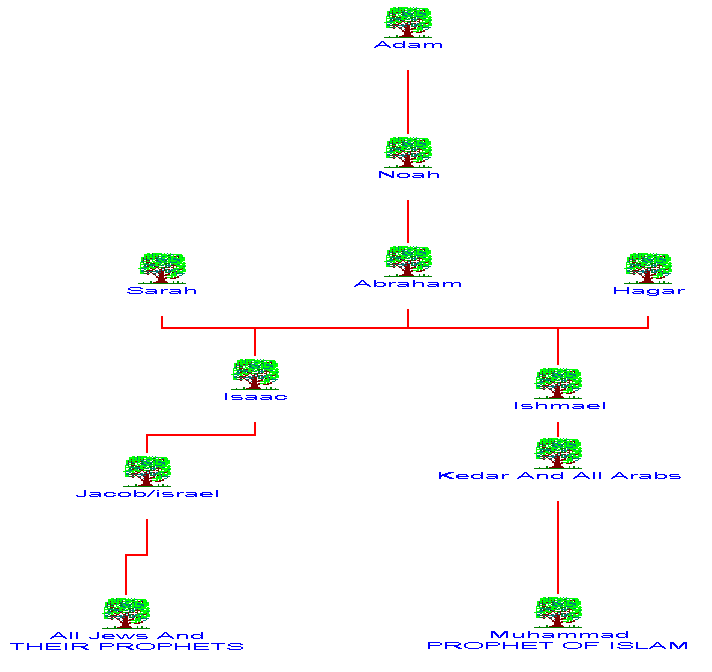
Fig. 3 Arabs and Jews. Semitic “brethren.”
In Genesis 16 we are told that after Hagar(pbuh) became pregnant with Ishmael, Sarah (pbuh)felt that Hagar despised her, so she dealt with her harshly untilshe was forced to escape from this harsh treatment
“And when Sarai dealt harshly with her, shefled from her face”
Genesis 16:6.
The angel of God then appeared before Hagar and toldher to return to Sarah and submit herself to her will and that”the Lord has heard thy affliction” and wouldreward her with a son called “Ishmael” (God hears) andwould multiply her seed exceedingly. Hagar willingly bowed tothe command of her Lord and returned and submitted herself toSarah. In A Dictionary of Biblical tradition in English literature,we read:
“The Jewish Haggadah identifies Ishmael asone of the six men who were given a name by God before their birth(Ginzberg, LJ 1.239).”
6.9: A rod out of the stem of Jesse
“And there shall come forth a rod out ofthe stem of Jesse, and a Branch shall grow out of his roots: Andthe spirit of the LORD shall rest upon him, the spirit of wisdomand understanding, the spirit of counsel and might, the spiritof knowledge and of the fear of the LORD;”
Isaiah 11:1-2
Once again, we have here a verse which has beenpopularlyinterpreted to apply to Jesus, and once again it must be statedthat although all Muslims believe in Jesus and in the prophesiesof him in the OT, still, this specific prophesy does not applyto him, why?
To understand this prophesy we need to study theverses carefully. These verses tell us that the rod (branch) whichshall grow out of the stem (trunk) of “Jesse” shallbe filled by God with wisdom, understanding, council, might, knowledge,and the fear of God. In other words, he shall be a statesman,a prophet and a judge. The obvious question that springs to mindis: Who was “Jesse”? In the Encyclopedia Biblica weread that Jesse is a contraction of Ishmael, or:
“Jesse, for Ishmael… The changes whichproper names undergo in the mouths of small children account fora large number of these particular abbreviations – who could guess,to take modern examples, that Bob and Dick arose out of Robertand Richard? … such forms as in ai were particularly commonin later times … and many more in the Talmud,which also exhibits various other kinds of abbreviation”
Encyclopaedia Biblica, Rev. T. K. Cheyne D.Litt D.D.,J. Sutherland Black M.A. LL.D., Vol. 3, under “Names,”p. 3292, item 52
Now, the reason why these biblical scholars havesaid this may not be readily apparent to us simply by readingthe English rendition of these two words, however, when theseChristian scholars went back and looked at the original Hebrewwords, that is when they realized it’s true meaning. Althougha complete understanding of why this is true would require a knowledgeof the Hebrew language, still, it is possible at least phoneticallyto see this even in the English language. Let us have a look.
In Hebrew, the word Ishmael is writtenas Yishma`e’l. It is pronounced {yish-maw-ale’}.
Similarly, in Hebrew, the word Jesse is written asYishay. It is pronounced {yee-shah’-ee}, or in Aramaic it is ‘Iyshayand pronounced {ee-shah’-ee}.
Thus, we begin to see, even in our phonetic Hebrewrendition, how these Christian Biblical scholars came to recognizethat just as “Dick” is a contraction of “Richard,”and “Bob” is a contraction of “Robert,” similarly,by studying the Hebrew words themselves, they found that {yee-shah’-ee}is indeed a contraction of {yish-maw-ale’}.
Isn’t it amazing that we have been told this notby Muslims, but by Christian scholars? Which Muslim “Moor”stood over these Christian scholars with a drawn sword and forcedthem to come to this realization? Out of the thousands upon thousandsof Hebrew names in the Bible, what drove these Christians to recognizethat Jesse is derived from Ishmael and not, forexample, from Judah, or Isaac, or Shem, or any ofthese other thousands upon thousands of Hebrew names? The oddsagainst it are astronomical if what the Qur’an said was false.Yet here we have it in black and white. Isn’t it amazing how withevery passing day the most learned among Christians scholars aredrawing closer and closer to Islam?
It is further interesting to note the following wordsof the authors of this same “Encyclopaedia Biblica”:They say: “In many cases the contraction is such as torender the discovery of the original form impossible.”… hmm.
The only “branch” from the stem of Ishmaelwho was a statesman, a prophet and a judge was prophet Muhammad(pbuh). The reason many people interpret this verse to apply toJesus (pbuh) is because he is claimed to be of the lineage ofking David, and Jesse was the name of the father of king David.However, why would this prophesy tie the coming prophet to thefather of David who was for all practical purposes a completelyunknown figure in the Bible? It would be much more logical tofollow the much more popular trend found elsewhere in the Bibleof associating Jesus with king David himself who was botha king and a prophet and a much more popular figure in the Bibleand much better known to anyone who reads it. In other words,what is so direly special about king David’s father that thisprophesy had to completely bypass the legendary prophet king Davidhimself in order to apply itself to his unknown father? The answeris that it was not meant to apply to the father of king Davidbut to a descendant of Ishmael the son of prophet Abraham.
It is further important to remember that insistingon tying prophet Jesus (peace be upon him) to a human lineagedescendant from king David shall ultimately result in a completenullification of the religion known today as “Christianity.”This is because if Jesus is the descendant of king David thenhe has a human father and his father is not God.
Some attempts have been made to insist that Jesuswas the physical Son of God and at the same time apply spiritualcontradictory human lineages to him such as Matthew 1 and Luke3 so that he can be the physical son of both David andGod. This, even though the Bible is quite explicit that the lineagemust be a “physical” and not a “spiritual”lineage. We find this stipulation spelled out quite clearly inthe Bible in:
- Acts 2:30 “Therefore being a prophet,and knowing that God had sworn with an oath to him, that of thefruit of his loins, according to the flesh, he would raise upChrist to sit on his throne;” and
- Romans 1:3 “Concerning his Son JesusChrist our Lord, which was made of the seed of David accordingto the flesh;”
Therefore, the only way that Jesus (pbuh) could bethe physical Son of God and also be the physicalson of king David “according to the flesh” is if hislineage from kind David passes through his (human) mother Mary(pbuh). However, if we were to read the two contradictory lineagesfound in Matthew 1 and Luke 3 we would find that both attemptto make his lineage pass through a human father. In oneit is “Joseph the son of Jacob” and in theother is “Joseph the son of Heli.” Such practices canonly hurt the message of Jesus (pbuh) rather than helping it.
6.10: Reference to moses, Jesus, andMuhammad (pbut) in that order
“And this [is] the blessing, wherewith mosesthe man of God blessed the children of Israel before his death.And he said, The LORD came from Sinai, and rose up from Seirunto them; he shined forth from mount Paran,and he came with ten thousands of saints: from his right hand[went] a fiery law for them.”
Deuteronomy 33:1
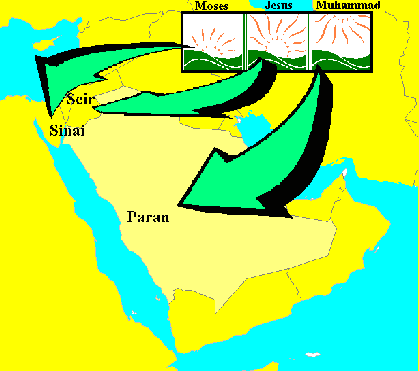
Fig. 8 The succession of the prophetsof God, like the rising sun.
This is a chronological succession of prophets whichis narrated through reference to location (see Fig. 8). This prophesyis reported at the end of Deuteronomy in association with thestory of the death of prophet Moses (pbuh). It wasa blessing and glad tidings bestowed by prophet Moses upon hisfollowers just prior to his death. It was designed to give hisfollowers hope upon the occasion of the passing of their prophetthat God is not abandoning them, rather, the best is yet to come,and He shall continue to bless mankind with His guidance and Hislight.
Sinai is a reference toMoses (pbuh). It is an obvious reference to mountSinai where Moses (pbuh) received his revelation (Exodus 19:20).
Seir is a reference toJesus (pbuh). It is usually associated with the chain of mountainsWest and South of the Dead Sea extending through Jerusalem, andBethlehem, the birthplace of Jesus (pbuh). Itwas later extended to include the mountains on the East side aswell (Dictionary of the Bible, John L. McKenzie, S.J., p. 783).However, Seir is also identified with the Northern borderof the tribal territory of Judah and usually with Saris near Kesla(Chesalon), barely nine miles West of these two cities (The EerdmansBible Dictionary, by Allen C. Myers, pp. 921-922, and The Interpreter’sDictionary of the Bible, V4, p. 262) Prophet Moses(pbuh) never in his lifetime entered Palestine, and thus, thiscould not be a reference to him.
As we have already seen in section 6.4, Paranis a reference to the city of Makkah in the ArabianPeninsula. The wilderness of Paran is where Abraham’swife Hagar and his eldest son Ishmaelsettled (Genesis 21:21) in the Arabian desert, specifically, Makkah.Makkah is, of course, the capital of Islam in Arabia and the birthplaceof Mohammed (pbuh). Mount Paran is the chain of mountains in thatsame region which the Arabs call the “Sarawat mountains”.Muhammad (pbuh) received his first revelation in the cave of “Hira’a”located in these mountains (see Fig. 9). Jesus never in his lifetraveled to Paran. Mohammed, however, was born there. He becamethe prophet of Islam there. And it was the capital of the Islamicreligion in that day and this. No prophet of the Bible ever camefrom the Arabian city of Paran (Makkah). Prophet Muhammad (pbuh)is the only prophet of God who has ever fulfilled this prophesy.
We also read in verse 33:2 that a fiery law shallissue forth from the right hand of the prophet from Paran.Muhammad (pbuh) did indeed come with a new law called the Shari’ah.The reference to “right” hand is a reference to strength,justice, and guidance. In Islam, all clean and desirable actionsare performed with the “right” hand (eating, shakinghands, etc.), while all other actions are done with the left hand(washing one’s private parts, picking up garbage, etc.). In theQur’an, the good are described on the Day of Judgment as receivingtheir book of deeds in their “right” hands, while thewicked receive theirs in their “left” hand. This canbe seen for example in Al-Haqah(69):13-37. This general attitudeis also conveyed in the Bible. We read:
“Biblical phrases referring to the righthand reflect a widespread human cultural attitude, namely therecognition that for most people the right hand is both strongerand more adept than the left, and is the hand with which manytasks are instinctively undertaken … Eccl. 10:2 links ‘a wiseman’s heart’ with his right hand, and ‘a fool’s heart’ with hisleft. When the Son of Man separates the sheep from the goats atthe Last Judgment, it is to the damned ‘on the left hand’ thathe says, ‘Depart from me, ye cursed, into everlasting fire’ (Matt.25:41) …The right hand is often mentioned as a symbol of strength,both for human beings and anthropomophically for God (e.g. Job40:14; Isa. 48:13)”
A Dictionary of Biblical Tradition In EnglishLiterature,David Lyle Jeffrey, p. 442.
This fiery law that shall issue from the right handof the prophet from Paran will be a new lawfor the children of Israel and not the same one they had beenpracticing in the time of Moses (pbuh) and later.This is held out by simple logic; if I already own something,then I can not say that my neighbor shall bring “for me”this same “something” which I already own. In such acase, he would have “brought” nothing and it would havebeen more logical to say he would “confirm” the preexistentlaw. No prophet of the Bible ever in his lifetime either camefrom Paran or preached the replacement of the law of Moses (pbuh).Even Jesus (pbuh) came to confirm and reinforce the law of Moses(Matthew 5:17-19), as explained in detail in chapter one. Muhammad(pbuh) is the only prophet of God who fulfilled both of theserequirements.
However, if we look closely, we will find that theprophesy contains one more requirement. It tells us that thisprophet from Paran who will bring a fiery new lawshall come with 10,000 saints. Once again,two years before the death of prophet Muhammad (pbuh), in theyear 630 AD, he lead 10,000 of his followers to their final anddecisive victory against the pagans of Makkah (see chapter 10).This was one of the most bloodless victories of all history. TheMuslims took control of Makkah, the capital of paganistic Arabia,virtually without a single casualty. Upon entering Makkah victorious,Muhammad did not take it’s inhabitants as prisoners. Even thoughthese people had been torturing himself and his companions, andkilling many of them over many years, still, Muhammad commandedthat they not be tortured, nor should retribution be sought againstthem. Rather, he pardoned them all and set them free. Most ofthem entered into Islam.
Once again, we find that prophet Moses(pbuh) was appointed seventy very close and devout followers (Exodus24:1-9, Numbers 11:16-25). Jesus (pbuh) was appointed eleven veryclose and devout followers (if we were to exclude Judas), as seenin Matthew 10:1-5, Mark 3:14-19, etc. Prophet Muhammad, once again,was the only one to fulfill this requirement. Mr. Kais Al-Kalbiasks the question:
“When this verse Deut 33:2 was translatedfrom Hebrew to English, the phrase ‘10,000 saints10,000saints’ was kept the same. But when this verse was translatedfrom Hebrew to Arabic, the phrase ‘10,000 saints’ was intentionallychanged to ‘holy valley’, why?”
Prophet Muhammad the last messenger in the Bible,third edition, Kais Al-Kalbi, pp. 231-232.
The wording also bears out this chronologicalsuccessionof prophets. Came: daybreak and the arrival of the sunin the morning. Rose up: like the light of dawn. Shinedforth: Mid-day sun which lights up the Earth from East toWest. Islam has indeed come to shine all over the earth as themid-day sun. It is estimated to have 1.2 billion adherents throughoutthe globe, and according to Western sources, it is said to bethe fastest growing religion in the world today.
“This day have I (God) perfected your religionfor you, completed My favor upon you, and have chosen for youIslam as your religion.”
The noble Qur’an, Al-Maidah(5):3
6.11: God did not kill Muhammad (pbuh) forspeaking in His name
In Deuteronomy 18:20 we read
“But the prophet, which shall presume tospeak a word in my name, which I have not commanded him to speak,or that shall speak in the name of other gods, even that prophetshall die.”
Muhammad (pbuh) spoke not just a single word, butdictated a whole book in God’s name. For twenty three years hespoke exclusively in the name of God Almighty. He was given onehundred and fourteen chapters, all of which were, and are to thisday, recited day after day in God’s name. Chapters in the Qur’anbegin with the words “In the name of God, the Gracious,the Merciful.” Yet he did not die, but lived tofulfill his message completely. He himself even narrated in thename of God a similar verse in the Qur’an:
“And if he (Muhammad) had invented falsesayings in Our (God’s) name, We would have taken him by the right,then We would have severed from him his aorta, and there is noneamong you who could have held Us off from him”
The noble Qur’an, al-Haaqah(69):46
(Remember that theplural form of this verse is theArabic plural of respect, not the Christianplural of “Trinity,” as seen in chapter14). If the claims of some are true: That Muhammad (pbuh) wasan impostor, then did God go to sleep for twenty three years?Of course not! He knew full well what Muhammad (pbuh) was claiming.If he was not telling the truth, why did God not kill him?Why did he allow him to perpetrate a lie that would span fourteencenturies, and eventually come to cover the globe?
6.12: Glorifies Jesus(pbuh)
“Beloved, believe not every spirit (prophet),but try the spirits whether they are of God: because many falseprophets are gone out into the world. Hereby know ye the Spiritof God: Every spirit that confesseth that Jesus Christ is comein the flesh is of God: And every spirit that confesseth not thatJesus Christ is come in the flesh is not of God: and this is that[spirit] of antichrist, whereof ye have heard that it should come;and even now already is it in the world.”
1 John 4:1-3
This one is very easy to understand: Every prophetwho does not confess that Jesus (pbuh) came in the flesh was notsent by God. He is a false prophet. But any prophet that confessesthat Jesus (pbuh) came in the flesh was sent by God. Whatdoes the Qur’an and Muhammad (pbuh) say about Jesus (pbuh)? Theysay that a Muslim is not a Muslim if he does not believein Jesus (pbuh), in his miraculous birth, in his giving life tothe dead by God’s permission, in his healing of the lepers andthe blind by God’s permission, in his piety and chastity, in histruthfulness, and in the fact that he was the Messiah (the Christ).The Qur’an contains many verses to this effect. For example, inA’al-Umran(3):40 we read:
“And the angles said ‘O Mary, Allah givesyou glad tidings of a Word from Him, his name is Messiah, Jesusson of Mary, High honored in this world and the next, of thosenear stationed to Allah.”
So now we must ask: Has Muhammad (pbuh) fulfilledthis criteria or not? This is all the more remarkable when itis contrasted with the popular opinion of the time such as theclaims of the Jews regarding Jesus (pbuh) and his mother Mary(pbuh) as seen in part nine of section 6.3. As a matter of fact,Jesus is referred to by name in the Qur’an fully sixteen times,as compared to only four places in the whole Qur’an where Muhammad(pbuh) is mentioned by name.
No other religion in the whole world outsideChristianitymakes it an article of faith for its adherents to believein, love and honor Jesus except Islam. Reading the Qur’an bearstestimony to that (see for example (19):16-36, A’al-Umran(3):33-68,Al-Nissa(5): 72-77). Here we have the testimony of Jesus himselfin the Bible that Muhammad was a prophet of God. If Jesus’words carry any weight at all with us then we must concede thatMuhammad was a prophet of God and therefore spoke in the nameof God.
Further, Jesus gives a second criteria to judge thetruthfulness of a prophet. He says:
“Beware of false prophets, which come toyou in sheep’s clothing, but inwardly they are ravening wolves.Ye shall know them by their fruits. Do men gather grapes of thorns,or figs of thistles? Even so every good tree bringeth forth goodfruit; but a corrupt tree bringeth forth evil fruit. A good treecannot bring forth evil fruit, neither [can] a corrupt tree bringforth good fruit. Every tree that bringeth not forth good fruitis hewn down, and cast into the fire. Wherefore by their fruitsye shall know them.”
Matthew 7:15-20
So, according to the testimony of Jesus, if we wishto know whether prophet Muhammad (pbuh) was a true prophet ornot we need to see what sort of “fruit” his messageproduced. A moderately detailed description of these fruits canbe found in chapters 9 and 10, however, let us listen to the wordsof the Hindu Professor K. S. Ramakrishna Rao. He says:
“Historical records show that all contemporariesof Muhammad, both friend and foes, acknowledged the sterling qualities,the spotless honesty, the noble virtues, the absolute sincerity,and the absolute trustworthiness of the apostle of Islam in allwalks of life and in every sphere of human activity. Even theJews and those who did not believe in his message accepted himas arbitrator in their personal disputes on account of his scrupulousimpartiality”
Muhammad the Prophet of Islam, K. S. RamakrishnaRao, p. 13
(Please read chapter nine for more on the fruit ofthe message of Muhammad, pbuh)
6.13: The rejected stone
From the promise in Genesis 21:13-18, Jesus (pbuh)spoke of the kingdom of God being taken away from the Jews andgiven to the rejected stone of
“Hear another parable: There was a certainhouseholder, which planted a vineyard, and hedged it round about,and digged a winepress in it, and built a tower, and let it outto husbandmen, and went into a far country: And when the timeof the fruit drew near, he sent his servants to the husbandmen,that they might receive the fruits of it. And the husbandmen tookhis servants, and beat one, and killed another, and stoned another.Again, he sent other servants more than the first: and they didunto them likewise. But last of all he sent unto them his son,saying, They will reverence my son. But when the husbandmen sawthe son, they said among themselves, This is the heir; come, letus kill him, and let us seize on his inheritance. And they caughthim, and cast [him] out of the vineyard, and slew [him]. Whenthe lord therefore of the vineyard cometh, what will he do untothose husbandmen? They say unto him, He will miserably destroythose wicked men, and will let out [his] vineyard unto otherhusbandmen,which shall render him the fruits in their seasons. Jesus saithunto them, Did ye never read in the scriptures, The stone whichthe builders rejected, the same is become the head of the corner:this is the Lord’s doing, and it is marvelous in our eyes? Thereforesay I unto you, The kingdom of God shall be taken from you, andgiven to a nation bringing forth the fruits thereof. And whosoevershall fall on this stone shall be broken: but on whomsoever itshall fall, it will grind him to powder. And when the chief priestsand Pharisees had heard his parables, they perceived that he spakeof them. But when they sought to lay hands on him, they fearedthe multitude, because they took him for a prophet.”
Matthew 21:33-46
Indeed, prophethood was transferred from the nationof the Jews to the Jews’ rejected stone,the nation of the Arabs (Ishmael’s nation, the nationof Muhammad pbuh). Some have misunderstood this verse to referto Jesus (pbuh) as the rejected stone. This can be seen to bea misinterpretation by simply reading the above verse carefully.Jesus (pbuh), in this parable is obviously drawing a parallelbetween the actions of the Jews and their killing and stoningof previous prophets, or “servants” in this verse.
“Wherefore ye be witnesses unto yourselves,that ye are the children of them which killed the prophets. Fillye up then the measure of your fathers”
Matthew 23:31-32
In other words, Jesus (pbuh) is speaking to the Jewsas a racial entity. The men standing before him did not kill,beat, and stone the previous prophets, rather their forefathersdid. But as a nation, they are all responsible. They are followingin their forefathers footsteps. What is Jesus (pbuh) telling theJews? He is telling them that they, as a nation, have abused theirposition, and therefore, God Almighty will take His kingdom fromthe Jews and give it to a different “NATION.”
How will we know which nation God’s prophethood willbe transferred to? The verse states that it will be given to thenation of the “rejected stone.”Jesus (pbuh) was indeed rejected by the Jews, but he is not theone intended. Why? Because Jesus was a Jew. His disciples werealso Jews. Jesus (pbuh) himself even said quite clearly:
“But he answered and said, I am not sentbut unto the lost sheep of the house of Israel”
Matthew 15:24
We also read
“Then saith the woman of Samaria unto him,How is it that thou (Jesus), being a Jew, askestdrink of me, which am a woman of Samaria?”
John 4:9
He even told his own twelve apostles:
“Go not into the way of the Gentiles (non-Jews),and into any city of the Samaritans enter ye not: But go ratherto the lost sheep of the house of Israel. And as ye go, preach,saying, The kingdom of heaven is at hand”
Matthew 10:5-7
To further emphasize this Jesus (pbuh) is quotedas saying:
“But he (Jesus) answered and said, It isnot meet to take the children’s (Jews) bread, and to cast [it]to dogs (Gentiles).”
Matthew 15:26
Is the kingdom of God going to be taken fromthe Jews and given to the Jews?
It is important to notice that the verses whereinJesus (pbuh) is alleged to have commanded his followers to preachto the whole world (such as Mark 16:15) are either now consideredlater “insertions” because they are nowhere to be foundin the most ancient manuscripts available today (those of thefourth century) such as the Sinaitic Manuscript, the Vatican #1209,and the Armenian version, or refer only to preaching to “allnations” (such as Luke 24:47) which, in order to not conflictwith the above verses must be understood to refer to the twelvenations of Israel. This is exactly what the Qur’an says. An exampleof a reference to the tribes of Isaac as “nations”can be seen in Genesis 17:16. There are other examples, such asthe referral to the twelve tribes of Ishmael astwelve “nations” in Genesis 25:16, the referral to thetribes of Ham in Genesis 10:20, the tribes of Shem in Genesis10:31, the tribes of Noah in Genesis 10:32, and the tribes ofAbraham in Genesis 17:5 ……etc.
Well, what do Christian scholars have to say aboutthe word “all” in “all nations”?If we go back to one of their foremost references, Strong’sconcordance,and look up this word and it’s meaning we will find that the originalGreek word is “pas” {pas}. The following descriptionis given for this word:
“…..’The whole world has gone after him’Did the whole world go after Christ? ‘Then went all Judea, andwere baptized of him in the Jordan’. Was all Judea or all Jerusalembaptized in the Jordan? ‘ye are of God little children’, ‘andthe whole world lieth in the wicked one’, Does the whole worldthere mean everybody? The words ‘world’ and ‘all’ are used insome seven or eight senses in the Scripture, and it is very rarelythe ‘all’ means all persons, taken individually….”
Strong’s Concordance, C.H. Spurgeon from a sermonon Particular Redemption.
Mr. Tom Harpur, says:
“Most of Jesus’ ministry took place in theNorthern district of Israel, the Galilee, and it is clear he thoughtof his mission as directed to the Jews, not to the world at large”
For Christ’s Sake, Tom Harpur, p. 35.
In the tenth year1 of Muhammad’s (pbuh)prophethood, Allah Almighty sent Gabriel with a beast called Al-Buraqin order to take prophet Muhammad (pbuh) from the “InviolableMosque” in Makkah to the “Furthest Mosque” in Palestine(currently known as Israel). He was then taken up into the heavenswhere he saw many of the signs of the Almighty and then he returnedto Makkah. All of this happened in one night which was later namedthe night of “Israa and Miraj” (Travel by night andascension)*. After this deed was accomplished, Allahrevealed to Muhammad (pbuh) the first verses of the chapter ofAl-Israa(17). Scholars of the Qur’an from long ago noticed thatwhile the first verse speaks about this occurrence explicitly,the following verses suddenly begin to speak about the childrenof Israel, the scripture that was sent to them by Allah, and howthey shall bring corruption into the earth. These scholars concludedthat the verses were revealed in order to confirm the transferof Allah’s covenant from the children of Israel to the Islamicnation and to reveal the reason for this decree.
Please read in this regard the parting words ofprophetMoses in the Old Testament when he spoke to the children of Israelon his deathbed:
“And it came to pass, when moses had madean end of writing the words of this law in a book, until theywere finished, That Moses commanded the Levites(Jews), which barethe ark of the covenant of the LORD, saying,Take this book of the law, and put it in the side of the ark ofthe covenant of the LORD your God, that it may be there for awitness against thee. For I know thy rebellion, and thy stiffneck: behold, while I am yet alive with you this day, ye havebeen rebellious against the LORD; and how much more after my death?Gather unto me all the elders of your tribes, and your officers,that I may speak these words in their ears, and call heaven andearth to record against them. For I know that after my death yewill utterly corrupt [yourselves], and turn aside from the waywhich I have commanded you; and evil will befall you in the latterdays; because ye will do evil in the sight of the LORD, to provokehim to anger through the work of your hands.”
Deuteronomy 31:25-29
On pages 24-25 of “The five Gospels,” writtenover six years by 24 Christian scholars from a number of Westernuniversities, we read
“Christian conviction eventually overwhelmsJesus: He is made to confess what Christians had come to believe…Thecharge to announce the good news to the whole world (Mark 13:10and Matthew 28:18-20) was developed by Paul, Mark and others inthe early days of the new movement.”
This book has already demonstrated in chapter onehow “Saint Paul” was the one primarily responsible forthe corruption of the message of Jesus (pbuh).
Logic too verifies the Christian recognition that”the great commission” of the above verses was a laterinsertion of the church and not the words of Jesus (pbuh). Thisclaim can be demonstrated to be supported by logic by observingthat had Jesus (pbuh) indeed commissioned his apostles to preachto the whole world, as claimed in the above verses, then obviouslythey would not differ on this matter later on. However,the Bible tells us that long after this alleged commission, “St.Paul” decided to preach to the Gentiles (non-Jews). We aretold in Galatians 2:13-15 that this resulted in a fierce debateand a great difference of opinion between the apostles and Paul(the apostles Peter the Rock, James the son of thunder, and Barnabason one side, and Paul on the other). This would not have beenthe case if Jesus (pbuh) had explicitly commanded his apostlesto preach to the gentiles and this verse was not a later insertion.
We also notice that Paul only refers to his ownphilosophyand opinion in his charge of “hypocrisy”against the apostles, never does he quote the alleged commandof Jesus (pbuh) wherein he is claimed to have publicly commandedthe twelve disciples to preach to the Gentiles. If this versewas not a later insertion, then St. Paul could have very simplydefended his point of view by simply quoting Jesus (pbuh). Therewould be no need for him to say anything more. Thus, these versesare recognized by Christian theologians as later insertions ofthe Church and not the words of Jesus (pbuh). Since this topicwould take up too much time and space to get into here I willsuffice with this sampling for now (see section 1.2.2.1 for moreon this topic).
However, there is another problem which preventsJesus (pbuh) from being the one intended. If Jesus (pbuh) wasindeed the one intended by this verse then we must apply the restof it to him also. We read….
“Jesus saith unto them, Did ye never readin the scriptures, The stone which the builders rejected, thesame is become the head of the corner: this is the Lord’s doing,and it is marvelous in our eyes?.. And whosoever shall fall onthis stone shall be broken: but on whomsoever it shall fall, itwill grind him to powder”
Matthew 21:42
This rejected stone of the Jews,the nation of Ishmael, would indeed come to be victoriousagainst all comers. The Islamic nation, through the guidance ofAllah, and which fought in His name, grew till it stretched fromChina to Spain and was victorious against all pagan superpowers(including the Persians and the Romans) of it’s time. It thenwent on to raise science to new heights. There was not a singlenation that was able to stand in the way of the Muslims who foughtin the name of God and died in His cause. Both the Jews and theChristians were either subjugated by the Roman pagans or tookthem as allies. Jesus (pbuh), could not be this “rejectedstone” because he did not fall on the Jews or the Romansand “grind them to powder,” nor did they fall on himand become “broken.” Quite the contrary, the Bible allegesthat Jesus (pbuh) was arrested, beaten, spat on, whipped, kicked,mocked, cut, laughed at, crucified, and then sent to hell forthree days. In the mean time, the Romans and Jews went back tobusiness as usual.
There is a distinct difference between saying thatJesus (pbuh) died for someone’s sin and between saying he fellon nations and ground them to powder, and nations fell on himand were broken. This is the profile of a military leader andnot a meek sacrificial lamb of God who tells his followers:
“Ye have heard that it hath been said, Aneye for an eye, and a tooth for a tooth: But I say unto you, Thatye resist not evil: but whosoever shall smite thee on thy rightcheek, turn to him the other also. And if any man will sue theeat the law, and take away thy coat, let him have [thy] cloak also.And whosoever shall compel thee to go a mile, go with him twain”
Matthew 5:38-41
and also “Then saith he (Jesus) unto them,Render therefore unto Caesar the things which are Caesar’s; andunto God the things that are God’s.”
Matthew 22:21
Whilem on the other hand, the Qur’an taught Muhammad(pbuh) and his followers:
“And fight against them until persecutionis no more and religion is for God alone. But if they desist thenlet there be no hostility except against wrongdoers”
Al-Bakarah(2):194.
Many Christians will object “No, Jesus (pbuh)was the one intended.” They will explain that the verse isnot meant to be taken literally but in an abstract sense.Jesus was prophesying himself. Thus, Jesus did indeed fall onthe sinners and grind them to powder and they did fall on himand become broken. In other words, matters of FAITH andnot WAR are intended. This is a valid theory, so let us test it:
Those who make these claims will themselves readilyacknowledge that the “son of the householder”is Jesus (pbuh) but then they go on to tell you that “therejected stone” is also Jesus(pbuh). So:
- If Jesus (pbuh) is both the “son of thehouseholder” and also “therejected stone,” then one would expectthere to be some sort of hint in the text associating one withthe other. For example, the text could have combined the two termsinto “the rejected son.” We notice that this is notthe case.
- If the “rejected stone”is an alias for a character previously mentioned in the text,and not a completely new character, then what arguments fromthe Biblical text can we present that can not just aseasily be applied to the other servants (prophets) who were chasedaway or killed, or even the “householder” (God) himself?In other words, any arguments which are presented from thetext will be equally valid for any of the many other prophetswho were beaten, stoned, and killed by this nation.
- In this parable, the first servant (prophet)was beaten and was taken out of the picture. The second was killedand was also taken out of the picture. The third was then stonedand taken out of the picture. Then the son was killed and takenout of the picture. Where does the text indicate that the “sonof the householder” has comeback to life while the other “servants” remain deador chased away? Where does the text state the “son”shall come back to life but the other dead servants shall not?
- The goal of a parable is always to describe amatter in “real-life” terms which can be seen in ourevery day lives so that we can better understand the point beingmade. IN REAL LIFE, would we expect a dead son of a householderto come back to life and “miserably destroy”all the husbandmen who killed him, or would we expect the householderto send an army to wipe out the husbandmen who killed his sonand servants?
- The “Householder” in this parable refersto a non-abstract God. The “servants” refer to physicalprophets. The “Son of the Householder” refers to a physicalJesus (pbuh), the beating, killing, and stoning of the servantsrefer to a physical beating, killing, and stoning of the prophets,even the vineyard refers to a physical kingdom of God. But now,in order to make this rejected stone referto Jesus (pbuh) we must claim that the “grinding and breaking”refer to an ABSTRACT grinding and breaking, thus Jesus(pbuh) is the one intended. Notice how the verse is made to conformto our preconceived concepts and not the other way around?
- If the “grinding and breaking” referredonly to an other-worldly reward for all who do not believe andnot an earthly defeat (followed by one in the hereafter), thenwhy did Jesus (pbuh) use the words: “whosoever shall FALLon this stone” and not “whosoever shall REJECT thisstone.” This would more accurately describe acts of BELIEFand not WAR. Also, if acts of BELIEF were meant and not acts ofWAR then there would be no need for “on whomever it shallFALL” otherwise it would be implied that Jesus was forcingpeople to disbelieve.
For example, if a Jew did not believe in Moses(pbuh), would it be more accurate to say: “He REJECTED Moses”or to say “He FELL upon Moses”? If Pharaoh sent an armyto kill Moses (pbuh) and the Jews, would it be more accurate tosay “Pharaoh FELL upon Moses” or “Pharaoh REJECTEDMoses”? These verbs were carefully chosen for a reason. Indeed,if we were to go back to the Bible itself, we would find thatthe term “fall on” is in fact used to convey the generalmeaning of “fight”, or “to wage war”. Forexample, in Judges we read:
“And they said unto him, We are come downto bind thee, that we may deliver thee into the hand of thePhilistines.And Samson said unto them, Swear unto me, that ye will not fallupon me yourselves.”
Judges 15:12
And “And the men were afraid, because theywere brought into Joseph’s house; and they said, Because of themoney that was returned in our sacks at the first time are webrought in; that he may seek occasion against us, and fallupon us, and take us for bondmen, and our asses.”
Genesis 43:18
And “And they said, The God of the Hebrewshath met with us: let us go, we pray thee, three days’journey into the desert, and sacrifice unto the LORD our God;lest he fall upon us with pestilence, or with the sword.”
Exodus 5:3
And “Then Zebah and Zalmunna said, Rise thou,and fall upon us: for as the man is, so is his strength. And Gideonarose, and slew Zebah and Zalmunna, and took away the ornamentsthat were on their camels’ necks.”
Judges 8:21
There are countless other examples, however, theseshould suffice. Thus, we see that the prophesy is for one whowill wage war against those who killed and persecuted the prophetsof God. This war against the “killers of the prophets”by this messenger of God would result in “miserably destroying”these transgressors. This prophesy was fulfilled by Muhammad (pbuh)who began by signing pacts and treaties with the Jews. However,after they reneged on their pacts and broke their promises, hefought against them, utterly destroyed them, and finally expelledthem from Arabia for all time (see chapter 10).
6.14: Other Prophesies
There are many other points which could be broughtup in this comparison, however. Such prophesies include Daniel2 which history has shown us to have been fulfilled only by theIslamic nation. For those readers who would like to read moreon these matters, I recommend the books:
- “Prophet Muhammad the Last Messenger inthe Bible” by Kais Al-Kalbi.
- “Mohammed A Prophecy Fulfilled,” byH. Abdul Al-Dahir
- “Muhammad in the Bible”, by Professor`Abdul-Ahad Dawud.
- “Muhammad’s Prophethood: An Analytical View,”By Dr. Jamal Badawi
- “Muhammad in the Bible,” Dr. JamalBadawi
- “The Sources of the Qur’an: A Critical Reviewof the Authorship Theories,” by Hamza Mustafa Njozi.
I shall leave it up to the interested reader to studyIslam, Muhammad, and the Qur’an, and arrive at their own conclusionwith regard to Muhammad (pbuh) having fulfilled all of the requirementsof the coming “Second Messiah”/”Paraclete”/Prophet.
It is not at all uncommon in the West for peopleto be known by two names. For examples, a man called William wouldbe called “Bill” by his friends, Robert would be called”Bob”…etc. In a similar manner, Muhammad (pbuh) wasknown by two names: “Muhammad” and “Ahmed.”I mention this to clarify the following verse:
“And when Jesus son of Mary said: O Childrenof Israel! verily! I am the messenger of Allah unto you, confirmingthat which was (revealed) before me in the Torah, and bringinggood tidings of a messenger who cometh after me, whose name isAhmed(the praised one). But when he came to them with clear proofs,they said: This is clearly magic”
The noble Qur’an, Al-Saf(61):6
It is one thing for someone to make a clever playon words and twist their meaning to suite his fancied desire sothat they would refer to Muhammad (pbuh). It would be much harderto do so with more than ten. These verses lend themselves so easilyto Muhammad (pbuh) without having to resort to abstraction andapplying them to the Holy Ghost or other supernatural meanings,or to combining three prophesies into only two.
“Then We sent our messengers in succession.Whenever there came to a nation their messenger they called hima liar; so We caused them to follow one another (in destruction)and We made them tales (told to others). So away with a peoplewho will not believe!”
The noble Qur’an, Al-Muminoon(23):44.
“Alas for (My) servants! There comes nota messenger unto them but they ridicule him.”
The noble Qur’an, Ya-seen(36):30.