
Table of Contents
Chapter 10: The life of Muhammad
“Verily! this Qur’an guides unto that whichis straightest, and gives glad tidings unto the believers who do good worksthat theirs will be a magnificent reward.”The noble Qur’an, Al-Isra(17):9Note: The main sources of the following information were the books “Al-Seerahal-Nabawiyya” by Ibn Hisham, and “Al-Seerah al-Nabawiyya”by Abu-AlHasan Al-Nadwi. Other sources were used as well. The lands surrounding the Arabian peninsula:In the sixth century AD, at the time of the birth of Muhammad(pbuh), the Arabian Peninsula was surrounded by a number of great empires.These empires were in a state of constant conflict, waging wars and claimingterritories. The boarders of nations were constantly being redrawn, and attimes whole nations would crumble under the advancing forces of a more viciousand powerful neighbor. However, in an age when the people of all of thesenations had become accustomed to countless rulers, conquerors, philosophies,and religions, throughout all of this, Allah Almighty saw fit to protect theArabian peninsula from these forces and allow it’s inhabitants to roam free,with great pride in their freedom, never bowing to man-gods or rulers whoclaimed to be “incarnations” of mythological gods such as had becomethe fate of the Persians, the Romans, the Hindus, and many other nationssurrounding them. Although steeped in paganism and idol worship, theirs was asimplistic and very basic sort of paganism as compared to the infinitely morecomplex and multifaceted paganism of the multi-cultured nations surroundingthem, their religious philosophies, and their untold rituals.The situation the Roman empire has been dealt with in some detail inprevious chapters, so it will only be dealt with very briefly here (seechapters 1-3).The Roman empireThe situation the Roman empire was far from enviable. The ByzantineEmpire (the eastern part of the later Roman Empire), became a land of cripplingtaxation and rampant bribery. The citizens had become so frustrated with theirmiserable condition that civil unrest and rioting became commonplace. In theyear 532C.E., during the rule of Justin I, only one single such riot resultedin the death of over thirty thousand citizens in the capital of Costantinople. During this period, the amassing of material wealth and money by anymeans possible became a virtual obsession. The religious elite had becomeseverely intolerant of unconformance to their beliefs and this resulted inmassive bloodshed and campaigns of persecution. The rulers immersed themselvesin all manner of luxury and indulgence, caring little what the cost of theirentertainment might happen to be upon the citizens. Recreation and amusementconsisted of blood sports of the utmost viciousness. Up to 80,000 people at atime would attend these events in huge coliseums in order to amuse themselveswatching battles to the death at times between men and men, or at othersbetween men and lions or other man-eating carnivores.Egypt supplied both the grain that fed Rome and much of thegovernment’s revenue. The empire sucked this lush and fertile farm land dryunder crippling taxation, tyrannical rule, and religious persecution in orderto maintain the extravagant lifestyles of the elite ruling class. This sadstate of affairs was no better in Syria which was ruled with an iron fistresulting in taxation so severs that the citizens found no recourse but to selltheir children into slavery in order to pay their taxes. 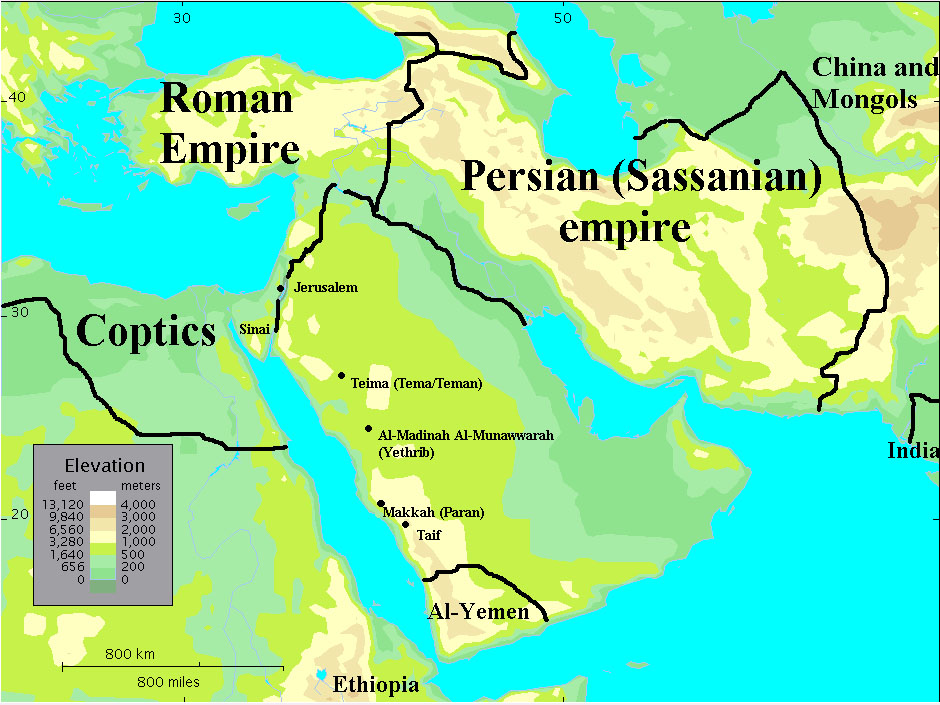 Map 1 Middle-easternregion during sixth century C.E.The Iranian empireZoroastrianism was the official religion of theSassanian empire during this period as it had been the faith of the Persiankings since it was founded in the seventh century BC by Zoroaster (orZarathusthra). In ancient Iran, two groups of gods were worshipped, the Ahurasand the Daevas. The message of Zoroaster was that Ahura Mazda, the Wise Lord oflight, was the sole creator and lord of the world and that the worship of theDaevas was the worship of darkness and evil. Other ancient mythological godswere later revived throughout this land, the most noteworthy of them being Mithra(associated with the sun), and Anahita (associated with water and fertility) inaddition to Ahura Mazda and his evil adversary Ahriman. The sacred literatureof Zoroastrianism is found in the Avesta, only a small portion of which remainstoday.The followers of this religion were required to worship the sun fourtimes a day in addition to the worship of the moon, fire and water. A complexcollection of rituals and practices were associated with these gods. Thisreligion was modified later by such as Mani (Manes), c.216-c.276 who called formonasticism and celibacy, and Mazdak (fifth century AD), who called for asocialistic group ownership of both money and women. People would enter intoone another’s homes, lay claim to their property and wealth and take libertieswith their women. Unemployment and disenchantment prevailed, and the citizenswere utilized by their rulers as cheap fodder for their armies. In theirdesperate search for a meaning for their pitiful existence these citizensexperimented with every conceivable philosophy from Eicureanism to monasticismand everything in-between. All of this eventually lead to the development ofvast rifts between the different levels of this society.During this period, bandits would sack the palaces of the rich,pillage and loot them and lay claim to the women. These new land owner’signorance in matters of farming eventually lead to the ruin of the farm land.So disenchanted did the people become with the tyranny and abuse of theirrulers that it later lead to a popular revolt by the farmers.The rulers of this empire ascended the throne of their fathersthrough inheritance, ruling with an iron hand, crippling taxation, and thetheory that this ruler was a god, the descendant of gods. This ruler wouldsurround himself with all manner of rare and precious possessions includinggold, rare animals, precious jewelry, fine clothing, exquisite furniture,imperial palaces, endless slaves, and delicate cuisine. Their life was indeedthe stuff that fairytales were made of, and it has been recorded that when thisregime finally fell before the Islamic empire, their ruler Yazdegird III (r.632-51) fled his land with one thousand cooks, one thousand musicians, onethousand trainers for his tigers, one thousand hawk trainers, and other membersof his royal staff, all the while considering himself to be in a very miserableand pitiful state of affairs. IndiaIn ancient times, this land had been the birthplace of many greatadvances in mathematics, astronomy, medicine, philosophy, and many otherdisciplines. However, over the centuries, a steady decline in moral values andreligious knowledge eventually lead in the sixth century C.E. to what manyhistorians consider to be it’s lowest state of decline.During this period nakedness became commonplace even in the temples.Women became public property and changed hands through gambling. If a woman’shusband were to die her existence would lose all meaning and remarriage wasprohibited for her for the rest of her existence. Higher levels of societydeveloped the ritual of “Seti” which required a widow of a noblemanto burn herself to death as a sign of faithfulness to her deceased husband.The Aryan invaders and Brahmans developed afour-level classification for society called the Caste system, it consisted of:1) The religious elite, or priests, called the “Brahmins”.They were considered superior to all others and sinless.2) The Ksatriyas, or warriors and rulers;3) The Vaisyas, or merchants and farmers;4) The Sudras, or peasants and laborers.There was also a fifth class called “Panchamas”, orUntouchables. They include those whose occupations require them to handleunclean objects. It is speculated that the Untouchables were originallyassigned such lowly tasks because of their non-Aryan origins. The law statedthat if an untouchable stretched out his hand or his stick against a Brahmanthen his hand would be chopped off. And if he kicked a Brahman then his legwould be severed. And if an Untouchable claimed to teach a Brahman then hewould be made to drink boiling oil. Under their law the punishment for thekilling of an untouchable was equal to that of the killing of a frog, a crow,an owl, a cat, or a dog. The Untouchables were also forced to live outside thecity.The Sudras were considered to have been created from the feet of thecreator of the heavens and their purpose in life was to serve the higherclasses. They were not allowed to own money, sit with a Brahman, touch him withtheir hand, or read the sacred books.The original religion of India was Hinduism. However, with time amore general state religion was created incorporating Buddhism and other faithsas well as Hinduism. So deeply engrained into this society did polytheismbecome that it is recorded that by the sixth century C.E. the inhabitants ofthis land had adopted over 330 million gods (L.S.S. O’Malley, Popular Hinduism,the Religion of the Masses, Cambridge, 1935, pp. 6-7). During this era,anything grand, or anything wonderful, or anything useful was worshipped as agod. The Arabian PeninsulaThe Arabs during this century has sunk to a very low state. Theybecame obsessed with intoxicants, gambling, and idol worship. Girls became sucha disgraceful commodity among them that they would bury their infant girlsalive for fear of disgrace.Women in this society became a commodity that was inherited by herhusband’s heirs just as they would inherit his money or livestock. Men couldmarry an unlimited number of women, and would sometimes kill their own childrenif they feared they would cause them poverty. The men would further designatespecific foods that were for their personal consumption and prohibited upontheir wives or children.Slavery and treachery were rampant throughout the land. Tribalfeudalism became commonplace, and great battles would be waged over the outcomeof a horse race or other trivial matters. Over the centuries, the house thatProphet Abraham and his son Ishmael had built in Makkah(the Kaaba) was taken by these people as home for their idols and their paganworship. By the time Muhammad (pbuh) came, 360 idols had been fashioned andplaced inside and around the Kaaba, and the surrounding tribes had distortedthe pilgrimage first instituted by prophet Abraham into apagan ritual of running naked around these idols while whistling and clapping.The pagans of Arabia continued to believe in God, however, they regarded Him asthe “supreme” god and felt it necessary to set up”intermediary” gods (idols) who would “intercede” withGod/Allah for them. The Birth of Muhammad (pbuh):Muhammad,Birth ofMuhammad (pbuh) was born on Monday the 12th of the month of”Rabi-AlAwwal” “The Year of the Elephant” (“A’amal-Feel” in Arabic) which corresponds roughly to April 20, 571. The reasonit was given this name was because it was the year when Abraha Al-Ashram, thelocal governor of the Ethiopian protectorate of al-Yemen, mounted his elephantand lead his army in an attempt to storm Makkah and destroy theKaaba.Muhammad’s father’s name was Abdullahand his mother’s name was Amina the Daughter of Wahab. His full name wasMuhammad the son of Abdullah the son of AbdulMuttalib the son of Hashim the sonof AbdulManaf the son of Kusai the son of Kilab the son of Murrah the son ofKaab the son of Luai the son of Ghalib the son of Fihir the son of Malik theson of Al-Nadhar the son of Knana the son of Khuzaima the son of Mdraka the sonof Ilias the son of Mudir the son of Nizar the son of Ma’ad the son of Adnan.The ancestry of Adnan goes back to Ishmael the son of Prophet Abraham(pbut). Muhammad’s grandfather, AbdulMuttalib, was the leader of the tribe of Quraish, the noblest of the tribes of the region, and his mother was a woman ofprominent nobility and ancestry in the same tribe.Muhammad’s father, Abdullah, died before he was born and never sawhim. Just before his birth, Muhammad’s mother Amina had a dream wherein she sawa light issuing forth from her and illuminating the palaces of Basra. As wasthe custom in that day, upon his birth Muhammad’s mother Amina sent him to livethe first years of his life in the desert in order to learn the pureuncorrupted classical Arabic and to breathe the fresh desert air far from theboundaries of the city of Makkah . For the first two yearsof his life he nursed from Halima Al-Saadia. At the end of the two year termHalima asked his mother to allow him to remain with her a while longer and sheconsented.Muhammad’s (pbuh) mother Amina died when he was six years old andwas followed shortly thereafter by his grandfather AbdulMuttalib when he waseight years old. At this point, he went to live with his uncle AbuTalib and histhree cousins Ali, Jaafar, and Akeel. Under the guidance of his uncle helearned to be a sheepherder and a tradesman. As he grew up he earned areputation for honesty, fairness, humbleness, and integrity. It was not longbefore the people of Quraish gave him the nickname of”Al-Ameen” (“The Trustworthy “). When Muhammad (pbuh) was about sixteen years old he entered into theemploy of Khadeejah the daughter of Khuwailid, a widow, a prominentbusinesswomen, and one of the nobles of Quraish . Upon reachingthe age of twenty five, he married her. It is estimated that she wasapproximately forty years old when he married her. She became the mother of allof his children except Ibraheem. Their children were Al-Qasim, Al-Tahir,Al-Tayyib, Zainab, Rukayyah, Um-Kalthoom, and Fatima. After the death ofKhadeejah, Muhammad married Maria the Coptic who gave birth to his last child,Ibraheem. One of the first signs of Muhammad’s wisdom and diplomacy came whenhe was thirty five years old. The tribes of Quraish found itnecessary to rebuild the Kaaba in order to prevent it from collapse. When theygot to the point in the construction when it was necessary to insert the”Black Stone “, the tribes began to contend withone another for the honor of placing the stone in it’s place. This continuedfor a number of days until the situation became extremely volatile. Blood pactswere consummated between the various tribes to fight to the death and all-outwar was on the verge of breaking out between them over this matter. At thispoint they came to a peaceful compromise. They agreed that the first person toenter the door of the holy mosque shall choose the one who shall receive thishonor and they shall all abide by his judgment.As it happened, the first person to enter the holy mosque wasMuhammad (pbuh). Upon seeing him the tribes all breathed a sigh of relief andproclaimed: “It is Al-Ameen (The trustworthy), we accept him! It isMuhammad!.”Muhammad called for a garment, laid it upon the ground, and thenplaced the stone in the middle of it. He then asked all of the tribes to selecta single representative from their tribe who was then asked to grasp an edge ofthe garment. All of the chosen representatives then carried the stone togetherto the Kaaba. When they reached it Muhammad (pbuh) rolled it in place. The Beginning of the Prophethood:It is narrated that the first signs of Muhammad’s prophethood was aseries of visions he would receive at night which would then come true exactlyas he had envisioned them.
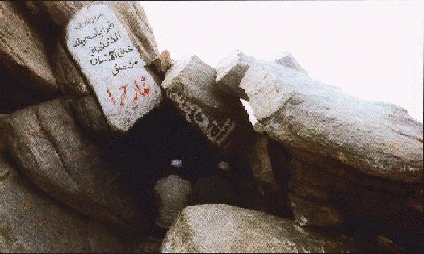
Fig. 9 The cave of Hira where Muhammad first became the prophetof Islam.The story of the first visit of the angel Gabriel toMuhammad (pbuh) has been narrated in detail in section 6.2. Immediately afterreceiving this visit, Muhammad (pbuh) ran back home to his wife, trembling andin a state of terror crying “Cover me! Cover me!”.When he had had a chance to calm down, Khadeejah asked him what hadhappened and he told her the whole story. Muhammad’s wife Khadeejah was verywell acquainted with his character and when this story was narrated to her andshe saw the terror in his eyes she said: “No, by Allah! God shall notdisgrace you. You do good by your kin, carry the burdens of others, give to theneedy, aid the weak, and assist in all good things.” However, asshe did not know exactly what to make of this matter, she decided to ask theadvice of her Christian cousin, Waraka the son of Nawfal.When Waraka heard what had happened he said: “By Him in who’shands my soul rests, you are the prophet of this nation, and the one whovisited you is none other than the chief of the angels who visited Moses. Verily, your people shall call you a liar, abuse you, expel you, and wage waragainst you.”When Muhammad (pbuh) heard these words he was bewildered, for heknew of his noble standing with his people, their great respect and admirationfor him, and how they called him “The Truthful, the Trustworthy,” so he asked Waraka: “Will they expel me?.” Warakareplied “Yes! Never has there come a man before you with similar to thatwhich you have come with except his people fought him and waged war againsthim. If I were to live to that day, I shall stand by you and assist youmightily.” However, Waraka died shortly thereafter.The first people to believe in Muhammad (pbuh) were his closest ofkin and some of his close friends. Among them were his wife Khadeejah, hiscousin Ali ibn Abi-Talib, his close friend Abu Bakr Al-Siddik, and his adoptedson Zaid ibn Haritha, as well as many of the poor and weak such as Bilal theEthiopian, and Abdullah ibn Masood, among others. Some of those who acceptedMuhammad’s call were nobles and leaders in the tribe of Quraish ,such as Uthman ibn Affan, Abdulrahman ibn Auf, Saad ibn Abi-Wakkas, and Talhaibn Ubaidallah. However, Muhammad’s call to Islam continued in secret for aperiod of three years at which point the following verse was revealed to him:”Therefore expound openly that which you are commanded, and beheedless of those who associate partners with God.” The noble Qur’an, Al-Hijir(15):94Upon receiving this command, Muhammad (pbuh) climbed to the top ofthe hill of Al-Safa and shouted at the top of his lungs: “Ya sabaha!.”This call was well known to be a call of dire distress and impending peril. Itwas usually reserved to warn of a siege by a hostile army.Immediately the citizens clamored around him to learn what alarmingnews he had to reveal to them. When they had assembled around him heproclaimed: “O children of Abdul-Muttalib, O children of Fihr, O children ofKaab, if I were to warn you that at the bottom of this hill are horses [of war]about to attack you, would you believe me? .” The people replied: “Yes!.” Then Muhammad said: “Then [be notified that] I am a warner,before me is a terrible punishment.” Everyone fell silent and did not know what to say until one of thenobles, Muhammad’s uncle Abu Lahab, blurted out: “Damn you the rest of theday! Is this why you assembled us?”From that day forward, Muhammad (pbuh) called to Islam openly andwithout fear. With time, more and more people began to accept this call andbecame Muslims. Most of them, however, were of the poor, the weak, and thedestitute of Quraish . In the beginning, the nobles did not payhim much heed until they learned that he was deriding their idols. This is whentheir animosity and their campaign of retribution began.At first, the nobles tried to convince Muhammad’s followers that hewas a lunatic or a magician. However, when this method did not succeed theyresorted to physical abuse and torture. Those ofthem who had no clan to protect them were subjected to the worst of thistorture. Many were whipped, stoned, beaten, starved and burned. The nobles tookgreat pains to come up with new and innovative ways to torture them. Amongthese was the method employed by Umayya against his slave Bilal the Ethiopian.He would take him out to the desert at the hottest time of day, lay him on hisback under the scorching sun, then order that a large boulder be rolled ontohis stomach. All the while Bilal remained resolute, repeating: “[God is]one, [God is] one.” At the same time, the tribe of Makhzoom would take the family ofYasir, the father the mother and the son, out to the desert during the middayheat and torture them severely. While this was going on, Muhammad (pbuh) wouldpass by them and say: “Have patience family of Yasir. Your appointment iswith heaven.” Khabbab ibn Al-Art narrated that: “They used to take me out,light a fire, and then roast me over it. A man then came and placed his foot onmy chest extinguishing the fire with my back.”It was well known in the Arabian peninsula that one does not attackor abuse members of a strong clan or tribe for fear that that tribe might seekretribution. Those who did not belong to such a tribe would enter into a pactof protection with a noble of a strong clan or tribe. In such a manner peoplewould protect their families and wealth from the aggression of their neighbors.When Quraish first began it’s campaign of persecutionof Muhammad (pbuh) and his companions many of them sought protection by allyingthemselves with non-Muslims in this manner. For example, Abu Bakr Al-Siddiq hadallied himself with ibn Al-Daghnah, and Uthman ibn Madhgoon allied himself withAl-Waleed ibn al-Mugeerah. Muhammad (pbuh) himself was under the protection ofhis uncle Abu-Talib. This protection by no means protected them from all abuse,however, it did afford them a measure of protection against the severesttorture or murder. It is worth mentioning though that both Abu-Bakr and Uthmanboth felt such protection by non-Muslims inappropriate and later renounced thatprotection in favor of the protection of Allah Almighty.Because of the continuous and unrelenting persecution of Quraishtowards the Muslims, it was next to impossible for any among them to publiclydeclare his acceptance of the faith much less call others to Islam. One day thecompanions of Muhammad (pbuh) gathered together and said to one another”By Allah, Quraish has yet to hear this Qur’an recited to them out loud,so who among you shall recite it to them?” Abdullah the son of Masoodvolunteered: “I shall do it.” They objected: “We are afraid thatthey might attack you, we want someone who has a strong tribe or clan toprotect him if they decide to harm him.” Abdullah replied: “Let me bethe one, God shall protect me.”At day break, Abdullah set out to their gathering place next to theKaaba and in a loud voice he began to recite the Qur’an. He read: “In the name of Allah, Most Compassionate, Most Merciful. TheMost Compassionate! [He] has taught the Qur’an. He created man. He taught himeloquent speech …” The noble Qur’an, Al-Rahman(55):1-4As Abdullah continued to recite the Qur’an the nobles of Quraishasked one another “What is he saying?” Then one of them said “Heis reading part of that which Muhammad has brought!” So they all sprang upand began to strike him about his face, all the while he continued to recitethis chapter to them until he felt that they had heard enough. When Abdullah returned to the Muslims and they saw the marks whichthe beating had left on his face they said: “This is what we feared wouldhappen to you.” Abdullah replied: “The enemies of Allah have neverbeen more impotent against me than they were today, and if you wish I shallreturn and recite before them it’s equivalent tomorrow!” They responded:”No, that is enough. You have spoken to them words which they hate [tohear]”However, if this was the situation of the followers of Muhammad(pbuh) then how was Muhammad himself treated by these people?The nobles of Quraish consolidated all of theirresources in an effort to stamp out Muhammad’s message. They told everyone hewas a liar, a magician, a poet, and a lunatic. They sat in the streets and didtheir utmost to terrify the people of Muhammad and bar them from speaking tohim. They tortured his friends and did their best to constantly abuse him. Theywould throw thorns and sharp objects in his path, dump camel entrails on hishead while he prayed to God, curse and swear at him whenever they saw him,starve him and his companions, and even attempted to kill him. With time thenobles of Quraish even chose to change Muhammad’s name from Muhammad (thepraised one) to Muthammam (The reviled one). Thus, whenever they would speak ofhim they would say: “Cursed be the reviled one” etc. For this reason,Muhammad (pbuh) used to say to his Companions: “Do you not marvel at howAllah has even deflected their curses from me? They curse Muthammam and I amMuhammad”When this continued for a long while the nobles of Quraishwent to Muhammad’s uncle Abu-Talib and attempted to bribe him to renounce hisprotection of Muhammad (pbuh). When this did not succeed, they went to Muhammaddirectly and attempted to bribe him with wealth, leadership, nobility, and toappoint him as their leader if he would but renounce his message. He refused. When the torture of Quraish became unbearable,Muhammad (pbuh) authorized his companions to emigrate to Ethiopia (Abyssinia) . At this point eighty three Muslims fled Makkah and traveled toEthiopia. When Quraish received news of their emigration they sent a delegationto Negus (Al-Najashi) the Christian king of Ethiopia with many gifts in thehope that they might persuade him to return the emigrants to them. A famousexchange occurred between the three parties with the outcome being the refusalof the king to deliver the Muslims back into the hands of Quraish. This couldbe deemed the first strategic victory of the Muslims against their persecutors,so let us hear this story.When the nobles of Quraish saw that the Muslims hadfound a reprieve from their torture and abuse in Abyssinia and that they wereallowed to practice their religion freely there, these nobles decided to send adelegation to the King of Abyssinia consisting of Abdullah the son of Rabia andAmr the son of Al-Aas, and with them they sent many gifts for the king and hisgenerals.When this delegation arrived in Abyssinia, they first presentedtheir gifts to the king’s generals and received passage to speak to the king.When they stood before the king they said: “There has come to your land a scrapping lot of our mostignorant juveniles. They have departed from the religion of their fathers andhave not accepted your religion, rather, they have invented a completely newreligion which neither we nor you have heard of before. The nobles among theirpeople, their fathers, their uncles, and their clan have sent to you to returnthem to them, for they are best acquainted with them and closer in bond tothem.” The king’s officers then spoke upsaying: “They have spoken the truth O king so let us return them to theirpeople.”Upon hearing this the king became very angry and refused to accepttheir words or to return those who had sought sanctuary with him to thisdelegation. He then commanded that the Muslims be assembled before him as wellas his Bishops. When they had all assembled before him he asked the Muslims: “What is this religion which has caused you to relinquish thereligion of your fathers and not to accept our religion nor any of these otherfaiths?” Ja’far the son of Abu-Talib, thecousin of Muhammad (pbuh) then arose and said: “O King of Abyssinia, Weused to be a people of ignorance, worshipping idols, eating dead animals,performing indecencies, casting off family bonds, doing evil to our neighbors,and the strong among us would eat the weak. This remained our common traituntil God sent to us a messenger. We knew his ancestry, his truthfulness, histrustworthiness, and his chastity. He called us to Allah that we might worshipHim alone and forsake all that which we had been worshipping other than Him ofthese stones and idols. He commanded us to be truthful in speech, to keep ourtrusts, to strengthen our family bonds, to be good to our neighbors, to avoidthe prohibitions and blood, and to avoid all indecencies, lying, theft of theorphan’s money, and the slander of chaste women. He further commanded us toworship Allah alone, not associating anything in worship with Him. He commandedus to pray, pay charity, and fast (and he listed for him the requirements ofIslam). So we believed him, accepted his message, and followed him in thatwhich he received from Allah, worshipping Allah alone, not associating anypartners with Him, refraining from all prohibitions, and accepting all thatwhich was made permissible for us. For this our people greeted us withanimosity and vindication. They tortured us and persecuted us in our religionin the hope that they might turn us from the worship of Allah to the worship ofidols, and that we might accept that which we had accepted of old of our evildeeds. So when they overcame us, dealt unjustly with us, restricted us, andbared us from our religion, we fled to your land and chose you above allothers, hoping for your sanctuary, and hoping that we would not fear injusticein your presence. “The King listened to Ja’far’s words patiently and quietly then hesaid: “Do you have with you any of that which your companion has brought toyou?” Ja’far replied “Yes.” The King said: “Thenrecite it before me.” So Ja’far recited to him the verses of thechapter of Maryam (chapter 19). It reads:”Kaf, Ha, Ya, Ain, Saad. [This is a] recital of the mercy ofyour Lord to His slave Zachariah. When he called unto his Lord a call insecret. Saying: ‘My Lord, indeed my bones have grown feeble, and my headglistens with gray hair, and I have never been unblessed in my supplicationunto you my Lord. And verily, I fear [what] my relatives [shall do] after me,and my wife is barren, so grant me from Yourself an heir. Who shall inherit me,and inherit from the family of Jacob, and make him O Lord one in whom You arewell pleased.’ [Allah said:] O Zachariah! Verily We give you glad tidings of ason whose name is Yahya(John). We have granted this name to none before him. Hesaid: ‘My Lord, whence can I have a son when my wife is barren, and I havegrown quite decrepit in old age?’ He said: ‘So has your Lord said. It istrivial upon Me. [Indeed,] I had created you previously when you werenothing…” (For the rest of this chapter please obtain one of the acceptableEnglish translations of the Qur’an as outlined in the book list at the end ofthis book)When the king heard these verses he wept till he soaked his beard,and with him his Bishops also wept. The king then said: “Verily, this andthat which was brought by Jesus have indeed come from the same burninglight.” He then turned to the emissaries of Quraishand said to them: “Return to your people, for I shall never deliver them toyou”Then next morning, Amr the son of Al-Aas returned to the king andsaid: “They say a most monstrous thing regarding Jesus the son ofMary.” At this the king summoned the Muslims again and asked them: “Whatdo you have to say regarding Jesus the son of Mary?”Ja’far the son of Abu-Talib replied: “We say in his regard thatwhich our prophet says: That he was the servant of God and his messenger, aspirit from Him, and His Word which He bestowed upon Mary the chaste, thepure.”Upon hearing this the king struck the ground with his hand andlifted up a stick. He then said “Verily, Jesus the son of Mary did notsurpass what you have just said even so much as this stick.” Theking granted the Muslims sanctuary and the emissaries of Quraishreturned with empty hands.This king of Ethiopia later passed away during the lifetime ofMuhammad (pbuh). When Muhammad learned of his death, he commanded the Muslimsto assemble for a congregational “prayer upon the deceased” (funeralprayers) on the king’s behalf. While all of this was going on in Ethiopia, Muhammad (pbuh) and hiscompanions who had chosen to remain behind in Makkah continued toendure the punishment and torture of Quraish . However, theirnumbers continued to increase with every passing day in spite of the bestefforts of Quraish. Many of those who converted to Islam were nobles among themsuch as Umar ibn al-Khattab. In the seventh year of Muhammad’s (pbuh) message, the nobles of Quraishbecame desperate to stop the growth of Islam in their city, so they all mettogether and wrote the “Sanction of Hashim and Banu Muttalib.” In this pact, the nobles all agreed to neither buy the goods of thesons of Hashim and Banu Muttalib (the tribe of Muhammad), nor to sell to them.They further agreed not to marry from them nor to allow them to marry fromtheir tribes. This document was then hung inside the Kaaba. This sanctioncontinued for three years. During this period, the children of Hashim andAbdulMuttalib suffered severely until they were reduced to eating the leavesoff of the trees. They could neither buy nor sell goods from Quraish andQuraish prevented all other merchants from dealing with them except atexorbitantly high prices.Although the Arabs of this time period had become steeped in manyevil traits, nevertheless, they were also known for a number of good ones aswell. Among these was a limited sense of honor and justice prevalent among manyof them. It was this trait which finally drove a number of people of Quraish, among them Amr ibn Rabeea, to collect a number of like-minded people in orderto pressure the nobles who had signed the sanction into nullify it. When thepeople then rose to tear up the document they found that the insects had eatenit except for the following words at it’s top: “In your name OLord…”In the tenth year of the message, Muhammad’s uncle Abu-Talib and hiswife Khadeejah both died With their death the abuse of Quraishmultiplied greatly. Of those few people who were allowed to hear the Qur’anmany became Muslims. However, the continuous and unrelenting torture of Quraishtowards the Muslims drove Muhammad (pbuh) to seek an ally for them to protectthem against Quraish and allow the people to hear the message of Islam. So hetraveled to Al-Taif* in search of the protection of the tribe ofThaqeef and with the hope that they might accept his message. He presented hismessage to Ibn Abd-Yalayl ibn Abdu Kulal and the nobles of Al-Taif. They,however, met him with curses and abuse. They then roused the citizens andenflamed their passions against him till they stoned him out of their city andhe fled from them into a farm belonging to Utba and Shaiba the sons of Rabeea.These two watched him from a distance as he sat below one of their grape arborsand supplicated to Allah. When Muhammad (pbuh) saw that the people of Thaqeef had left himalone and returned to their daily lives, with a heavy heart he lifted his handstowards the heavens and prayed: “O my Lord, unto you I bewail my weakness, inability, anddisregard of mankind towards me. O Most Merciful of the merciful, you are theLord of the weak and my Lord. Unto whom shall you deliver me?. Unto one who isdistant and shall glower at me, or unto an enemy whom you have given authorityover me? If you are not angry against me then I do not care [what befalls me],but your [gifts of] well being are more commodious for me. I seek refuge in thelight of your face that has overcome all darkness, and through which allmatters of this life and the hereafter have been established in justice, thatyour retribution should fall upon me, or your disdain should befall me. Untoyou is [all] appeasement until you are appeased, and no one has power orability except in You”As Utba and Shaiba watched Muhammad (pbuh) they felt pity on him andsent to him their slave boy, Addas, to collect a bowl of grapes and take it tohim. Addas collected the grapes and took them to Muhammad placing them in hishand. He then said: “Eat.” As Muhammad was about to eat he began withthe words “In the name of Allah” (which all Muslims say beforeeating or drinking). Addas was a Christian and when he heard these words hesaid to Muhammad “Verily, these are not the words of the people of thisland.” Muhammad asked him from which land he came and Addas replied”From ‘Ninwa’.” Muhammad said: “From the land of the pious manJonah the son of Amittai.” Addas marveled: “And how do youknow Jonah the son of Amittai?” Muhammad (pbuh) responded: “He is mybrother. He was a messenger and I am a messenger” Upon hearingthese words Addas took to kissing the hands, head and feet of prophet MuhammadWhen Urwa and Shaiba saw this they said to one another:”Verily, he has quite corrupted our slave boy.” When Addas returnedto them they said to him: “Fie upon you Addas! Why did you kiss the man’shead, hands and feet?” Addas replied: “O masters, there is nothing inthis earth better than this matter. He has told me of a matter which is onlyknown to a messenger” They rebuked him saying: “Fie unto you Addas!Do not allow him to divert you from your religion. Your religion is far betterthan his!”Muhammad (pbuh) then departed and returned home practicallyoverwhelmed with excessive sorrow. On his way home he stopped in Qarnath-Tha’alib, as he looked up, he saw a cloud shadowing him and he saw angel Gabrielin it. Angel Gabriel then addressed him saying: “Allah has heard what yourpeople said to you, and how they have replied to you. Allah has sent the Angelof the Mountains to you so that you may order him to do whatever you wish tothese people.” The Angel of the Mountains then called out greetinghim and then said, “O Muhammad! Order what you wish. If you like, I shallcause al-Akhshabayn (two mountains surrounding Al-Taif ) to fallupon them.” The Prophet (pbuh), replied “No, for I hope thatthere shall be among their children those who will worship Allah alone, andwill worship none besides Him.” He then returned to Makkahand to the abuse of it’s people.Shortly thereafter, Allah Almighty sent for Muhammad (pbuh) who wastaken to the “Furthest Mosque” (‘Temple mount’ in Palestine) and thenup into the heavens where he met the prophets of God, saw many of the signs ofGod, and then the five prescribed daily prayers were prescribed upon him andall Muslims. All of this happened in one night which was later called the nightof “Israa and Miraj ” (travel by nightand ascension).Muhammad (pbuh) continued to call the surrounding tribes to Islamand to the aid of the Muslims at every possible opportunity. During the tradingseason when the surrounding tribes would all convene in Makkah ,Muhammad (pbuh) would go out, speak to them and encourage them to accept Islam.All the while his uncle, Abu-Lahab, would follow him around. Whenever he spoketo a tribe or invited them to Islam, Abu-Lahab would stand in his way and dohis best to dissuade them.When Muhammad (pbuh) would speak to one of these tribes, he wouldtell them that he was the messenger of God and that he had been sent to guidethem out of their ignorance and out of the worship of idols into the light ofGod and the worship of one single God, the Creator and Sustainer of allcreation. He would then recite to them the Qur’an and encourage them to acceptIslam. One of the tribes who eventually met Muhammad in this manner was thetribe of Al-Kazraj of the city of Al-MadinahAl-Munawara (called Yethrib at that time ). When they heardMuhammad’s claims they began to remember the prophesies of the Jews in theircity and how the Jews were continually threatening them with the impendingarrival of their “final prophet” who would lead them to a greatvictory over them and establish the kingdom of God on earth.When they heard the words of Muhammad (pbuh) and the Qur’an theybegan to say among themselves: “This is indeed the prophet that the Jewshave been threatening you with, so do not allow them to beat you to him.”So they believed in him and accepted his message. Most of the Jews, on theother hand rejected Muhammad For this reason, we read in the Qur’an “And when there came to them (the Jews) a Book from God,confirming that which is with them,- although before that they were praying forvictory against those who disbelieved,- so when there came to them that whichthey recognized, they refused to believe in it. So [let] the curse of Allah[fall] on those who disbelieve.” The noble Qur’an, Al-Baqarah(2):89The citizens of Al-Madinah then returnedhome and spread the word. The next year, twelve of them returned and gaveMuhammad (pbuh) their pledge of submission and acceptance of his message. Thiswas called “The first pledge of Al-Aqaba”When this delegation left to return to their people, Muhammad (pbuh)sent with them teachers who taught the people of their city the Qur’an and thereligion of Islam. This continued for one year until there was hardly a housein Al-Madinah except there were people in it whohad accepted Islam. At the end of the year the people sent another delegationto Muhammad (pbuh) consisting of seventy five representatives. They gaveMuhammad the famous second pledge of Al-Aqaba, the “pledge of war.”In it they pledged to protect Muhammad and his companions within their citywith their wealth and their might no matter what the cost to themselves andtheir families, and to protect them as they would protect their own wives andchildren. Upon receiving this pledge, Muhammad (pbuh) authorized his followersto emigrate to Al-Madinah (for more see section6.4).A Muslim by the name of Salamah the son of Salamah the son of Waksh,a citizen of Al-Madinah , once narrated: “We used to have a Jewish neighbor from the tribe ofAbd-Alash’hal. One day he left his house and came out to talk to some membersof the tribe of Abd-Alash’hal. At that time I was the youngest among them. Iwas wearing a mantle of mine and laying on it in my family’s yard. He (theneighbor) then began to make mention of Judgment Day, the resurrection of allmankind, judgment, the scales, Paradise, and Hell. He was saying all of this toa tribe of polytheist, followers of idols, people who did not believe in anafterlife or a resurrection after death. For this reason they replied to him:’Do you really believe that all of this shall come to pass? Do you reallybelieve that mankind shall be resurrected after their death to a place wherethere is a Paradise and a Fire to be rewarded for their deeds?’ He replied,’Yes, by He in whom we testify!.’ He continued that he would prefer to beroasted in the most tremendous furnace in this earthly life rather than have toendure the fire of Hell in the hereafter. The others then replied: ‘What thenis your proof of what you say?’ He replied ‘A prophet who shall come from thatvicinity’ and he pointed in the general direction of Makkah and Yemen (South).They replied ‘And when shall we see him?’ He looked at me, a young child, andanswered ‘If this child reaches his prime he shall see him'”Salamah then continued “By Allah!, night and day did not pass but Muhammadhad become the messenger, and he was alive among us. We then believed in himand accepted him but he disbelieved in him and rejected him out oftransgression and envy. We then said to him one day ‘[what is the matter withyou?] Are you not the same one who previously told us so much about him?’ Hereplied ‘Yes! but he is not the one.'”Asim the son of Omar the son of Qutadah narrated that an elder fromthe Jewish tribe of Bani-Quraidah said to him: “Do you know the story of how Thalaba the son of Sa’iah, Usaidthe son of Sa’iah, and Asab the son of Ubaid, the children of the tribe ofHadal the brethren of Bani-Quraidah, became Muslims?”He said “I replied: No I do not.” He said: “There was oncea man from the children of Israel who came to us from the land of Al-Sham(Babylon, Palestine, etc.). His name was Ibn-Alhai’iban. He came to us twoyears prior to the beginning of Islam. As he lived among us we never before sawa man better or more devout in his daily worship than he. Whenever rain wouldbe withheld from us we would go to him and say to him: Go out O Ibn-Alhai’ibanand pray to God to grant us rain. He would reply: I shall not do so unless youagree to pay out of your harvest a charity [to the needy]. We would ask him,how much? And he would reply a ‘Saa’ (weight) of dates or two ‘Muud’ (weights)of wheat. He said: So we would pay this charity and he would accompany us outto the edge of town and beseech God on our behalf. Before he would rise toleave a cloud would overshadow us and the rain would begin to pour. He did thisfor us not once, or twice, or even three times [but more]. When he was on hisdeath bed and he knew that he was about to pass away, he said: O children ofIsrael, what do you think drove me to leave the land of wine and leavened breadto come to the land of wretchedness and hunger?. They replied: ‘You know best’He said: Then know that I only came to this land in anticipation of a prophetof God whose time has drawn near, and this land is the destination of hisemigration (see chapter 6). I had hoped that his time might come so that Imight follow him. So do not allow anyone to beat you to him O children ofIsrael for he shall be sent to spill blood and to take as spoils the women andchildren of those who oppose him. Therefore do not allow that to prevent youfrom him. When Muhammad was sent, and when he surrounded Bani-Quraidah, theseyoung men who had attended his speech told their people: ‘By Allah!, this isindeed the prophet which Ibn-Alhai’iban told you of.’ They replied: ‘It is nothim.’ They returned: ‘But it is!, and it is his description.’ So these [three]young men left their people and accepted Islam.” The Emigration to Al-Madinah:When the Muslims received authorization from Muhammad (pbuh) toemigrate to Al-Madinah , they began to flee indroves under the cover of night for fear that they might be discovered by Quraish. Those who fled Makkah were from that day forward named”Al-Muhajireen” (The Emigrators). When they departed from Makkah theyleft behind all of their wealth, their livestock, and their homes. The peopleof Quraish wasted no time in claimingthis property and their zeal in amassing their newfound wealth helped to occupythem from setting out in pursuit of the Muslims who had fled with only theclothes on their backs, enough provisions for their trip, and an undying loveof God burning brightly in their hearts.Although the Muslims had forsaken all of their worldly possessionsto the people of Quraish , still, this did not prevent many ofthem from being captured and tormented by Quraish.Hind the daughter of Abi-Umayya Huthaifah ibn Al-MugeerahAl-Qurasiyya Al-Makhzoomiyya (more popularly known as Um-Salama) was one suchvictim. She was married at the time to Abdullah ibn Abdulasad, one of the firstten converts to Islam. They had a son named Salama. Upon receiving theauthorization to emigrate to Al-Madinah, Abdullah collected some provisions,placed his wife and son on the back of their camel and set out for Al-Madinah. As they reached the outskirts of the city some of the men of thetribe of Makhzoom (the tribe of Um-Salama), saw them. They came running andsaid: “Although we may be powerless to stop you, still, you shall not beallowed to take our daughter and travel throughout the land with her,”and they wrenched the reins of the camel from his hands.As this was going on, a group of men from the tribe of Um-Salama’shusband Abdullah, the tribe of Abdulasad, became enraged by this display andshouted: “By God, if you take her you shall not take his son, the son ofour tribe” and they wrenched the boy away. Both tribes then beganto pull on the boy until they dislocated his arm. Finally, the tribe ofMakhzoom took Um-Salama and the tribe of Abdulasad took her son Salama, andthey both left Abdullah with no recourse but to flee to Yethrib alone.After that, Um-Salama would go out every day to the edge of the cityand weep over the loss of her son and her husband until well into the night.This continued for about a year until the tribes finally had mercy upon her,returned her child to her and allowed them to catch up with her husband.Another example is that of Suhaib Al-Roomi of the Arab tribe ofNumair. As a child he had been taken captive by the Romans in one of theirraids on the city of Al-Thani in Iraq. After spending many years as a slave inthe service of the Roman nobles he escaped and returned to Arabia. He came to Makkahas an emigrant barely remembering a single word of Arabic. Due to his heavyaccent and his bright red hair he was given the nick-name of”Al-Roomi” (The Roman). Suhaib spent many years in Makkah barteringand trading, and eventually he managed to amass substantial wealth. During hisstay in Rome, Suhaib had once heard a Christian priest commenting to a Romannoble that the time was near when a final prophet of God would be coming fromthe land of Arabia and would confirm the message of Jesus (see chapter 6). WhenSuhaib later heard of Muhammad’s message he inquired after him and ultimately,he accepted Islam.When Muhammad (pbuh) authorized the emigration to Al-MadinahSuhaib collected his belongings, and set out for Al-Madinah. However, the nobles of Quraish had heard of his intentions andprevented him from leaving the city. They then set up a continuous guard toensure that he would not leave the city, nevertheless, through his cunning helater managed to elude them and leave. It was not long after that Quraish learned that Suhaibhad tricked them and escaped, so they sent out their best riders on theirfastest horses in heated pursuit of him. Somewhere along the road to Al-Madinahthey caught up with him. Upon seeing them Suhaib dismounted, pulled out his bowand arrows and called to them: “O people of Quraish. By Allah, you knowthat I am a very skilled archer. By Allah, you shall not reach me until I killwith each arrow in my quiver a man among you, and then I shall smite you withmy sword until it falls from my hand.”The detachment of Quraish replied: “You came to usas a lowly emigrant with no money. Now that you have prospered by way of us youwish to leave? By Allah, we shall not allow you to leave with your life andyour wealth!” Whereupon Suhaib replied: “If I were to delivermy wealth to you, will you let me be?” They replied “Yes.”So Suhaib revealed to them the location where his wealth was buried and theyretrieved it and let him go.When Suhaib reached Quba (a city located two miles from Al-Madinah), Muhammad (pbuh) saw him and hastened to greet him saying: “You haveindeed prospered in your trade O father of Yahya, you have indeed prospered inyour trade.”When Suhaib heard these words he replied: “By Allah, no one hasbeat me to you [with this news]. You have not been informed of it except by wayof [the angel] Gabriel .” All of the Muslims in Makkah emigrated in secret andunder the cover of night out of fear of the persecution of Quraish. All, that is, except Umar ibn Al-Khattab. Umar was a powerful man and greatlyrespected by Quraish. He was ambidextrous and highly skilled in matters of war.When he resolved to emigrate he stood up in the middle of the holy mosque inMakkah in front of it’s nobles and proclaimed: “I have resolved toemigrate. Let he who wishes his parents to lose their child or wishes to makehis children orphans, let him meet me behind this hill,” and hedeparted. Of course, no one followed him.After Muhammad (pbuh) authorized the Muslims to emigrate to Al-Madinah, all able bodied Muslims departed until there was no one left behind excepthimself, his close friend Abu-Bakr, his cousin Ali, and those who had beenpersecuted and imprisoned.When Quraish saw that Muhammad (pbuh) had found astrong ally and a tribe that would protect him and his followers from theirpersecution they began to fear that he might leave and join them. They decidedthat extreme measures were necessitated in order to prevent this fromhappening. It was time for Muhammad to die.The nobles of Quraish met in “Dar-Alnadwa”and plotted as to how they shall execute this deed. They decided that the beststrategy was to choose a young and capable representative from each of theirtribes and to dispatch these representatives to his home. They would all thenstrike Muhammad (pbuh) with their swords simultaneously such that his bloodwould be distributed between all of the tribes. In this manner, the children ofAbdulManaf would not be able to take vengeance against all of the tribes ofQuraish combined.Gabriel visited Muhammad (pbuh) and informed him ofthis plot, so Muhammad requested from his cousin Ali that he take his place inhis bed and he informed him of this plot. He consoled him not to worry, no harmshall befall him. When the young men of Quraish collected outsideMuhammad’s home, Allah momentarily took away their sight. Muhammad (pbuh) thenscooped up a handful of dust, sprinkled it upon their heads, and then departed.As he did this he read the first verses of Yaseen(36): “YaSeen. By the Qur’an full of Wisdom, Truly you [O Muhammad]are one of the messengers. On a straight path. [This is] a Revelation sent downby the All-Mighty, the Most Merciful, that you may warn a people that whichtheir forefathers were warned, but they are heedless” until he reached the verse “And We have set a barrier beforethem and a barrier behind them, and [thus] we have covered them so that theysee not.”A man then passed by them and said “what are you waiting forhere?” They replied “For Muhammad” He responded “Hehas already departed and left dust on your heads.” They thenplaced their hands upon their heads and found the dust. So they peered insidethe house and saw Ali in the bed and thought he was Muhammad The next morningAli got up out of the bed and they realized that Muhammad (pbuh) had indeedescaped just as that man had told them. They quickly set out in his pursuit.Muhammad (pbuh) set out with Abu-Bakr towards Yethrib. When the tworeached the cave of Thor at the edge of Makkah , AbuBakr said: “Wait O messenger of Allah while I inspect it [for dangerouscreatures].” Once he had inspected it he asked Muhammad (pbuh) toenter. While they were inside the cave, the dispatchment of Quraishreached them. As they walked about all around the cave Abu Bakr becameterrified and said: “O Messenger of Allah, if one of them were but to lookbeneath his feet he would see us.” Muhammad (pbuh) turned to himand said: “O Abu Bakr, what shall you think of two [men] the third of whomis God? [through guidance and protection]” In this regard the following verses were later revealed: “If you help him not [it matters not], for Allah helped him whenthose who disbelieved drove him forth, the second of two; when they two were inthe cave, when he said unto his comrade: Grieve not. Verily! Allah is with us.Then Allah caused His peace of reassurance to descend upon him and supportedhim with troops you did not see, and made the word of those who disbelieved thenethermost, while Allah’s Word is the highest. For Allah is Exalted in Might,Wise.” The noble Qur’an, Al-Tawba(9):40Muhammad (pbuh) and Abu-Bakr remained inside the cave for three dayswhile Abdullah the son of Abu-Bakr brought them news of the plotting of Quraish. His daughter, Asma, would also bring them food every day. After three days,they took a guide by the name of Abdullah ibn Arqat and set out for Makkah. At times Abu-Bakr would walk behind Muhammad (pbuh) and at others he wouldwalk in front of him. Finally, Muhammad (pbuh) asked him about that andAbu-Bakr explained that at times he would fear that an attack would come atMuhammad from behind, so he would walk behind Muhammad (pbuh) to protect him.At other times he would fear an attack from in front of them so he would walkin front of him for the same reason.When Quraish realized that Muhammad (pbuh) had eludedthey announced a reward of one hundred camels for anyone who would capture himand return him to them. Suraqa ibn Malik ibn Ju’ushum heard of this reward andset out in pursuit of Muhammad (pbuh).Suraqa was a skilled tracker and Muhammad (pbuh) and Abu Bakr hadspent three days in the cave before departing, eventually he caught up withthem. However, as he began to close in on them his horse tripped and fell. Hethen got up and mounted his horse, and again it tripped and fell. When thishappened a third time his horse began to sink into the ground and a strong windbegan to blow. When Suraqa saw this he realized that he would not be allowed tocapture them. So he called out to them: “I am Suraqa ibn Ju’ushum. Will youallow me to speak to you? By Allah, I promise not to harm you” Theyasked him what he wanted and he replied: “I want you to write a pact for methat shall be a sign between me and you.” Muhammad (pbuh)commanded that this pack be written and Suraqa took it and left. As hedeparted, Muhammad said to him: “conceal our location” andthey parted ways.Suraqa never spoke to anyone about what had happened until manyyears later, after the Muslims captured Makkah . At that point,Suraqa returned to Muhammad (pbuh) with the pact in his hand and embracedIslam.When Muhammad (pbuh) drew near Al-Madinah, he came upon the city of Quba (two miles away from Al-Madinah). Ever sincethe beginning of the emigration of the Muslims to Al-Madinah, the citizens ofthe city had been waiting with the utmost anticipation for his arrival. Theyhad received word that he had left Makkah and was en route tothem. Every day a party of them would go out to the outskirts of the city atdaybreak and look for him, they would stay there waiting for him until themidday heat would force them indoors.Muhammad (pbuh) and Abu Bakr first arrived on Monday the 12th ofSafar (the third lunar month). Muhammad was fifty three years old at the time.When they arrived the citizens had already returned home for the afternoon. Thefirst person to see him called out at the top of his lungs announcing hisarrival. Muhammad (pbuh) and Abu Bakr were men of similar age. Most of thecitizens of Al-Madinah had never seen Muhammad(pbuh) in person, so they could not tell which one was him. When Abu Bakrrealized this he stood over Muhammad (pbuh) and shaded him with his coatwhereupon the people recognized Muhammad (pbuh).It is estimated that about five hundred people greeted them on thatday and the people clamored on the roof tops trying to get a glimpse of him andcrying: “Which one is him? Which one is him?” while thechildren and the slaves filled the streets shouting “God is great! God’smessenger has come! God is great! Muhammad has arrived!”The people then joined together in singing:The full moon (Muhammad) has risen upon usFrom the direction of “Thaniyyat al-Wada’a”And all thanks [to Allah] is incumbent upon usSo long as a caller calls to AllahO you who were sent among usYou have come with a heeded commandYou have brought favor upon the cityWelcome, O best of callers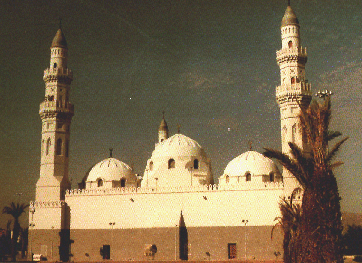 Fig. 10 The Mosque of Quba. The first Mosque built in Islam. Hereit has been expanded greatly since it’s simple beginnings at the time ofMuhammad (pbuh)Muhammad (pbuh) remained in Quba four days. During his stay he laidthe foundations for the first masjid (mosque) to be built in Islam, the masjidof Quba. After these four days he departed on Friday and prayed the Friday(congregational) prayer in Bani Salim ibn Ouf.When Muhammad (pbuh) entered the city of Al-Madinahall of it’s people vied for the honor of having him as their guest in theirhome and they would call to him: “stay with us and under ourprotection.” Some of the people would also take hold of hiscamel’s reins in order to guide it to their homes. However, each time Muhammad(pbuh) would respond to them with the words: “Leave it (my camel) be, forit has been commanded [where to go]”Muhammad (pbuh) released the reins of his camel and allowed it toroam freely. The people all followed the camel through the city hoping againsthope that it might stop at their home. Each time it would come upon one oftheir homes it’s owner’s heart would soar; perhaps I shall be the one. And eachtime it passed by a home their hearts would plummet, for they had lost thehonor of the best of guests, the messenger of God. Finally the camel ofMuhammad (pbuh) came to a stop and sat down at a location in the city where theMasjid of the Prophet stands today.The nearest home to that location was the home of Khalid the son ofZaid Al-Najjari Al-Khuza’i, more popularly known as Abu-Ayyoob. Abu Ayyoobcarried Muhammad’s belongings into his home, cleared out the top (second) floorfor him and left the bottom floor for himself and his wife. He did this out ofrespect for the messenger of Allah so that he would not reside above him.Muhammad (pbuh), however, objected and told him that he received many visitorseach day and he feared that they would cause Abu-Ayyoob distress by passingback and forth to reach him. Abu-Ayyoob finally consented and took the topfloor. However, a few nights later Abu-Ayyoob accidentally struck a jar ofwater during the night and spilled it all over the floor. He and his wifehastened to soak it up with their sheets fearing that it might leak through anddrip on Muhammad (pbuh). In the morning Abu Ayyoob pleaded with Muhammad toallow him to take the lower floor and Muhammad (pbuh) consented.The land that Muhammad’s camel had come to a stop upon was at thattime owned by two orphans from Banu Al-Najjar named Sahil and Suhail, thechildren of Amr. This land was used as a “Marbad” (a place to drytheir dates). Muhammad (pbuh) asked them to sell it to him but they insistedthat he accept it as a gift. Muhammad (pbuh) refused to take it without payingfor it and insisted on paying for it until they finally sold it to him. He thencommanded that the masjid be built on that spot. This masjid was later named”The masjid of the Prophet Muhammad”Muhammad (pbuh) worked with the Muslims in the construction of thismasjid, transporting the bricks, and laying them in place. All the while hewould recite:O my lord, verily the true reward is that of the hereafterSo forgive the “Ansar” and the “Muhajereen”
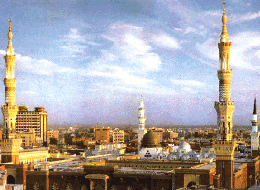
Fig. 11 The “Prophet’s Mosque” in Al-Madinah. Here ithas been expanded greatly from it’s humble beginnings at the time of ProphetMuhammad (pbuh)As he was doing this, the Muslims would work with him chanting andreciting poetry while they raised the construction of the masjid.This continued for approximately eleven months until the masjid was finallycompleted.As mentioned previously, those Muslims who emigrated from Makkahwere from that day forward called the “Muhajereen “(the “Emigrators”). The Muslims who received them in Yethrib werenamed the “Ansar ” (The “supporters”). The city of Yethrib was also later renamed to “Al-MadinahAl-Munawara” (The illuminated city) and this has remained it’s name tothis day, however, this name is sometimes shortened to “Al-Madinah”only (I have referred to it as such in this book in many places).Muhammad (pbuh) paired the Muhajereen and the Ansartogether in brotherhood. The Ansar competed with one another to be host to oneof the Muhajereen. They would split everything they owned in half and allowtheir guest to choose which half they would prefer. Muhammad (pbuh) thencommanded that a pact be written between the Muhajereen and the Ansar whereinhe outlined a contract of peace with the tribes of the Jews within the city andconfirmed their right to free practice of their religion and protection oftheir wealth. He also outlined their rights and their obligations and then allparties pledged to uphold this pact and observe it. For the details of thistreaty see “Al-Seerah Al-Nabawiyya” by Ibn Hisham. Not long after the masjid was built, the Muslims began to go to itfive times a day to attend the five daily prayers. The Jews had a horn they useto call to prayer, and the Christians had a bell, however, Muhammad (pbuh) didnot like these methods. Someone suggested raising a flag, however, he dislikedthis idea too. Not long after, Abdullah ibn Zayd received a vision at nightrevealing to him how to call the people to prayer. He came to Muhammad (pbuh)and recounted to him what he had heard and seen in his dream. Muhammad (pbuh)told him that this was a revelation from God and then he ordered Bilal theEthiopian to call to the five daily prayers as Abdullah had been taught. Tothis day, in Muslim countries throughout the world, when the time of prayerarrives we can hear the “Adhan ” recited all over thecity from the tops of the masjids. It translates loosely to:Allah is the Almighty! Allah is the Almighty!Allah is the Almighty! Allah is the Almighty!I bear witness that there is no deity worthy of worship other thanAllah!I bear witness that there is no deity worthy of worship other thanAllah!I bear witness that Muhammad is the messenger of Allah!I bear witness that Muhammad is the messenger of Allah!Welcome, and come unto prayer!Welcome, and come unto prayer!Welcome, and come unto prosperity!Welcome, and come unto prosperity!Allah is the Almighty! Allah is the Almighty!There is no deity worthy of worship other than Allah!Sixteen months after Muhammad (pbuh) arrived in Al-Madinah, he was commanded to change the direction of prayer of the Muslims from theholy mosque in Jerusalem to the Kaaba in Makkah . From that dayforward all Muslims have directed their prayers towards the Kaaba in Makkah.Within the boundaries of the city of Al-Madinahthere lived a number of tribes of the Jews. Most notable among them were thetribes of Quraidha, Qainuqaa, and Nadheer. One of the most learned Rabbis inthe tribe of Qainuqaa was a man by the name of Al-Husain the son of Salam. WhenMuhammad came to Al-Madinah Al-Husain accepted him and became a Muslim.Muhammad then changed his name to Abdullah (servant of God). Thus, he becameknown as Abdullah ibn Salam. Let us leave it to Abdullah himself to tell us hisstory.Abdullah ibn Salam narrated: “When I first heard of the messenger of Allah (from the newsthat came to me from Makkah), I recognized his description, his name and histime, all of which we (the Jews) had been anticipating. This caused me greatjoy, however, I kept silent until the messenger of Allah came to Al-Madinah.When he arrived in Quba, among the children of Amr the sons of Ouf, a man cameand informed us of his arrival. At the time I was at the top of one of my datepalms working on it and my aunt, Khalida the daughter of Al-Harith, was sittingbeneath me on the ground. When I heard the news of his arrival I shouted thepraise of my Lord. When my aunt heard me she rebuked me saying: ‘Fie upon you!If you had heard of the arrival of Moses the son of Umran you wouldhave done no more than this’ So I replied to her: My aunt, verily he is thebrother of Moses the son of Umran and upon the same religion. He was sent withthat which was sent with Moses. My aunt queried: ‘My cousin, is he the prophetwhom we were told would come at this hour?’ I replied, yes. Then she said: ‘Itis good then.’ So I departed to meet the messenger of Allah and accepted Islam.I then returned to my family and told them to embrace Islam, and they did”Abdullah continues: “I kept the news of my acceptance of Islam a secret from theJews. I then went to the messenger of Allah and told him: O messenger of Allah.Verily, the Jews are a slanderous people, and I ask that you conceal me in yourhome so that they shall not see me, then ask them about my stature among thembefore they learn of my acceptance of Islam. For if they were to learn of thisnews they shall slander me and revile me. So the messenger of Allah hid me inpart of his home and asked that they come assemble before him. They then spoketo him and asked him questions. Finally, he asked them: ‘What sort of man isAl-Husain the son of Salam among you?’ They replied: ‘Our master, the son ofour master. He is our Rabbi and scholar.’ When they were through, I stepped outbefore them. I then told them: O children of Israel, seek refuge in Allah andaccept that which he has brought you. For by Allah, you know that he is themessenger of Allah, you find it written in the Torah that is with you in bothname and description. Verily I bear witness that he is the messenger of Allah.I accept him, believe him and recognize him. They said ‘You lie!’ Then theyslandered me excessively. So I asked the messenger of Allah: Did I not tell youthat they are a slanderous people? A treacherous, lying, trespassing people? SoI publicized my acceptance of Islam and that of my family. My aunt alsoembraced Islam and became a devout Muslim.”Safiyah bint Huyay once narrated the following story regarding herfather and uncle, who were Jews: “When the Messenger of Allah arrived at Quba, my father Huyayibn Akhtab and my uncle Abu Yaser went to him after morning prayer while it wasstill dark and they did not return until sunset. They returned tired anddemoralised, and were walking slowly. I went near them but they did not eventurn towards me due to their sadness. Then I hear my uncle say to my father,’Is he the one?’ He replied: ‘Yes, by Allah’. My uncle said: ‘Do you know himand confirm him?’ He said: ‘Yes’. My uncle said: ‘How do you feel about him?’He said: ‘By Allah! Hatred and enmity as long as I live.'”The people of Quraish continued to display animosityand hatred towards the Muslims in Al-Madinahhowever, Muhammad (pbuh) continued to console them to “Stay your hands and Perfect your prayers.” The noble Qur’an, Al-Nissa(4):77After the Muslims had learned how to pray and how to humblethemselves in the following of the commands of Allah and the obeying of Hismessenger, they were then given sanction to fight, however, it was not mandated upon them. This sanction was delivered in thefollowing verse:”Sanction [to fight] is given unto those who are fought againstbecause they have been wronged; and Allah is indeed able to grant themvictory” The noble Qur’an, Al-Hajj (22):39Muhammad (pbuh) began to send out detachments to different tribes inthe area. Although these detachments did not always do battle with thesetribes, their main objective was to instill a healthy respect for the might ofthe Muslim nation so that their neighbors would think twice about abusing themor terrorizing them. Among these detachments was that of Abdullah ibn Jahsh. In the second year after the emigration, Muhammad (pbuh) sentAbdullah ibn Jahsh and his detachment to a location near Makkah inorder to collect intelligence and bring news of Quraish ‘sactions. While they were there, a caravan of Quraish passed by and after longconsultations the Muslims decided to attack it and take it. They did this inRajab, one of the four “forbidden months” that the Arabs had for manycenturies recognized as being unlawful for one to fight in them. When theyattacked the caravan they killed one man and captured two others. They thendrove the caravan to Al-Madinah and presented it toMuhammad (pbuh).When Muhammad (pbuh) saw what they had done he said: “I did notcommand you to fight in the forbidden month!. I did not command you to fight inthe forbidden month!” and he refused to take anything from thatcaravan.All of the Muslims then severely rebuked and chastised them untilthey felt that indeed they had lost. At this point the following verse wasrevealed: “They question you (O Muhammad) with regard to warfare in thesacred month. Say: Warfare therein is a great [transgression], but to turn[people] from the path of Allah, and to disbelieve in Him and in the InviolablePlace of Worship, and to expel His people thence, is [even] greater with Allah;for persecution is worse than killing…” The noble Qur’an, Al-Baqara(2):217 The Battle of Badr, battle of:The second year after the emigration was the year that the fastingof the month of Ramadan was prescribed upon all Muslims. However, it was famousfor another reason, for it was in this year, the fifteenth year of the Islamicmessage, that the great turning point of Islam arrived. This was the year ofthe great battle of Badr (see section 6.5) . Due to it’stremendous importance in the history of the Islamic message, this day was namedin the Qur’an “Yawm al-Furqaan” (loosely translated: “Theday of discerning and decisiveness”). For fifteen years, the Muslims had born the abuse and torture of Quraishand their nobles. They had lost their wealth, land and homes, and had enduredgreat hardship. Many had died. Even after the emigration, Quraish insisted onfollowing them with their abuse and every so often they would send smalldetachments to fight with them. These detachments would go so far as to enterthe outskirts of the city and their farms. In the third month of the next lunar year, the month of Safar(twelve months after the emigration), Muhammad (pbuh) received news of acaravan headed towards Quraish that was being lead by Abu-Sufyan,one of the staunchest of the nobles of Quraish in animosity to the Muslims.Muhammad (pbuh) decided to take this caravan and reimburse the Muslims part oftheir wealth which had been wrongfully taken from them when they fled Makkah.As he traveled towards Makkah , Abu-Sufyan receivedword of Muhammad’s intentions and this news alarmed him greatly. Abu-Sufyansent hurried word to Quraish appealing for their assistance andurging their swift response. When Quraish received this plea they immediatelysummoned all of their nobles, all of the tribes of Makkah, and a number of thesurrounding tribes and readied the provisions of war. Not a single one of thenobles of Quraish stayed behind except for Abu-Lahab who sent Al-Aasi ibnHisham ibn Al-Mugheera in his place (upon the condition that Abu-Lahab pay offhis debt of 4000 dirhams). This was the day the nobles had been waiting for.This was the day when they would finally put this upstart nation in it’s placeand would finally stamp out Muhammad and his followers. They would make anexample of them so severe that all of the tribes of Arabia would be terrifiedof them for generations to come. The army of Quraish then hastened to cut offthe Muslims before they reached the caravan.Muhammad (pbuh) received word of Quraish ‘s army,their numbers and their weapons. His men had agreed to set out with him for amuch more innocuous matter than this and were not prepared for all-out war. Forthis reason, Muhammad (pbuh) collected them before him and informed them of thearmy of Quraish. He then sought their council and asked them all for theiropinions. When Muhammad (pbuh) asked for their council, he was in realityseeking the response of the Ansar . They had pledged to protect himand his followers with their life and their wealth so long as they residedwithin their city. However, he was now asking them to leave the city and wagewar in another land. He wished to see how they would respond.The first to respond to Muhammad’s query were the Muhajereen. They pledged to follow him to the ends of the earth and to die Muslims.Muhammad (pbuh) then posed the question again, and again the Muhajereenresponded well. After Muhammad (pbuh) asked a third time, Saad ibn Muath, oneof the leaders of the tribes of Al-Madinah stood upand said:”Perhaps your question is directed at us O messenger of Allah?Perhaps you feel that the Ansar believe that they are only obligated to assistyou within the boundaries of the city? I hereby speak in the name of the Ansarwhen I say and answer on their behalf: Journey were you will, and extend thehand of friendship to whom you will, and reject whom you will, and take fromour wealth what you will, and give us what you will. Indeed, that which youtake from us is more beloved to us than that which you give us. Whatever youmay decree in a matter, our decree proceeds from yours. By Allah, were you tomarch with us to the lakes of Ghamadan (in Yemen), we would march with you!. ByAllah, were you to traverse this sea, we would traverse it with you!.”Another man from the Ansar then arose and said similarwords. When Muhammad (pbuh) heard these words his face lit up and he wasgreatly pleased. He then commanded them: “March forth [then] and receive glad tidings. For Allah haspromised me one of two (victory or Heaven). By Allah, it is as if I am lookingat their places of death [as I speak]” Muhammad’s army consisted of 313 men, two horses, and seventycamels. Two or three men would take turns riding these camels, and nopreference in this matter would be given to an officer or a soldier. The flagwas given to Musab ibn Omair, and the banners of the Muhajereenand the Ansar were given to Ali ibn abi Talib and Saad ibn Muathrespectively. The flag was white and the two banners were black. The army of Quraishconsisted of between nine hundred and one thousand men.While the two armies were advancing upon one-another, Abu-Sufyandiverted his caravan away from the beaten path and down towards the shoreline.When he managed to take his caravan out of the face of danger he sent amessenger to the army of Quraish to return home for the caravanwas safe. However, the nobles of Quraish insisted on fighting the Muslims andrefused to return without having taught them a lesson.When the two armies met, Muhammad (pbuh) lined his men up andprepared them for war. He then entered into his tent and supplicated to God,prayed to Him, and beseeched Him to grant them victory over their enemy. For ifthis handful of men were to be slaughtered this day, the message of God wouldvanish from the face of the earth for all time. Muhammad (pbuh) continued tosupplicate to God, reverence His name and beseech Him for His assistance ingreat earnest and in all humbleness and submissiveness for some time. When AbuBakr saw his state he attempted to console and comfort him as best he could.Finally, Muhammad (pbuh) withdrew from the tent and addressed his men. Heencouraged them to fight, to fear God and to seek His great reward. Thefighting then began. It was the custom in that time that such battles would begin withcelebrated representatives from each party fencing individually with oneanother until one party’s representative killed the other’s. Quraishsent three skilled swordsmen from among their nobles to represent them. Theywere, Utba ibn Rabeea, his brother Shaiba, and his son Al-Waleed. Muhammad(pbuh) met them with Obaida ibn Al-Harith (himself the son of Muhammad’sgrandfather), his uncle Hamza, and his cousin Ali. The Muslim party made shortwork of the representatives of Quraish and killed them quickly. However,Obaidah was injured severely by his opponent and died later on.Both armies began to edge closer and closer to one-another untilMuhammad (pbuh) finally gave the command: “Rise up to a Paradise the widthof which is the heavens and the earth.” When Muhammad (pbuh) gave this command Omair ibn Al-Hamam asked: “AParadise the width of which is the heavens and the earth?” Muhammadreplied: “Yes!” Then Omair said: “Bakhin, Bakhin (aterm of satisfaction) O messenger of Allah.” Muhammad asked him:”What drove you to say Bakhin, Bakhin?” He replied: “NothingO Messenger of Allah except that I had hoped to be of it’s inhabitants.”Muhammad replied: “Then, you are of it’s inhabitants.” Obaidah took some dates out of his sack and began to put them in hismouth but stopped suddenly and said: “If I am given life enough to eatthese dates, indeed I would have lived [too] long.” He then tossedthem aside and fought until he was killed.Both parties fought long and hard until the Muslims gained the upperhand and defeated Quraish . Seventy men of Quraish were killedand seventy were taken as prisoners. Of the Muslims six men of the Muhajereenwere killed and eight men from the Ansar . All of the greatestnobles of Quraish died on that day at the hands of the Muslims. The followingverse of the Qur’an was then revealed: “And Allah has granted you victory in Badr,battle of when you were weak. So fear Allah that you might [learn to] bethankful [to Him]” The noble Qur’an, A’al-Umran(3):123After he had buried the dead of Quraish, Muhammad (pbuh) turned totheir grave and said: “O inhabitants of [this grave], we havefound what our Lord promised us to be true, so have you found what your Lordpromised you to be true?.”When the Muslims returned home Muhammad (pbuh) ordered them to treatthe prisoners well . Abu Aziz narrated: “I was [among the prisoners] in a group of the Ansar when theybrought me back from Badr. Whenever they would bring me mydinner they would give me the bread [a delicacy] and suffice with dates forthemselves out of respect for the command of the Messenger of Allah (to do goodby the prisoners). Whenever a man among [my guards] would come into thepossession of a piece of bread he would pass it over to me. Out of bashfulnessI would pass it back to him, but he would return it to me and refuse to eatit.”Among the prisoners were the relatives of Muhammad (pbuh) such ashis uncle Al-Abbas, his cousin Akeel, and others. However, he insisted thatthey not be given preferential treatment and be treated just like any of theother prisoners.Muhammad (pbuh) did not kill the prisoners, rather, he forgave themand allowed them to be ransomed back to their people. He ransomed them backaccording to their wealth. Those who did not have anything were forgiven andset free without a ransom. Others were set free with the condition that theyteach ten of the Ansar how to read and write. Zaid ibn Thabit*was one of the Muslims who learned to read and write in this way. During the battle of Badr , the Jews of thetribe of Banu-Qainuqa broke their treaty with Muhammad (pbuh) and fought withthe pagans of Quraish against him. Muhammad (pbuh) latersurrounded them and ordered them to leave the city. He allowed them to gowherever they pleased and to carry whatever belongings they wished with them,however they were no longer welcome in Al-Madinah .They then left and migrated to Northern Arabia (al-Sham). Other battles:Other battles ensued after that, however, the details shall be leftfor other books to elaborate upon. Any number of book stores can provide anumber of books that describe them in detail. Contact any of the book storeslisted at the back of this book for more on this topic.Some of the highlights of these battles are:The battle of Uhud which was fought in thethird year after the emigration. In this battle Muhammad (pbuh) had given theMuslims specific commands on where and how to fight. In the beginning, theyfollowed his command and were victorious. However, no sooner did they have thepagans of Quraish on the run than they forgot his commands andwere subsequently defeated. Seven hundred Muslims and roughly three thousandpagans fought in this battle. Seventy men of the Ansar and twentytwo men of Quraish died in this battle. In the fifth year after the “Hijra” (the emigration), theMuslims and the pagans again met on the field of battle. This time, the men of Quraishsummoned many of the tribes of Arabia and enlisted their aid. They alsoreceived the aid of another of the tribes of the Jews in the city of Al-Madinah, called the tribe of Bani-Quraidha. The city of Al-Madinah was vulnerable fromone direction only, the direction of the homes of Bani-Quraidha. The Muslimsmade a pact with the tribe of Bani-Quraidha to protect that side of the cityand not to allow the pagans entry. They, however, betrayed their pact withMuhammad and allowed the confederates to attack them from behind. This battlewas named the battle of Al-Ahzab (the confederates), or the battle ofAl-Khandaq (the trench).The Muslims consisted of three thousand fighters. The Pagans hadmanaged to collect four thousand men from Quraish and sixthousand from the tribe of Ghatfan in addition to their allies from the Jews ofBani-Quraidha. The Muslims dug a trench which held the pagans off for a longtime, and Muhammad (pbuh) managed to employ a measure of physiological warfareagainst them as well. Finally Allah sent a strong wind that overthrew theirpots and ripped their tents out of the ground chasing them away. It isestimated that seven Muslims and four men from the confederates died in thisbattle.It was in regard to this battle that the following verses were laterrevealed: “When they came upon you from above you and from below you, andwhen the eyes grew wild and the hearts reached to the throats, and you imaginedvain thoughts concerning Allah. There were the believers sorely tried, and wereshaken a tremendous shaking.” up to the verses: “When the Believers saw the Confederate[forces], they said: ‘This is what God and his Apostle had promised us, and Godand His Apostle indeed spoke the truth.’ And it only added to their faith andtheir obedience. Among the Believers are men who have been true to their covenantwith God: of them some have paid their vow by death [in battle], and some ofthem still are waiting; and they have not altered in the least: That God mayreward the truthful for their Truth, and punish the hypocrites if He will, orrelent toward them [if He will]. Verily! Allah is Oft-Forgiving, Most Merciful.And Allah repulsed the disbelievers in their fury; they gained no good. Allahaverted their attack from the believers. And Allah is ever All-Strong,All-Mighty. And He brought those of the People of the Scripture who supportedthem down from their strongholds, and cast terror into their hearts. Some youslew, and some you made captive. And He caused you to inherit their land andtheir houses and their wealth, and land you have not trodden. and Allah is Ableto do all things.” The noble Qur’an, Al-Ahzab(33):10-27Immediately after they had defeated the confederates, Muhammad(pbuh) and the Muslims surrounded the Jews of Bani-Quraidha and finallydefeated them and expelled them from the city for their breaking of the treatyand their assistance of the confederates against them. The treaty of Al-Hudaibia and the Opening of Makkah:In the sixth year after the emigration, Muhammad (pbuh) saw a visionwherein he entered Makkah and circumambulated (circled) the Kaaba.This vision did not specify a date but he realized that he would soon captureMakkah. Muhammad (pbuh) commanded his men to prepare for “Umrah” (minor pilgrimage ) to Makkah. In the eleventh month ofthe sixth year, (the month of Thul-Qida), Muhammad departed for Makkah withapproximately one thousand and five hundred men. He had no intention of wagingwar but only to perform pilgrimage. The people of Makkah heard that he wascoming and feared for their lives. When he reached Al-Hudaibiyya, his camelstopped and sat down. The Muslims said “Al-Qaswa (the name of his camel)has refused to advance!” Muhammad (pbuh) replied “No! it hasnot refused, nor is that fitting conduct for it. But the bar that prevented theelephant (in “The year of the elephant” above) has held it back”He then said:”Quraish shall not come to merequesting a treaty that raises the name of God and reverences the bonds ofkinship but I shall accept it from them” He then poked his cameland rebuked it and it arose and continued onwards.Quraish came to Muhammad and made a pact with himstipulating that the Muslims shall not perform their pilgrimagethis year but shall wait till next year. And no man shall come from Quraishwithout the authorization of his master seeking refuge with the Muslims but heshall be returned to Quraish. And that no man from the Muslims shall come toQuraish seeking refuge but he shall be allowed to stay with Quraish. They alsoagreed to refrain from fighting for ten years and that whosoever wished toenter into Muhammad’s pact and treaty could do so, and whosoever wished toenter into Quraish’s pact and treaty could do so. Muhammad (pbuh) agreed tothis truce which was named “The Truce of Al-Hudaibiyya”.When the Muslims saw Muhammad accept this pact they weredumb-struck. How could he possible accept such a one-sided and unjust treaty(in their estimation)? However, Muhammad (pbuh) commanded them to return andthey did.During the course of the next year, Muhammad (pbuh) abided by hispromise and anyone who came to him seeking refuge without the consent of hismaster was returned to Quraish . Eventually, these men escapedfrom Quraish and became bandits, holding up Quraish’s caravans and terrifyingtheir people. Finally, Quraish begged Muhammad (pbuh) to please accept thosewho sought his protection and he did.One of the outcomes of this treaty was that the people of Arabiawere finally able to enter into the religion of Islam without the fear ofpersecution or death. The Muslims were finally able to travel to the tribes andrecite the Qur’an to them freely and without hindrance. In this one year (afterthe start of the truce) more people entered into Islam than had entered into itin all the fifteen years prior to that combined. One of the signs of this wasthat in the first attempt at pilgrimage (when Muhammadaccepted the truce) 1500 Muslims traveled with him. The next year, over tenthousand Muslims returned with him to perform the pilgrimage.Allah said in the Qur’an: “But it may happen that you hate a thing which is good for you,and it may happen that you love a thing which is bad for you. Allah knows, andyou know not.” The noble Qur’an, Al-Baqarah(2):216It is estimated that Muhammad’s lettersto the kings of the surrounding nations were sent out around the end of thesixth year after the emigration. Muhammad (pbuh) sent messengers to the leadersof Rome, Persia, Egypt, and Ethiopia among others. This was the beginning ofthe global call to Islam. Allah says in the Qur’an: “We have not sent you but as a universal [Messenger] to mankind,giving them glad tidings, and warning them, but most of mankind understandnot.” The noble Qur’an, Saba(24):38and also: “Say: O mankind! I am [sent] to you only as a plainwarner.” The noble Qur’an, Al-Hajj (22):49When Muhammad (pbuh) was about to send these letters, it was said tohim: “They do not accept a letter except with a seal,” so ametal ring was made for him with the words “Muhammad, the messenger ofAllah” engraved in it. This became his official seal.Muhammad’s letter to the king of Persia, Khosru (590-628AD), was asfollows: “In the name of God, Most Compassionate, Most Merciful. FromMuhammad the messenger of God to Khosru the great one of Persia. Peace be untohe who follows [true] guidance, believes in God and his messenger, and bearswitness that there is no god but Allah, and I am the messenger of Allah to allof mankind that I may warn [all] those who live. Embrace Islam and yours shallbe peace and safety. But if you refuse then upon you shall be the sin of theZoroastrians”His message to the king of Ethiopia (the successor of the king towhom the Muslims had previously emigrated) was as follows: “In the name of God, Most Compassionate, Most Merciful. FromMuhammad the messenger of Allah to Negashi the great one of Ethiopia. Peace beunto he who follows [true] guidance. [Further], I thank God on your behalf, theOne who there is no god but He. The King, the Holy, the Source of Peace andPerfection, the Giver of security, the Guardian. And I bear witness that Jesusthe son of Mary was the spirit of Allah and His word which He sent down untoMary, the virgin (and devoted), the pure, the chaste. So she bore him from Hisspirit and His blowing, just as He created Adam with His Hand. Iinvite you to God, the One. No partners has He. And [I invite you] toFriendship and consistency in His obedience, to follow me, and believe in thatwhich has come unto me. For I am the messenger of God, and I invite you andyour soldiers to God, the Noble, the Supreme. [Indeed,] I have delivered [themessage] and advised, so accept my advice. And peace be unto he who follows[true] guidance” Muhammad’s message to the ruler of the Coptics,”Al-Muqokas”: “In the name of God, Most Compassionate, Most Merciful. FromMuhammad the slave and messenger of Allah to ‘Al-Muqokas’ the great one of theCoptics. Peace be unto he who follows [true] guidance. [Further,] I greet youwith the greeting of Islam. Embrace Islam and yours shall be peace and safety.Embrace Islam and God shall double your reward. But if you turn away then uponyou shall be the sin of the Coptics. {Say: O People of the Scripture! Come to aword that is just between us and you: that we shall worship none but Allah, andthat we shall associate no partners with Him, and that none of us shall takeothers for lords beside Allah. But if they turn away, then say: Bear witnessthat we are they who have surrendered [unto Him]}1″Muhammad’s message to Hercules (610-641AD), Emperorof Rome: “In the name of God, Most Compassionate, Most Merciful. FromMuhammad the slave and messenger of Allah to Hercules the great one of Rome.Peace be unto he who follows [true] guidance. [Further,] I greet you with thegreeting of Islam. Embrace Islam and yours shall be peace and safety, and Godshall double your reward. But if you turn away then upon you shall be the sinof the ‘Ariusins’* . {Say: O People of the Scripture! Come to a word that isjust between us and you: that we shall worship none but Allah, and that weshall associate no partners with Him, and that none of us shall take others forlords beside Allah. But if they turn away, then say: Bear witness that we arethey who have surrendered [unto Him]}”Delving into the details of the responses of these kings toMuhammad’s messages is beyond the scope of this book. For more see any of themany books available at one of the bookstores listed at the back of this book.However, one response in particular bears a short mention. It is the responseof the Caesar of Rome (Hercules ) to Muhammad’s message.Abdullah ibn Abbas narrates for us this story in Sahih Al-Bukhari. He says: “Allah’s Messenger (pbuh) wrote to Caesar and invited him toIslam. Allah’s Messenger (pbuh) sent Dihyah al-Kalbi with his letter andordered him to hand it over to the Governor of Busrah who would forward it toCaesar, who as a sign of gratitude to Allah, had walked from Hims to Ilya (i.e.Jerusalem) when Allah had granted him victory over the Persian forces. So when the letter of Allah’s Messenger (pbuh) reached Caesar, hesaid after reading it, “Seek for me any one of his people, if at presenthere, in order to ask him about Muhammad” At that time AbuSufyan ibn Harb*was in Sha’m with some men from Quraysh who had come (to Sha’m) as merchantsduring the truce that had been concluded between Allah’s Messenger (pbuh) andthe pagans of Quraysh. AbuSufyan said, “Caesar’s messenger found us somewhere in Sha’mso he took me and my companions to Ilya (Jerusalem). We were admitted intoCaesar’s court, to find him sitting in his royal court wearing a crown andsurrounded by the senior dignitaries of the Byzantines. He said to his interpreter, ‘Ask them who among them is a closerelation to the man who claims to be a prophet.'” AbuSufyan said, “Ireplied, ‘I am the nearest relative to him.’ He asked, ‘What degree ofrelationship do you have with him?’ I replied, ‘He is my cousin,’ and there wasnone of Banu Abdul Manaf* in the caravan exceptmyself. Caesar said, ‘Let him come nearer.’ He then ordered my companions tostand behind me near my shoulder and said to his interpreter, ‘Tell hiscompanions that I am going to ask this man about the man who claims to be aprophet. If he tells a lie, they should give me a sign.'” AbuSufyan added, ‘By Allah! Had it not been shameful that mycompanions label me a liar, I should not have spoken the truth about Muhammadwhen Caesar asked me. But I considered it shameful to be labeled a liar by mycompanions. So I told the truth.*’ Caesar then said to his interpreter, ‘Ask him what kind of familydoes Muhammad belong to.’ I replied, ‘He belongs to a noble family among us.’He said, ‘Has anybody else among you ever claimed the same before him?’ Ireplied, ‘No.’ He said, ‘Had you ever known him to tell lies before he claimedthat which he claimed?’ I replied, ‘No.’ He said, ‘Was anybody amongst hisancestors a king?’ I replied, ‘No.’ He said, ‘Do the noble or the poor followhim?’ I replied, ‘It is the poor who follow him.’ He said, ‘Are they increasingor decreasing?’ I replied, ‘They are increasing.’ He said, ‘Does anybody amongthose who embrace his religion become displeased and then renounce hisreligion?.’ I replied, ‘No.’ He said, ‘Does he break his promises?’ I replied,’No, but we have now a truce with him and we are afraid that he may betrayus.'” AbuSufyan added, “Other than the last sentence, I could notwork in a single word against him. Caesar then asked, ‘Have you ever waged warwith him?’ I replied, ‘Yes.’ He said, ‘What was the outcome of your battlesagainst him?’ I replied, ‘The result varied; sometimes he was victorious andsometimes we were.’ He said, ‘What does he order you to do?’ I said, ‘He tellsus to worship Allah alone, not to worship others with Him, and to discard allthat our forefathers used to worship. He orders us to pray, give in charity, bechaste, keep our promises and return that which is entrusted to us.’ When I had said that, Caesar said to his interpreter, ‘Say to him: Iasked you about his lineage and your reply was that he belonged to a noblefamily. In fact, all messengers of God came from the noblest lineage of theirnations. Then I questioned you whether anybody else among you had claimed sucha thing, and your reply was in the negative. If the answer had been in theaffirmative, I should have thought that this man was following a claim that hadbeen made before him. When I asked you whether he was ever known to tell lies,your reply was in the negative, so I took it for granted that a person who didnot tell a lie about people could never tell a lie about God. Then I asked youwhether any of his ancestors was a king. Your reply was in the negative, and ifit had been in the affirmative, I should have thought that this man sought thereturn of his ancestral kingdom. When I asked you whether the rich or the poor people followed him,you replied that it was the poor who followed him. In fact, such are thefollowers of the messengers of God. Then I asked you whether his followers wereincreasing or decreasing. You replied that they were increasing. In fact, thisis the result of true faith until it is complete (in all respects). I asked youwhether there was anybody who, after embracing his religion, became displeasedand renounced his religion; your reply was in the negative. In fact, this isthe sign of true faith, for when its blessedness enters and mixes in the heartscompletely, nobody will be displeased with it. I asked you whether he had ever broken his promise. You replied inthe negative. And such are the messengers of God; they never break theirpromises. When I asked you whether you fought with him and he fought with you,you replied that he did, and that sometimes he was victorious and sometimesyou. Indeed, such are the messengers of God; they are put to trials and thefinal victory is always theirs.Then I asked you what he commanded of you. You replied that heordered you to worship Allah alone and not to worship others along with Him, toleave all that your fore-fathers used to worship, to offer prayers, to speakthe truth, to be chaste, to keep promises, and to return what is entrusted toyou. These are the qualities of a prophet who I knew (from the previousScriptures) would appear, but I did not know that he would be from amongst you.If what you say is true, he will very soon capture the land under my feet, andif I knew that I would reach him definitely, I would go immediately to meetHim; and were I with him, then I would have certainly washed his feet.'” Caesar then collected his nobles and military leaders and asked themwhat would be their response if he were to accept Muhammad’s request. The wholecourt was thrown into a great uproar, the officers became extremely restlessraising their voices in objection and their eyes grew wild. When he saw this hequickly interjected and claimed that he had only asked that question in orderto test their resolve and their firm stance. So he renounced his previousresolve and refused Muhammad’s message.Jabir ibn Samurah narrated in Sahih Al-Bukhari:Allah’s Messenger (pbuh) said:”When Khusraw (Chosroes) is ruined, there will be no Khusrawafter him; and when Caesar is ruined, their will be no Caesar after him. By Himin Whose Hands my life is, you will spend their treasures in Allah’sCause.”After exactly one year, in the eleventh month of the seventh yearafter the emigration, Muhammad (pbuh) and his followers set out for Makkahonce more and this time were allowed to enter it and perform the minor-pilgrimagethat they were bared from performing the year before.One of the conditions of the treaty of Al-Hudaibiyya was that anyonewho wished to enter into Muhammad’s pact could do so, and anyone who wished toenter into Quraish ‘s pack could do so. Of those who laterentered into Muhammad’s pact was the tribe of Khuza’a. And of those who laterentered into Quraish’s pact was the tribe of Banu-Bikr.The two tribes of Khuza’a and Banu-Bikr were ancient enemies. Thishatred and animosity was handed down through the generations, father to son.When Islam came, it put an end to this matter and everyone moved on with theirlives. After the two tribes had entered into the treaty between Quraishand the Muslims, the tribe of Banu-Bikr attacked some men from the tribe ofKhuza’a at night while they were at one of their wells and killed many of them.Some men from Quraish had assisted Banu-Bikr in their attack with weapons andmen. Those men of Khuza’a who escaped fled to the sanctity of holy masjid(mosque) in Makkah (wherein the Kaaba resides). Once they wereinside the holy masjid, the men of Banu-Bikr said: “They have entered thesanctity of the holy mosque. Your Lord! Your Lord!.” Some of theparty responded: “There is no Lord today! If you allow them to escape fromyou now then you shall never again find such a chance as this.”Amr ibn Salim of the tribe of Khuza’a immediately went to themessenger of Allah (pbuh) and recited before him some verses of poetrywherein he called upon him to uphold the pact between the Muslims and Khuza’a.Muhammad (pbuh) replied: “Receive our aid [then] O Amr the son ofSalim!.” Muslims are commanded in the Qur’an to verify all claims beforeacting upon them lest they inflict retribution upon an innocent unjustly. Forthis reason, Muhammad (pbuh) sent a messenger named Dhamrah to Quraishto verify this news and to give them notice. This messenger was told to givethem a choice between three matters:1) Either pay the “Diya” (Blood money) incumbent upon allmurderers towards their victims, or2) To renounce the treaty between Quraish and thegroup of men who had perpetrated this act, and they were the men of”Nufasa” of the tribe of Banu-Bikr, or3) For Quraish to “throw back” (annul) thetreaty between the Muslims and Quraish.The Qur’an says: “If you fear treachery from any people throw back [theircovenant] to them [so as to be] on equal terms. Certainly, Allah likes not thetreacherous” The noble Qur’an, Al-Anfal(8):58Quraish chose the third alternative and chose to annulthe treaty. However, soon after the messenger of Muhammad (pbuh) had departed,the nobles of Quraish regretted their annulment of the treaty and feared theconsequences of this act. So they sent one of their most respected nobles,Abu-Sufyan, in person to renew the treaty and to increase in it’s term,however, Muhammad (pbuh) refused to meet with him and he returned to Quraishempty handed.Muhammad (pbuh) prepared himself and the Muslims to march upon Makkah. At first he kept their objective a secret. However, before their departurefor Makkah he informed them of their goal. As he did this he supplicated toGod: “O my Lord, bar the spies and the news from Quraish sothat we might surprise them in their land.”Hatib ibn Abi Balta’a was a Muslim in Yethrib who had kin in Makkah. When he learned of Muhammad’s intent he wrote a letter of warning to Quraishand paid a woman to deliver it to Quraish with great urgency.No sooner had this woman set out than angel Gabrielcame to Muhammad (pbuh) informing him of what Hatib had done. So he sent Aliibn Abi-Talib and Al-Zubair ibn Al-Awwam to retrieve it before she reached Quraish. Ali and Al-Zubair set out on their horses in great haste and caught up withher before she reached Makkah . They then ordered her to get downoff of her camel and asked her to hand over the letter. She replied that shehad no letter, so they searched her belongings thoroughly but did not find themessage. At this point Ali said: “I swear by Allah that the messenger ofAllah did not lie nor have we lied! You shall hand over the letter or we shallstrip you [till we find it]!.” When she saw their resolve she toldthem to turn away. When they did so she removed it from her braids and handedit over to them.Muhammad (pbuh) sent for Hatib and when he arrived he said: “Donot judge me in haste O messenger of Allah. By Allah, I believe in Allah andHis messenger and I have not renounced my belief, however, I was a man of noclan in Quraish , and I have among them family, kin, andchildren. Further, I have no clan among them to protect my family. But thosewho are with you have clans [with Quraish] to protect [their families]. So Ihoped in the absence of that that I might gain their good will in protecting myfamily.”When Umar ibn Al-Khattab heard these words he said: “Allow me tostrike his neck O messenger of Allah, for he has betrayed Allah and Hismessenger and has apostatized!.” Muhammad turned to Umar and said: “Hehas attended Badr . And how do you know O Umar?, perhapsAllah gazed upon the people of Badr and said to them: ‘Do as you will for Ihave forgiven you [all]'” When Umar heard these words he weptbitterly and said: “God and His messenger know best.”Eight and a half years after the emigration, in the month ofRamadan, Muhammad (pbuh) departed Al-Madinah withten thousand Muslims and rode towards Makkah . When they reached”Mar Al-Dhahran” they stopped and set up camp. Allah had answeredMuhammad’s prayer and had kept the news from Quraish . All thatthey knew was that the treaty had been nullified and they had not yet receivednews of Muhammad’s intentions.On the way to Makkah , Muhammad’s cousin Abu-Sufyan ibnAl-Harith ibn AbdulMuttalib, met him. Muhammad refused to speak to him due tohis past abuse and animosity. Finally, Abu-Sufyan gave up trying to speak tohim and went to Ali complaining of his situation and asking for his advice.Ali advised Abu-Sufyan to go and stand directly in front of Muhammad(pbuh) and then say to him the words of the brothers of Joseph to Joseph:”By Allah, verily Allah has preferred you above us, and we wereindeed among the sinners.” The noble Qur’an, Yousuf(12):91Ali Explained: “For Muhammad (pbuh) does not love for someone tobe better in speech than him (and in all good conduct in general).”Abu-Sufyan went to Muhammad (pbuh) as he was instructed, stooddirectly before him and recited this verse. When he did so, Muhammad gazed uponhim and responded with the verse directly following it: “No blame shall be [cast] upon you today. May God forgive you,and He is the Most Merciful of those who show mercy!.” The noble Qur’an, Yousuf(12):92.Abu-Sufyan embraced Islam and from that day forward never again didhe gaze upon Muhammad (pbuh) directly, out of shame for his previous actions*.Before entering into Makkah , Muhammad (pbuh) did hisutmost to ensure the safety of everyone in Makkah save those who explicitlyrefused it. Muhammad addressed the Muslims before they rode into Makkah saying: “Hewho enters into Abu-Sufyan’s home shall be given sanctuary. And he who closeshis door shall be given sanctuary. And he who enters the holy masjid shall begiven sanctuary” Muhammad then severely cautioned all Muslimsagainst raising their weapons against anyone who did not attack them first. Healso severely cautioned them against taking their money, property, or homes,and to not lay their hands upon the citizens.It is recorded that Muhammad (pbuh) entered Makkah onthe Friday the 20th of Ramadan (ninth lunar month) in the eighth year after theemigration. Muhammad (pbuh) directed Al-Abbas to sit Abu-Sufyan somewhere inthe city where he shall see the passing of the Muslim army. As the tribes ofthe Muslims would pass by holding their flags, Abu-Sufyan would ask Al-Abbas “Whois this group?,” and Al-Abbas would tell him, until finallyMuhammad (pbuh) passed by in the “green” brigade clad in theirchain-mail coats and their armor, extending as far as the eye could see.Abu-Sufyan exclaimed “My Lord! who are these?” Al-Abbasreplied: “This is the messenger of Allah with the Muhajereenand the Ansar .” Abu-Sufyan said: “No force shallever resist such as these! By Allah O Abbas, the dominion of your nephew(Muhammad) has become immense indeed on this day!” Al-Abbasreplied: “It is the prophethood” Abu-Sufyan replied: “Howadmirable it is!”As the Muslims entered into Makkah victorious, Muhammadbowed his head down low in humility to God who had bestowed upon him thisbloodless triumph. So low did he lower his head in humility and submission thathis beard nearly touched his camel’s back. As he was in this state he recitedthe chapter of Al-Fath(48): “Verily, We have given you [O Muhammad] a manifest victory, thatAllah may forgive you your sins of the past and the future, complete his favorupon you, and guide you on the straight path…..”up to the end of the chapter.As Muhammad and his army strode through the heart of Makkah, the capital of Arabia and it’s political and spiritual center, he did so inall peace, humbleness, and justice. A man spoke to him on the that day,trembling with fear. As he did so, Muhammad (pbuh) consoled him saying: “Calmyourself, for I am not a king. I am but the son of a woman from Quraishwho eats ‘jerked’ meat.”As Saad ibn Obadah (one of the leaders of the Ansar )passed by Abu-Sufyan, he called unto him saying: “Today is the day of thegreat poems (immortalizing this day). Today that which is unlawful is madelawful. Today Allah has dishonored Quraish .” WhenMuhammad (pbuh) passed by Abu-Sufyan he complained to him of what Saad had saidto him. Muhammad disliked what he heard and responded: “Rather, today isthe day of mercy. Today Allah shall honor Quraish, and shall honor theKaaba!” Muhammad (pbuh) then commanded that the banner be takenfrom Saad and given to his son Kais. Some small scuffles ensued as a few men from Quraishattempted to attack some of the Muslims and put up a token resistance, however,they were quickly quelled. It is recorded that only twelve people were injuredin the opening of Makkah . Muhammad (pbuh) entered into the holy masjid and circled around theKaaba with his bow in hand. As he did so, he would poke the 360 idols which hadbeen placed around it with his bow and recite: “And say: Truth has come and has crushed falsehood. Verily,falsehood [by it’s nature] was destined to perish.”The noble Qur’an, Al-Israa(17):81Muhammad (pbuh) then commanded that all idols and statues be removedfrom the Kaaba and destroyed.Muhammad (pbuh) then stood in the door of the Kaaba. The people hadcollected below him and had filled the masjid, row upon row, waiting for him toissue his decree regarding their fate. Finally he spoke and said: “There is no deity worthy of worship but Allah, no partners hasHe. He has fulfilled His promise, given victory to his servant, and defeatedthe confederates by His own Self. [I declare that] every glory, money, or bloodhas been placed under these, my two feet, except for the “sidanah”(custodianship of the Kaaba), and “siqaya” (watering of thepilgrims)*… O people of Quraish, I relieve you of the false pride of the ageof ignorance, and it’s pride in it’s ancestry. Mankind is from Adam,and Adam was from dust.” He then recited: “O Mankind, We have created you from a male anda female and made you nations and tribes that you may know each other. Verilythe noblest among you in the sight of Allah is the most God-fearing among you.Verily, Allah is all-knowing, All-Aware” (The noble Qur’an,AlHujurat(49):13) Muhammad (pbuh) then asked the people: “O people of Quraish. What do you imagine that I shall do with you?.” The peoplereflected on their twenty one years (13+8) of abuse and open warfare againstMuhammad and the Muslims and feared the worst. However, they were completelyand utterly at his mercy now and could only respond: “[We hope it shall be]Goodness. [You are] a noble brother, the son of a noble brother” Muhammad(pbuh) replied to them: “Go, for you are [all] free!.” He thendescended, purified himself and then prayed eight “raka” (cycles) toGod.Muhammad (pbuh) then commanded Bilal the Ethiopian to perform the”adhan” (call to prayer) from the center of the holy masjid. Fromthat day forward, the inhabitants of Arabia began to enter into Islam indroves, wave after wave. Islam had finally succeeded in eradicating paganismfrom the heart of Arabia, from Makkah .Makkah was, and is to this day, the capital of Islam inthe world. It is the home of the Kaaba, the birthplace of the message of Islam,and the birthplace of Muhammad (pbuh) himself. When Muhammad (pbuh) was finallyblessed with the opening of Makkah the Muslims of Al-Madinah(the Ansar ) feared that he would leave them and return to hishometown. However, out of loyalty to the Ansar for all they had done andsacrificed for Islam, Muhammad chose to return with them and live inAl-Madinah.Over the next two years (the eighth and ninth years after theemigration), many more treaties were written, many more battles were fought,many nations sent their messengers to Muhammad (pbuh), and many more letterswere sent to neighboring nations. The requirements of Islam were finallycompleted with the introduction of the fifth and final pillar of Islam, that ofHajj (pilgrimage ) . The Pilgrimage:The tenth year after the emigration was the year when Hajj(major pilgrimage ) was revealed as the final requirement ofthe Islamic religion. In the eleventh month of the tenth year after theemigration, Muhammad (pbuh) informed the Muslims that Hajj had been prescribedupon all Muslims who had the means to perform it. The news spread quickly tothe Muslims of the neighboring lands that Muhammad intended to performpilgrimage and as he set out for Makkah , many more delegations ofMuslims joined up with him along the way. The Hajj was one of the best recordedand documented events of the Islamic message during the lifetime of Muhammad(pbuh). Countless Muslims recorded it in great detail, all the way down to theminutest aspect and nuance. The interested reader my seek any of the countlessreferences that deal with this topic.During this pilgrimage , Muhammad (pbuh) deliveredhis famous speech. On the day of Arafa, at the beginning of the HajjMuhammad (pbuh) stood before them and delivered a lengthy sermon. At the end ofthis sermon he said: “… I have left among you that which you shall never be leadastray if you adhere to it; the Book of Allah. [Verily] you shall be askedabout me [on the Day of Resurrection], so what will you say?.” They replied: “We will bear witness that you have conveyed themessage, discharged the ministry of Prophethood and given wise and sincerecounsel.” The Prophet Muhammad (pbuh) then raised his forefinger towards thesky and then pointing it at the people said: “O Allah, bear witness. OAllah bear witness,” saying it thrice. Bilal then pronounced Adhanand later on Iqamah (calls to prayer) and then Muhammad (pbuh) led the noonprayer. Just prior to the end of the Hajj , in the days of”Tashreeq”, Muhammad (pbuh) again addressed the people and said: “Verily your blood, your property, and your honor are as sacredand inviolable as the sacredness of this day of yours, in this month of yours,in this town of yours until the day you meet Him. Hear what I say now that youmay live! Do not commit injustice! Do not commit injustice! Do not commitinjustice! Verily, the wealth of a Muslim shall never be justified except withhis good will. Verily, every blood or property or pride is under my feet(completely abolished) until the day of judgment. The first blood-claim which Iabolish is that of the son of Rabi’ah ibn al-Harith, who was nursed among thetribe of Sa’ad and killed by Huthayl. And Allah, the Mighty, the Supreme, hasordained that the first usury to be abolished is that of [my uncle] Abbas ibnAbdulMuttalib. The ‘principle’ of your money (without usury) is lawful for you.Do not deal unjustly and do not be dealt with unjustly. Verily, time has made acomplete cycle [and returned] to it’s condition when Allah created the heavensand the earth.” He then recited: “Verily! the number of the months with Allah istwelve months. So was it ordained by Allah on the day when He created theheavens and the earth. Of them, four are sacred: that is the right religion. Sowrong not yourselves therein.” The noble Qur’an, Al-Tawba(9):36He continued: “Do not return after me disbelievers; some amongyou striking the necks of others. Verily, the Devil has lost hope that theworshipers shall worship him, but he [shall continue to] seek animosity betweenyou…” The Death of Muhammad (pbuh)Muhammad,Death of:After the Hajj in the tenth year, the following verse wasrevealed:”This day I (God) have perfected your religion for you,completed my favor upon you, and have chosen for youIslam as your religion” The Qur’an, Al-Maida(5):3Allah also said: “You are the best people sent out to mankind. You instruct thatwhich is good and dissuade from that which is evil and you believe inGod.”The noble Qur’an, A’al-Umran(3):111.Allah also took it upon Himself to personally preserve this religion(by preserving the book). He said: “Verily, It is We who have sent down ‘the Reminder’ (theQur’an), and it is We who shall preserve it” The noble Qur’an, Al-Hijr(15):9It was at this time that the following chapter was revealed: “When comes unto you (O Muhammad) the aid of Allah, and theconquest (of Makkah), and you saw the people enter into the religion in waves,then glorify the praises of your Lord, and ask His forgiveness. Verily, He isthe one who accepts the repentance and forgives.” The noble Qur’an, Al-Nasr(110)When the companions of Muhammad (pbuh) heard this chapter beingrecited they understood that the prophet Muhammad (pbuh) would not be with themmuch longer and their hearts began to weigh heavy with the thought of losinghim. In this final year of Muhammad’s life, he redoubled his efforts inworship, in the praise of his Lord, and in the recitation of the Qur’an inpreparation for his final journey. The illness which finally claimed the lifeof the messenger of Allah began in the second month of the eleventh year afterthe emigration.Muhammad (pbuh) had taught his followers that Allah is Just. Herepays goodness with goodness and exacts retribution for evil. However, he alsois Merciful. He multiplies all good deeds from ten to many hundreds of timesand He counts an evil deed as a single evil deed or He forgives it.Of the ways that Muhammad (pbuh) taught us that Allah bestows Hismercy upon us is that He occasionally ordains upon us trials in this life. Theevil among mankind lose hope when inflicted with such trials and engrossthemselves in further evil. The faithful among them, however, are blessed bythis trial. That is because they accept the trial and seek it’s reward. Thereward is then either bestowed upon them in this life or in the hereafter.Trials are also inflicted upon mankind to erase their sins or to multiply theirreward so that on the day of judgment when they are presented with the rewardof their perseverance and compliance, they would wish that they had beeninflicted with a thousand such trials.Similarly, when Muhammad (pbuh) was stricken with this illness, itravaged him and sapped his strength. He would tie a piece of cloth around hishead in order to reduce the severity of the migraines that would afflict him,and when he wished to move about he would lean upon the shoulders of two men asthey guided him to his destination. This continued for a little over a monthuntil he finally passed away in the third month of the eleventh year after theemigration.As Muhammad (pbuh) was on his death bed he asked his wife Aisha: “OAisha, what news of the gold?” (what money do we posses?). Shecame to him with between five and nine pieces which were all they owned. As heoverturned them in his hand he said: “What shall Muhammad say if he met hisLord and these are in his possession? Dispose of them [O Aisha]! (incharity)”After leading the Muslims for the last time in prayer, Muhammad satupon the “minbar” in the masjid and delivered the “sermon ofparting.” Among his words in this speech he said:”Allah gave a choice to one of [His] slaves either to choosethis world or what is with Him in the hereafter. He chose the latter.” Abu-Bakr understood the meaning of these words and began to weepbitterly, saying: “Rather, we would sacrifice ourselves and our childrenfor you O messenger of Allah.” The Prophet (pbuh) said: “OAbu-Bakr! Don’t weep. There is none among mankind more beloved to me in hisself and his money than Abu-Bakr. And were I to take a confidant in this life Iwould have taken Abu-Bakr as my confidant. However, the confidence of Islam isbetter.” He then commanded that all doors into the masjid beclosed except the door of Abu-Bakr. When Muhammad (pbuh) became too ill to leadthe daily prayers, he commanded that Abu-Bakr assume this responsibility.Aisha the wife of Muhammad (pbuh) narrated “The Messenger ofAllah, may Allah bless him and grant him peace [once] said, ‘No prophet diesuntil he is given the choice (between being a king on earth or receiving thereward of the hereafter).'” She continued, “[While on hisdeath bed] I heard him say, ‘[Rather] In the highest company. In the highestcompany’ and I knew that he was departing.” (Narrated in theMuwatta by Malik)On the day of Muhammad’s passing, he pulled back the curtain betweenhis room and the masjid and watched the Muslims as they followed Abu-Bakr inprayer. He was pleased with this sight and with having lived to see hisfollowers upholding the religion and devoted to their prayer. He smiled as hewatched them. The Muslims saw him as he peered through the curtain at them andjoy began to overcome their hearts. He looked so much healthier than they hadcome to expect, perhaps he had been cured? Muhammad (pbuh) gestured to them tocontinue their prayers and he drew the curtain closed again. It was not longafter that he passed away.The last verse of the Qur’an revealed by Muhammad (pbuh) was:”And guard yourselves against a day when you shall be returnedto your Lord, then every soul shall be paid in full that which it earned andthey shall not be wronged.”The noble Qur’an, Al-Baqarah(2):281The last words uttered by Muhammad (pbuh) before his death were awarning to his followers against their taking his grave as a placeof worship. He then advised the Muslims to attend to their prayers, theircharity, and that which their right hands do possess (do well by their slaves).Muhammad was sixty three years old when he passed away, having spent exactlytwenty three years in the call to Islam, the belief in one God, and theeradication of all false gods other than He. Shortly after Muhammad (pbuh) passed away, Abu-Bakr was elected thefirst “Khalifa ” (Caliph ) in Islam. Heruled them until his death and then he was followed by Umar ibn Al-Khattab,then Uthman ibn Affan, then Ali ibn Abi-Talib. These four were later named thefour “Rightly Guided Caliphs .” Jerusalem was opened byUmar in the year 641 during the period of his rule. He entered into it ridingupon a donkey, thus fulfilling the prophesy of Zachariah 9:9 (please see point43 in the table of section 2.2).After the Muslims captured Jerusalem the Jews and Christians werenot forced to convert but were allowed to continue their worship and pilgrimagefreely. As a supreme example of the tolerance all Muslims are commanded for thereligious practices of others, when Caliph Umar received the keys to Jerusalemfrom the patriarch Sophronius in the 7th century he was then asked to pray in aJerusalem church, he refused saying he did not want to provide a pretext forMuslims to appropriate a Christian holy site. During Caliph Umar’s rule themighty Sassanian (Persian) dynasty too fell before the Muslims. Abu-Hurayra said: I heard Allah’s Messenger (pbuh) saying:”My example and the example of the people is that of a man wholit a fire, and when it was lit, the things around it, moths and other insectsstarted falling into the fire. The man tried [his best] to prevent them, [fromfalling in the fire] but they overpowered him and rushed into the fire.”The Prophet (pbuh) added: “Now, similarly, I am grasping your belts toprevent you from falling into the Fire, but you insist on plunging intoit.” (narrated by Al-Bukhari)For those who would like to learn more about the life of Muhammadand Islam, you are encouraged to read the books:
- “Ar-raheeq Al-Makhtum” (Translated into English), bySafi-ur-Rahman Al-Mubarakpuri, Maktaba Dar-Us-Salam
- “The Life of Muhammad “, byMuhammad Husayn Haykal , translated from the eighth edition byIsmail Ragi A. al Faruqi, Crescent Publishing Co. or North American TrustPublications, ISBN# 0-89259-002-5.
- “Concept of Islam,” by Mahmoud Abu-Saud, American TrustPublications, ISBN# 0-89259-043-2
Muslim-SA@acsu.buffalo.eduLast modified: Mon Nov 18 14:22:11 EST 1996